-
No.2449 Jinhai Rd., Pudong, Shanghai
English
 Português


.png?x-oss-process=image/resize,w_240/quality,q_100)


.webp?x-oss-process=image/resize,w_240/quality,q_100)

.webp?x-oss-process=image/resize,w_240/quality,q_100)


.jpg?x-oss-process=image/resize,w_240/quality,q_100)


.webp?x-oss-process=image/resize,w_240/quality,q_100)


What to Consider When Choosing Diesel Generator Sets for a Hospital Backup Power System
Sep 18, 2026
A hospital's backup power system is judged on a single outcome: whether critical load — operating theatres, intensive care, life-support equipment — stays energised through the seconds between a mains failure and the generator picking up load. Meeting that outcome depends on more than rated capacity; it depends on transfer behaviour, parallel redundancy, noise compliance, and documented performance in a comparable clinical setting.
Transfer Speed and Automatic Mains Failure Response
MPMC's standby genset configuration prioritises one-step load acceptance per ISO 8528-5 alongside fast automatic mains failure (AMF) response through DSE or DEIF controllers. For a hospital, this AMF response time should be evaluated against the facility's own automatic transfer switch design and the maximum interruption time permitted for life-safety circuits, rather than assumed from the generator's rated output alone.
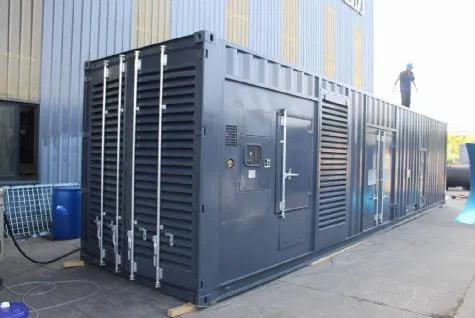 MPMC 4 MW containerised generator set from a documented hospital critical-load backup deployment, built in a 40HC super-silent enclosure.
Three Documented Hospital Backup Projects
MPMC's reference base includes three hospital-specific projects: a 4 MW critical-load backup installation in New Zealand on Perkins 4016-61TRG3 engines with Stamford S71D G41 alternators in 40HC super-silent enclosures rated at 85 dB(A) at 1 m at full load, with parallel and load-sharing control via DSE8610 controllers and ABB 3200A circuit breakers, engine block preheaters, and an internal 500-litre fuel tank with automatic fuel filling; a 3.2 MW hospital critical-power-backup project also in New Zealand on the same engine and alternator pairing; and a 3 MW hospital power-backup installation in China using two 1,500 kVA units on Perkins 4012-46TAG2A engines with Leroy-Somer LSA 50.2 L8 alternators, AREP AVR, and DSE7320 controllers with ABB circuit breakers.
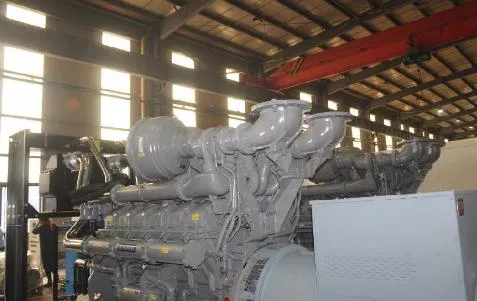 MPMC 3 MW generator set from a documented hospital power-backup deployment in China.
| Project | Capacity | Configuration |
|---|---|---|
|
Hospital Critical Load Backup, New Zealand |
4 MW |
Perkins 4016-61TRG3 / Stamford S71D G41, 40HC, 85 dB(A)@1m, DSE8610 |
|
Hospital Critical Power Backup, New Zealand |
3.2 MW |
Perkins 4016-61TRG3 / Stamford S7L1D-G41 |
|
Hospital Power Backup, China |
3 MW |
2×1,500 kVA, Perkins 4012-46TAG2A / Leroy-Somer LSA 50.2 L8, DSE7320 |
N+1 Redundancy Rather Than a Single Unit
A hospital specification frequently calls for N+1 or 2N redundancy rather than a single generator sized to full facility load, so that scheduled maintenance or an unplanned fault on one unit does not remove backup coverage entirely. MPMC's units support multi-unit parallel operation with intelligent load sharing through DSE or DEIF controllers, the same architecture documented on the New Zealand hospital projects, allowing a facility to specify two or more units that share load under normal running and pick up the full critical load if one unit is unavailable.
Noise Limits Near Patient Areas
Generator noise is a genuine clinical consideration when the plant room sits near wards, recovery areas, or outdoor patient spaces. MPMC's containerised Super Silent (SC) enclosures reach as low as 75–91 dB(A) at 1 m at 75% load depending on model, and the documented New Zealand hospital units specifically use a 40HC super-silent configuration rated at 85 dB(A) at full load — a figure worth requesting directly from any supplier being evaluated for a hospital site, rather than assuming a standard containerised enclosure meets clinical noise expectations.
Fuel Storage and Extended Runtime
A hospital cannot treat a multi-day mains outage as an edge case, which is why the documented New Zealand installations include an internal 500-litre fuel tank with automatic fuel-filling, extending unattended runtime without requiring a separate day tank installation. Confirming internal tank capacity, refuelling logistics, and automatic fuel-filling compatibility should form part of any hospital backup specification alongside the generator's electrical rating.
Warranty and Service Support for Life-Safety Equipment
Because engine, alternator, and controller warranty terms for MPMC's diesel genset range each follow the respective OEM's own global warranty policy, a hospital procurement team should confirm these terms separately for the engine, the alternator, and the controller rather than assuming a single blanket warranty covers the whole unit. MPMC's after-sales structure leverages the global service networks of its engine and alternator partners directly, giving a hospital facilities team access to local authorised service centres through the brand's own channels in most regions, which matters when a life-safety asset needs a rapid, qualified response rather than a wait for a manufacturer's own regional technician.
Specifying Hospital Backup Power
• Confirm AMF response time and one-step load acceptance against the facility's transfer switch design
• Specify N+1 or 2N redundancy with documented parallel and load-sharing control
• Request the containerised noise rating at your operating load, not only at 100% load
• Confirm internal fuel tank capacity and automatic fuel-filling for extended unattended runtime
• Request a documented hospital or critical-facility reference at a comparable capacity
• Verify engine block preheating is included for immediate cold-start load acceptance

Recent Posts

October 26, 2016
The Most Successful Engineering Contractor



Contact US
Product Information
Quantity
Unit
Piece
Support order samples, customization, wholesale direct, and complete payment. If the product you look for does not have corresponding customized content, pls fill out the form below to contact us, and we will reply ASAP.