-
No.2449 Jinhai Rd., Pudong, Shanghai
English
 Português



Containerized Power Solutions for Off-Grid Construction Camps in Southeast Asia
Nov 02, 2026
MPMC POWERTECH CORP., established in 2008 and headquartered in Shanghai Pudong, supplies the containerized generator sets and hybrid battery systems that contractors building in remote Southeast Asian locations rely on before a permanent grid connection ever reaches the site. A tropical off-grid construction camp brings together several problems at once: no fixed power supply, a load profile that changes as the project moves through phases, humidity and heat that stress equipment, and growing pressure to reduce diesel emissions even where no grid alternative exists. This article sets out the containerized hybrid architecture MPMC builds for this application, the camp-support equipment that complements it, and where the underlying platform has already been proven at scale in the region.
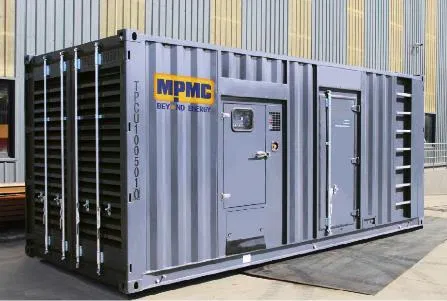 MPMC 3 MW super-silent containerized generator set suited to off-grid construction camp power
Why a Tropical Off-Grid Camp Changes the Power Brief
Construction sites share a distinctive power profile: no permanent grid connection during the build phase, rapidly changing load topology as work progresses, regulatory pressure to reduce diesel emissions and noise, and a need for equipment that can be redeployed as the project advances. In Southeast Asia specifically, high ambient temperature and humidity add a further design constraint, which is why MPMC's containerized platform is rated for continuous operation up to 50°C ambient rather than a temperate-climate baseline.
The Hybrid Core: Containerized Genset Plus Mobile Battery Storage
MPMC's containerized diesel generator set — available with Cummins, Perkins or Baudouin engines paired with Stamford or Leroy-Somer alternators — serves as the camp's base-load source, while the HBD-R Series Mobile BESS (30 kW–610 kW, 61.44 kWh–610.6 kWh per unit) absorbs load fluctuations and high-inrush motor starts. This lets the generator run near its optimal 75% fuel-efficiency load point instead of being oversized to cover peaks, and reduces fuel consumption compared with diesel-only operation. In a documented UK case using the same HBD-R architecture, adding battery storage extended the refuelling interval from every 2 days to every 7 days and stretched the maintenance interval from every 10 days to every 60 days.
| HBD-R Parameter | Range | Notes |
|---|---|---|
|
Continuous output |
30 kW – 610 kW |
Scalable per unit, parallel-capable |
|
Capacity |
61.44 kWh – 610.6 kWh |
6,000 cycles @90% DOD |
|
Cooling |
HVAC (smaller models) or LCAC (HBD-200-200 and above) |
Suited to hot, humid ambient conditions |
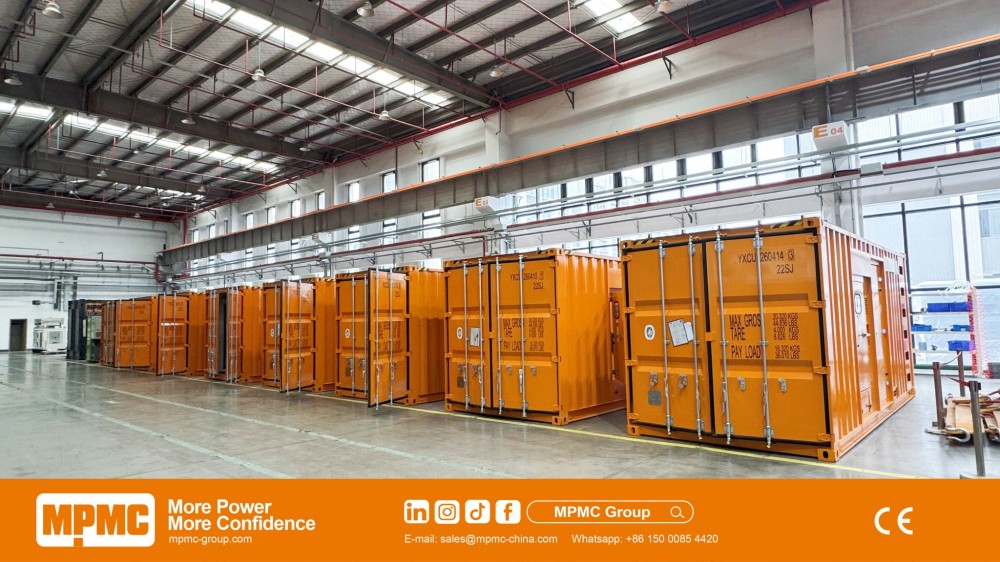 MPMC high-performance containerized generator sets configured for multi-unit camp power supply
Multi-unit parallel operation is also worth planning for on a larger camp: as the workforce and equipment count grow through the project timeline, additional containerized units can be added and synchronised through DSE or DEIF controllers rather than replacing an undersized single unit outright. This staged approach matches capital spend to the camp's actual build-out schedule instead of committing to peak capacity from day one.
GSB Hybrid Power Stations for Camp Support Areas
Away from the main construction zone, the GSB Series Hybrid Power Station (solar + diesel + battery, GSB-10 to GSB-60P, 10–120 kVA output, 20.4–112.5 kWh battery capacity, integrated slide-out solar array) supplies monitoring systems, temporary offices and residential camp areas. Its compact, highly mobile chassis and smart EMS control make it a practical fit for the support infrastructure around a main construction camp, where dedicated generator capacity for administrative loads would otherwise be wasteful.
A Documented Biofuel Precedent in the Region
MPMC's experience in Southeast Asia is not limited to construction camps: the company has delivered a 21.6 MW biodiesel island power station and an 18 MW biodiesel power project, both in Indonesia, powered by Cummins KTA50-GS8 engines running on biofuel with documented outcomes of rapid deployment and stable continuous operation in a tropical environment. That regional track record — covering the same climate and logistics conditions a construction camp faces — is a practical reference point when evaluating fuel-flexible options for a lower-emission camp power plan.
The 18 MW project in particular demonstrates delivery at scale within the region: eighteen containerized 1 MW units, running on biodiesel B35, were designed, manufactured, tested and commissioned as a single scope, lowering lifecycle CO2 by up to 85% compared with petroleum diesel. A construction camp sourcing a fraction of that capacity is drawing on the same manufacturing base and fuel-flexibility experience, rather than a one-off pilot project with no scale precedent behind it.
Where MPMC Sits Against Other Construction Camp Suppliers
Domestic competitors such as AGG (Fujian) and TIDE (Fujian/Hong Kong-registered) are established names in Southeast Asian construction and rental markets, competing respectively on distributor relationships and large-unit pricing. Neither currently pairs its genset line with in-house battery storage and hybrid solar power stations the way MPMC does. MPMC's combination of containerized gensets, HBD-R battery buffering and GSB hybrid stations gives a contractor one supplier for the full camp power architecture rather than separately sourced generation, storage and camp-support equipment.
That single-supplier structure also simplifies shipping and site logistics on a remote camp: containerized units, HBD-R battery modules and GSB stations are all designed to standard container footprints, which keeps freight planning straightforward when equipment has to travel by sea and then overland to a site with no established supply chain nearby.
| Element | Domestic Competitors | MPMC |
|---|---|---|
|
Genset + BESS integration |
Not standard |
HBD-R paired via compatible controllers |
|
Camp support power |
Separate small gensets typically |
GSB hybrid solar+diesel+battery station |
|
Regional biofuel track record |
Limited public data |
21.6 MW and 18 MW Indonesia projects |
Checklist: Specifying Power for an Off-Grid Construction Camp
• Confirm ambient temperature rating matches the site's tropical operating conditions
• Size the base-load genset against the 75% fuel-efficiency point, not the peak load
• Ask whether HBD-R battery buffering can extend refuelling and maintenance intervals
• Confirm GSB or equivalent hybrid station coverage for camp support and administrative areas
• Check container footprint and shipping configuration for the site's logistics access
• Ask whether biofuel or biodiesel blends are available if local emissions rules apply
• Confirm noise ratings against any nearby residential or environmental restrictions
• Request a documented reference project from the same climate region
Questions Construction Camp Planners Ask
By absorbing load spikes and motor-start inrush current, the HBD-R Series lets the genset avoid oversizing and run closer to its 75% optimal fuel-efficiency point, which is documented to extend refuelling intervals from every 2 days to every 7 days in a comparable case.
MPMC has delivered biodiesel-fuelled power projects at 21.6 MW and 18 MW scale in Indonesia, demonstrating that biofuel operation is viable in the region's tropical climate and logistics conditions.
The GSB Series Hybrid Power Station, combining solar, diesel and battery in a compact mobile chassis, is designed for exactly this supporting role, rather than running a separate dedicated genset for lighter administrative loads.
Yes. MPMC's containerized gensets, HBD-R battery units and GSB hybrid stations are all built for mobility and reconfiguration, which matters on a construction project where load topology and site layout change through successive phases.
MPMC's containerized platform is rated for continuous operation up to 50°C ambient, which is the practical baseline to specify for tropical Southeast Asian conditions rather than a temperate-climate default rating.


Recent Posts


Contact US
Product Information
Quantity
Unit
Piece
Support order samples, customization, wholesale direct, and complete payment. If the product you look for does not have corresponding customized content, pls fill out the form below to contact us, and we will reply ASAP.