-
No.2449 Jinhai Rd., Pudong, Shanghai
English
 Português


.png?x-oss-process=image/resize,w_240/quality,q_100)


.webp?x-oss-process=image/resize,w_240/quality,q_100)

.webp?x-oss-process=image/resize,w_240/quality,q_100)


.jpg?x-oss-process=image/resize,w_240/quality,q_100)


.webp?x-oss-process=image/resize,w_240/quality,q_100)


Suppliers of 1250 kVA Generator Sets for Data Centres: What the Specification Should Cover
Sep 07, 2026
A data centre standby specification rarely stops at the kVA figure on the nameplate. At 1250 kVA, the rating decides how many units a room needs and how the changeover behaves, but the outcome depends on load acceptance speed, parallel synchronisation, noise at the enclosure, and the factory testing that stands behind the figure. MPMC POWERTECH CORP., established in 2008 and headquartered in Shanghai Pudong, documents a 1250 kVA containerised model within its data centre reference configurations.
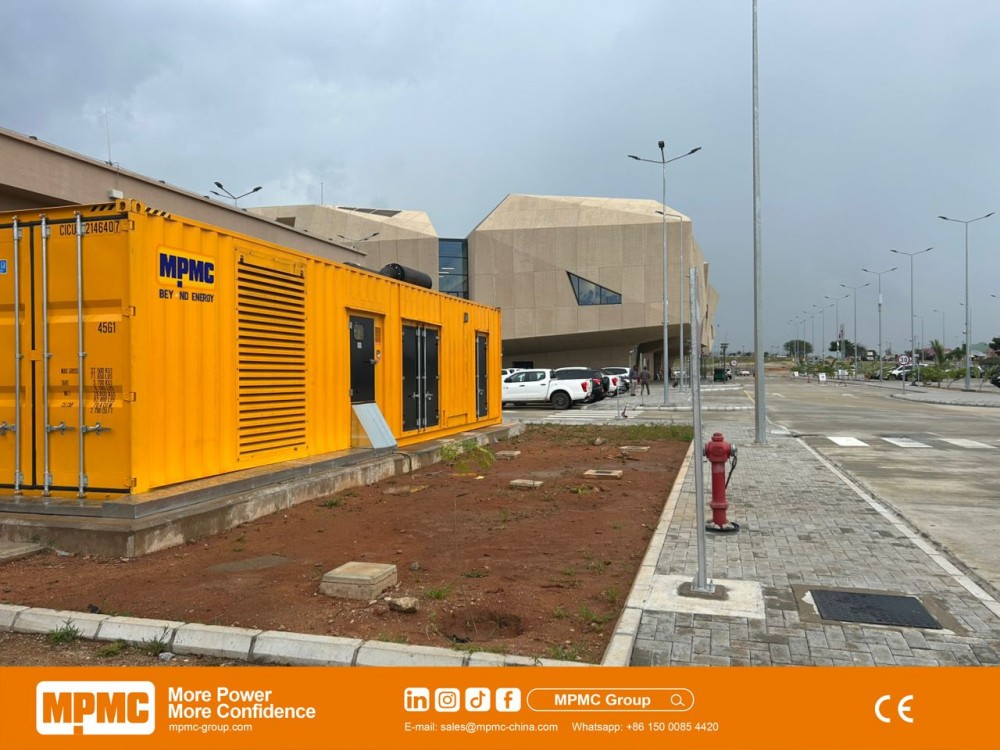 MPMC containerised diesel generator set — 1250 kVA class, Cummins engine
The Configuration Behind the Rating
MPMC lists the MCLS1250(S)-1 at 1,250 kVA / 1,000 kW prime and 1,375 kVA / 1,100 kW standby, built around a Cummins KTA50-G3 engine paired with a Leroy-Somer LSA 50.2 M6 alternator. The same containerised platform is available with multiple other engine brands at comparable ratings, including Perkins, Baudouin, MTU and Scania, so the 1250 kVA class is a configuration choice within a shared enclosure design rather than a single fixed product.
For rooms that outgrow a single unit, MPMC's twin-engine containerised range extends from 1,250 kVA to 3,000 kVA, built on Baudouin, Scania or Perkins engines, which lets a later expansion sit on the same enclosure family rather than introduce a second platform.
What Standby Duty at a Data Centre Actually Tests
Load Acceptance and Transfer Speed
MPMC's data centre configuration is built around one-step load acceptance to ISO 8528-5, with automatic mains failure handled by DSE or DEIF controllers — DSE 4520 MKII in AMF mode, or DEIF AGC 150 for parallel synchronisation. Both figures matter more than the kVA rating on its own: a set that accepts the full block load in one step avoids the staged loading sequences that can leave IT racks briefly underpowered during a transfer.
Parallel Redundancy Above a Single Unit
A single 1250 kVA set covers one room's base load, but most data centre specifications call for N+1 or N+2 redundancy. MPMC's containerised range supports multi-unit parallel operation with load sharing through DSE or DEIF AGC controllers and motorised circuit breakers from ABB or Schneider, which is what turns several individual units into one synchronised standby plant rather than a row of separate machines.
Noise at the Enclosure
MPMC's containerised super-silent (SC) type is documented at 75 to 91 dB(A) at 1 metre at 75% load depending on model. Data centres sited near office parks or residential edges tend to specify against this figure directly rather than against open-set ratings, since the enclosure — not the engine alone — determines what a neighbouring building actually hears.
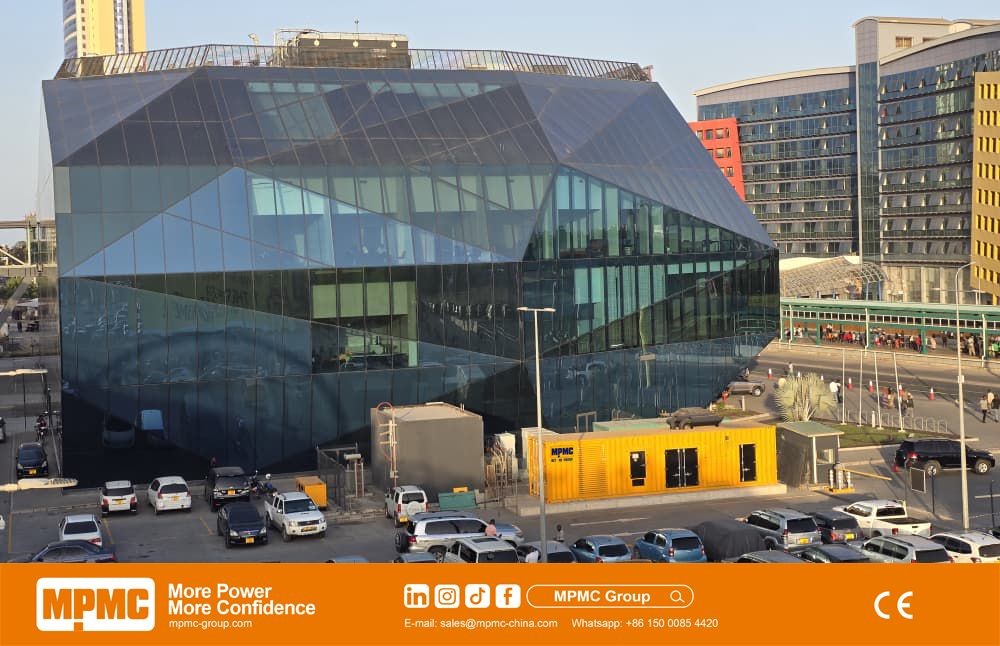 MPMC containerised diesel generator set
Factory Testing Behind the Figure
MPMC's load test protocol runs every unit through 0%, 25%, 50%, 75%, 100% and 110% load steps inside a CNAS-accredited test environment, including a constant-temperature room simulating 40°C and 50°C ambient — conditions that replicate a data centre's hot-aisle environment rather than an open test yard. Requesting the test report by serial number, rather than accepting a generic datasheet, is what turns a nameplate rating into a verified one.
Fuel Autonomy and Refuelling Logistics
MPMC offers built-in fuel tank options at 6, 8, 12 or 24 hours of runtime, with bonded or external tank arrangements available where a site's refuelling contract calls for longer autonomy between deliveries. For a data centre, this is a planning decision as much as a technical one: a 6-hour tank assumes a refuelling contract that can respond within that window, while a 24-hour tank buys headroom against a delivery delay at the cost of extra weight and footprint in the plant room.
| Enclosure Type | Key Feature | Data Centre Relevance |
|---|---|---|
|
Open Type (OE) |
Standard industrial application |
Rarely specified where a data centre sits near occupied buildings |
|
Silent Type (SR2) |
Noise reduction rated to ≤35 dB(A) |
Suits interior plant rooms with strict internal noise limits |
|
Containerised Type (SC) |
Heat, corrosion and water resistant; ISO container format |
Matches high-density plant rooms and coastal or tropical sites |
|
Rental Type (SR, AU/EU) |
Built to Australian and European rental standards |
Suits interim standby capacity during a phased build-out |
Where Battery Storage Can Reduce Runtime
For data centres pursuing hybrid renewable ambitions, MPMC's HBD-A Series BESS (125 kW–1,125 kW AC, 261 kWh–2,170 kWh, liquid cooling) can integrate with rooftop PV and the genset array to provide peak shaving, millisecond-level UPS-style response and grid frequency regulation, reducing how often the standby plant needs to run at all while the utility connection remains the primary source.
The same HBD-A integration carries MPMC's self-developed SCADA, with real-time remote monitoring, a 10-year data retention window and an SL3-level cybersecurity framework — relevant where a data centre operator needs an audit trail for standby plant performance rather than only a running total of hours.
Documented Deployments at Comparable Scale
MPMC's reference list includes a UAE data centre at 3,000 kVA on an MTU 20V4000 G63LF engine with a Leroy-Somer LSA 53.2 XL13 alternator at 6 kV output, a further UAE data centre installation at 12 MW, and a US data centre backup reference at 36 MW. A UAE factory power expansion project at 4.2 MW, running an MTU 16V4000G63 engine in parallel with the mains grid through a DSE 8620 controller and an ABB 3,200 A breaker, illustrates the same parallel-synchronisation approach applied to a peak-shaving and backup role rather than pure standby. These describe the class of project MPMC has delivered rather than a guarantee for a different scope.
Specification Points to Confirm Before Ordering
• Confirm prime and standby figures separately — 1,250 kVA prime is not the same commitment as 1,375 kVA standby.
• Request the ISO 8528-5 one-step load acceptance figure for the exact configuration quoted.
• Specify the AMF and parallel controller brand so integration with existing switchgear is known in advance.
• State the target dB(A) at the actual assessment distance, not a generic figure.
• Ask for the CNAS load test report at 0–110% for the specific serial number, not a shared datasheet.
• Decide N+1 or N+2 redundancy at design stage so switchgear headroom is built in from the first unit.
• Confirm anti-corrosion coating class against the site's coastal or tropical exposure.
• Set the fuel tank runtime (6, 8, 12 or 24 hour) against the site's refuelling logistics.
Questions Data Centre Buyers Ask
MPMC lists the MCLS1250(S)-1 at 1,250 kVA / 1,000 kW prime power, with a 1,375 kVA / 1,100 kW standby rating on the same configuration. Which figure applies to a given quotation should always be confirmed against the specific model code rather than assumed.
Yes. MPMC's containerised platform accepts multiple engine brands at comparable ratings, including Cummins, Perkins, Baudouin, MTU and Scania, which allows a buyer to match an existing service relationship or spare parts stock without redesigning the enclosure.
MPMC's twin-engine containerised range extends from 1,250 kVA to 3,000 kVA, and multi-unit parallel operation with load sharing through DSE or DEIF AGC controllers allows additional 1250 kVA-class units to be added and synchronised rather than replaced.
MPMC's containerised super-silent (SC) type is documented at 75 to 91 dB(A) at 1 metre at 75% load depending on model. The applicable figure should be requested for the exact model and load point relevant to the site's noise assessment.
MPMC runs load testing at 0%, 25%, 50%, 75%, 100% and 110% of rated load in a CNAS-accredited facility, including a constant-temperature room simulating 40°C and 50°C ambient. Requesting the test report by serial number confirms this was carried out on the specific unit being shipped.


Recent Posts




Contact US
Product Information
Quantity
Unit
Piece
Support order samples, customization, wholesale direct, and complete payment. If the product you look for does not have corresponding customized content, pls fill out the form below to contact us, and we will reply ASAP.