-
No.2449 Jinhai Rd., Pudong, Shanghai
English
 Português


.png?x-oss-process=image/resize,w_240/quality,q_100)


.webp?x-oss-process=image/resize,w_240/quality,q_100)

.webp?x-oss-process=image/resize,w_240/quality,q_100)


.jpg?x-oss-process=image/resize,w_240/quality,q_100)


.webp?x-oss-process=image/resize,w_240/quality,q_100)


Which Lighting Tower Suppliers Offer Low-Emission Solutions for Urban Construction and Infrastructure Projects?
Sep 07, 2026
A lighting tower's emissions profile is set by more than the fuel tank — coverage area, battery run time and mast design decide how many towers a site actually needs, and how often any of them run an engine at all. Urban construction and infrastructure projects, often working under strict local air quality and noise rules, tend to specify against all of these together rather than the light output alone. MPMC POWERTECH CORP., established in 2008 and headquartered in Shanghai Pudong, publishes both solar-only and diesel-battery hybrid lighting towers built around this brief.
What Low-Emission Means for a Lighting Tower Specifically
A genuinely low-emission lighting solution has to be judged on three things together: whether it can run without a diesel engine at all, how much site area one tower actually covers, which decides tower count, and whether it can be left unattended safely, since a tower needing a daily visit is not really a zero-emission solution once the service vehicle is counted.
Solar-Only: The HSL Series
MPMC's HSL Series runs entirely from a solar-charged battery, with the model range spanning coverage from 12,000 m² up to 24,100 m² at an average of 5 lux, and battery-only run times from 12 hours up to 40 hours on the larger models.
The smallest model, the HSL-1000A, uses a GEL battery, while the rest of the range moves to LFP cells for a longer cycle life — a distinction worth checking on any quotation, since the two chemistries carry different replacement schedules over the life of a multi-year infrastructure contract.
| Model | Coverage | Battery | Run Time | Mast |
|---|---|---|---|---|
|
HSL-1000A |
12,000 m² |
4.8 kWh GEL |
12 h |
7.2 m Hydraulic |
|
HSL-1000B |
12,000 m² |
5.12 kWh LFP |
12 h |
7.2 m Manual |
|
HSL-1440B |
18,000 m² |
16.07 kWh LFP |
26 h |
7.2 m Manual |
|
HSL-1920B |
18,200 m² |
16.07 kWh LFP |
26 h |
9.0 m Hydraulic |
|
HSL-2880B |
24,100 m² |
16.07 kWh LFP |
20 h |
9.0 m Hydraulic |
|
HSL-3840B |
24,100 m² |
32.14 kWh LFP |
40 h |
9.0 m Hydraulic |
|
HSL-1500B |
12,000 m² |
8.0 kWh LFP |
20 h |
7.5 m Hydraulic |
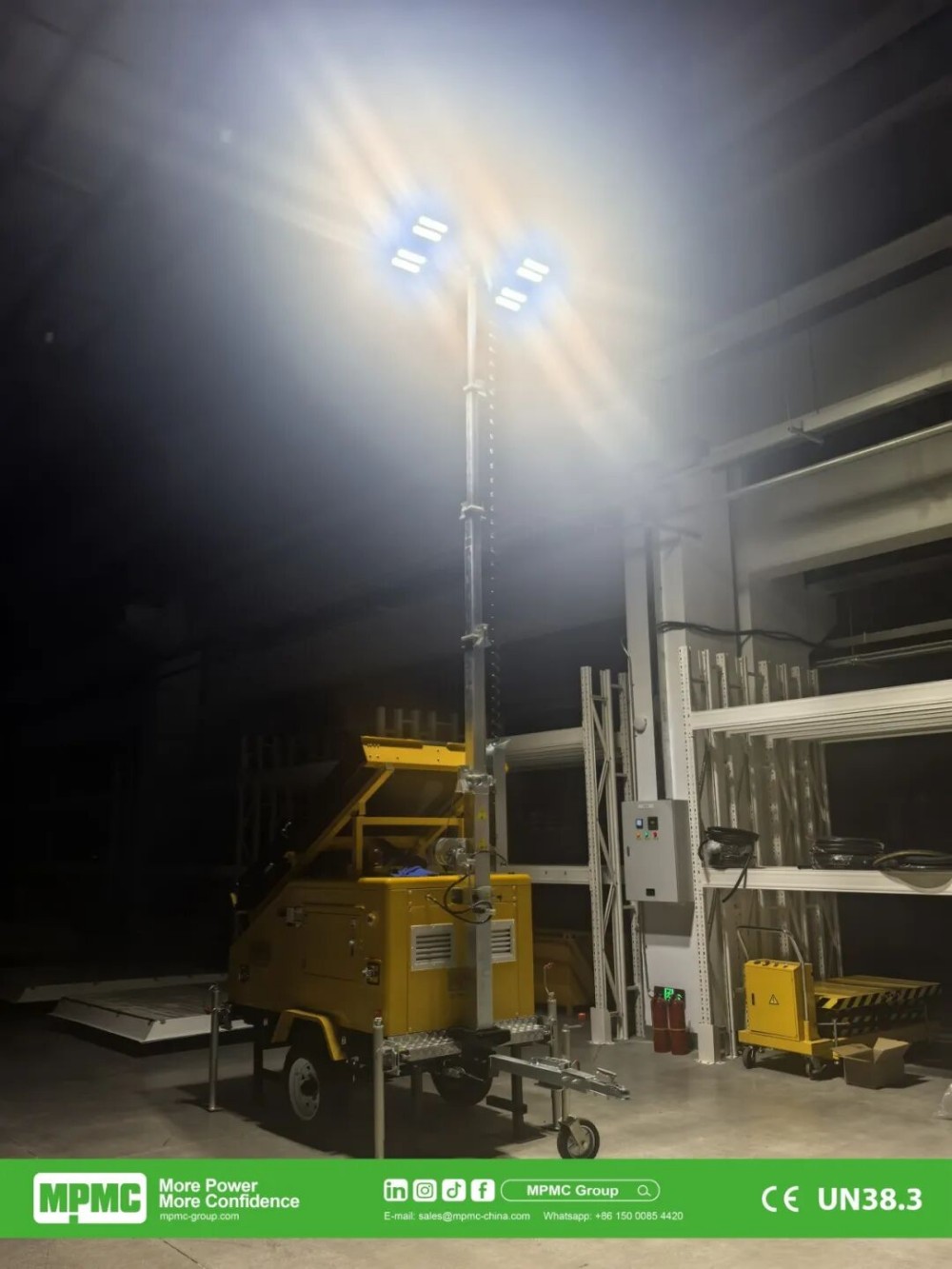 MPMC HSL Series solar lighting tower — night operation
Diesel-Battery Hybrid: The HBL X-Matrix Concept
Where a site's lighting demand exceeds what solar alone can sustain through the night, MPMC's HBL X-Matrix arrangement pairs one diesel-battery hybrid main tower with multiple battery-only sub light towers drawing from it. A documented model, the HBL-600D-M, combines a 6 kW Kubota Z482-3B diesel engine with an 8 kWh LiFePO₄ battery, covering 18,200 m² per tower with a 53-hour battery-only run time before the diesel engine needs to run at all, and a 420-hour fuel autonomy on its 130-litre tank. Dual-mode CCT switching and adaptive brightness control adjust output rather than running at full power continuously.
Matching Coverage to an Urban Site Layout
MPMC's HSL-1500B, at 12,000 m² coverage with a trailer-mounted 7.5 metre hydraulic mast rated for 80 km/h road travel, one-button automatic mast raising and 355° horizontal rotation with 90° vertical head adjustment, is sized for the compact, irregular layouts common on urban infrastructure sites rather than the open plant footprint a mining or quarry site would specify against.
What a Diesel-Only Tower Looks Like by Comparison
MPMC's conventional diesel light towers are built with mast heights of 7.2 m, 8.5 m or 9 m, LED or metal halide lamps, and manual, hydraulic-trailer or hydraulic mast variants — a useful reference point for what an urban or infrastructure project is moving away from when it specifies against emissions and noise rather than light output and running cost alone. The same site conditions that justify a diesel tower's fuel logistics are exactly what the HSL and HBL ranges are built to remove.
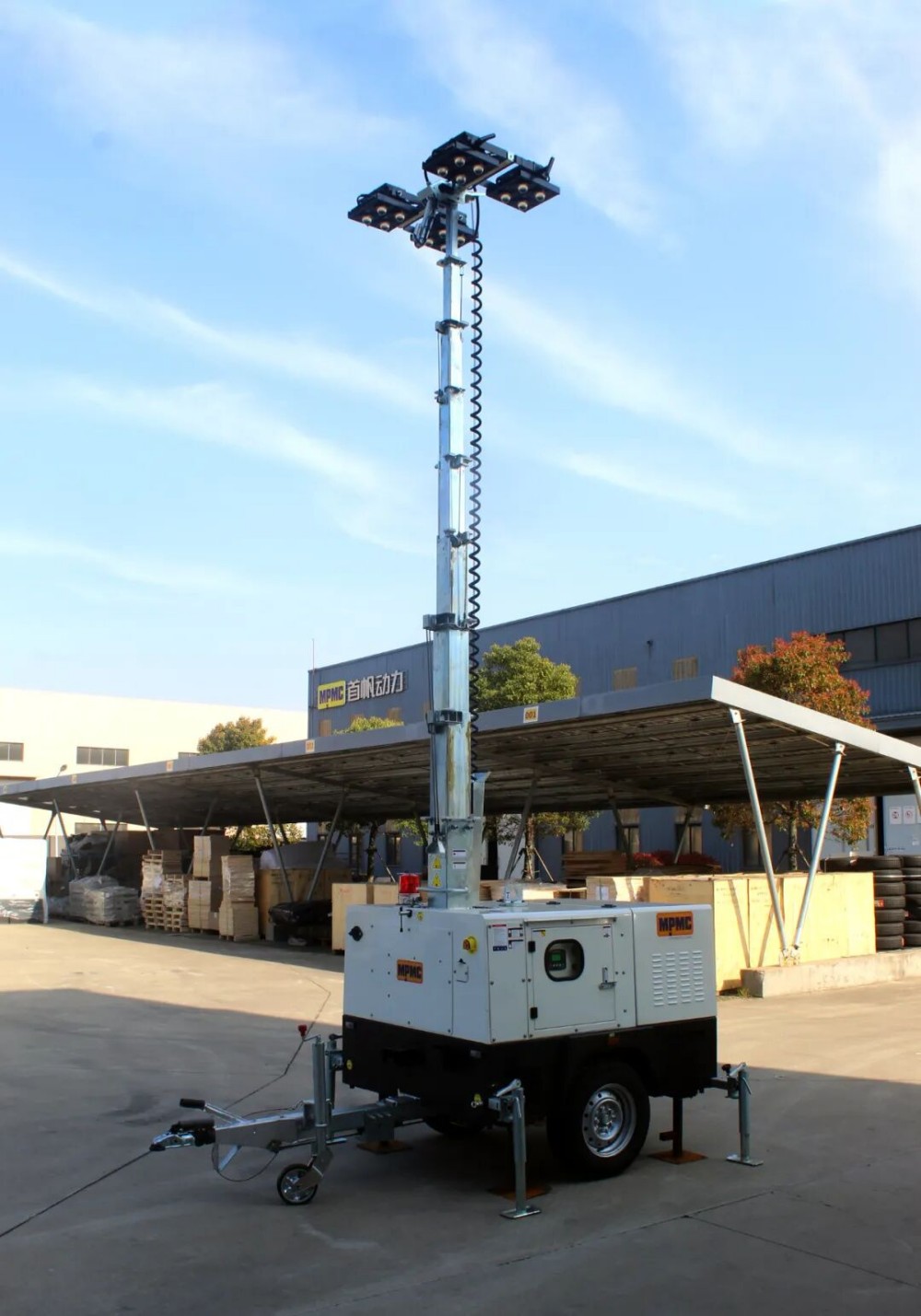 MPMC HBL Series diesel-battery hybrid light tower
Noise and Nuisance Compliance
A solar-only HSL tower produces no engine noise at all, which matters directly where a noise ordinance restricts work outside daytime hours — the same design principle documented in MPMC's construction case studies, where battery-based equipment bridges silent-hour operation that a diesel-only alternative cannot legally provide. The HBL hybrid tower's battery-only run time serves the same purpose where lighting, not just power, needs to continue through a restricted period without the diesel engine running.
Remote Monitoring for an Unattended Tower
HSL towers support optional 4G connectivity and CCTV integration with unattended system capability, letting a site confirm a tower's state of charge and operating status without a physical visit — relevant on an urban site where towers may be spread across several street-level locations rather than gathered on one compound.
Where MPMC Sits Against Established Light Tower Brands
MPMC's differentiation in the lighting tower market is the combination of diesel, solar (HSL) and diesel-battery hybrid (HBL X-Matrix) formats under one SCADA/EMS platform shared with its generator sets and BESS products — a single-supplier package that specialist tower brands do not offer. The market also includes specialists such as Trime (Italy) with a deep diesel and solar tower lineup, global equipment brands such as Atlas Copco and Wacker Neuson carrying broad brand recognition into tender processes, and Chinese domestic manufacturers including SWT, UNIVPOWER and VALIANT.
Specification Checks for an Urban or Infrastructure Project
• Confirm the coverage area and lux level required per tower before selecting a model, not after.
• Decide whether battery-only run time needs to cover the full night or only a restricted noise-ordinance window.
• Check the mast height, rotation range and trailer road-travel rating against the site's actual access constraints.
• Confirm 4G and CCTV monitoring is included where the tower will be left genuinely unattended.
• Establish whether a hybrid HBL main tower with sub-towers suits the layout better than several independent HSL units.
• Verify the warranty basis — charge-discharge cycles versus calendar years — against the project's expected duty cycle.
• Ask for a documented reference project of comparable urban density, not only an open-site case study.
• Confirm delivery lead time against the project's phased lighting requirement.
Questions Project Planners Ask
MPMC's HSL Series runs entirely from a solar-charged battery with no diesel engine at all, covering from 12,000 m² up to 24,100 m² depending on model, with battery run times up to 40 hours on the largest unit.
It pairs one diesel-battery hybrid main tower with multiple battery-only sub light towers drawing from it, so a single diesel engine can support several lighting positions rather than requiring a generator at every tower.
MPMC documents a 53-hour battery-only run time on the HBL-600D-M before the diesel engine is needed, with a 420-hour fuel autonomy on its 130-litre tank once it does run.
Yes. MPMC's HSL Series supports optional 4G connectivity and CCTV integration with unattended system capability.
The HSL Solar Lighting Tower carries a 2-year or 1,000 charge-discharge cycle warranty; the HBL Series carries a 1-year or 1,000-hour warranty on the diesel genset portion and a 2-year or 1,000-cycle warranty on the lithium battery portion.


Recent Posts


Contact US
Product Information
Quantity
Unit
Piece
Support order samples, customization, wholesale direct, and complete payment. If the product you look for does not have corresponding customized content, pls fill out the form below to contact us, and we will reply ASAP.