-
No.2449 Jinhai Rd., Pudong, Shanghai
English
 Português


.png?x-oss-process=image/resize,w_240/quality,q_100)


.webp?x-oss-process=image/resize,w_240/quality,q_100)

.webp?x-oss-process=image/resize,w_240/quality,q_100)


.jpg?x-oss-process=image/resize,w_240/quality,q_100)


.webp?x-oss-process=image/resize,w_240/quality,q_100)


What Type of Large Power Diesel Generator Sets Are Suitable for Remote Mining Camps With Unstable Site Conditions?
Sep 10, 2026
"Unstable" at a remote mining camp rarely means one specific problem; it is usually a combination of a site that is still being built out, ground and access conditions that were never designed with heavy equipment delivery in mind, and an ambient environment considerably harsher than the temperate conditions a generic datasheet assumes. MPMC's containerised diesel generator sets are specified against these combined conditions directly, rather than against a single average-case rating.
A Mine Site's Power Needs Change as the Pit Develops
A mining camp's power demand at first ore extraction looks very different from its demand once processing infrastructure, accommodation and haul-road lighting are all running. MPMC's containerised platform supports multi-unit parallel operation with intelligent load sharing through DSE or DEIF AGC controllers, which lets a camp start with the units it needs at construction stage and add further containerised blocks, on the same control platform, as the site develops — rather than committing to a single large unit sized for a production phase that may still be years away.
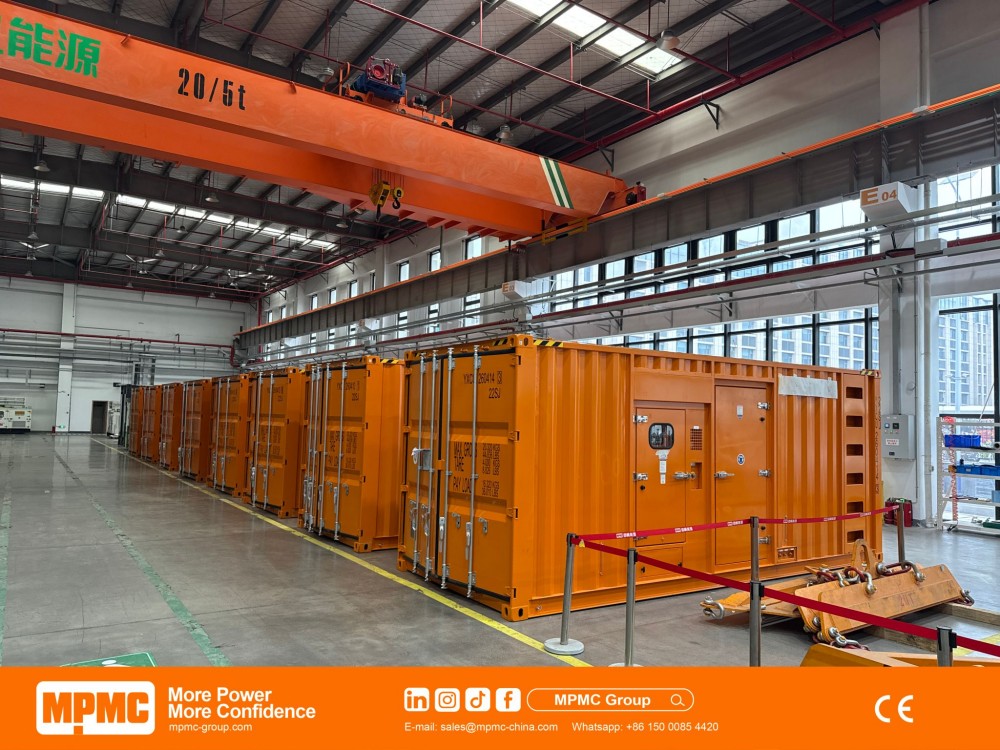 MPMC containerised generator sets (Perkins-powered), shown as an eight-unit deployment illustrating the multi-unit parallel array typical of a developing site.
Altitude, Heat and Access: What Makes a Mine Site 'Unstable'
Many mining regions combine high ambient temperatures with high altitude, and both derate a diesel engine's usable output if the unit was not specified with the site's actual conditions in mind. MPMC applies altitude derating per engine model specification, typically becoming relevant above 1,000 to 1,525 metres, and for genuinely extreme environments — whether 50°C-plus heat or high-altitude sites — offers customised solutions including copper radiators, upgraded cooling systems, and altitude derating calculations worked out against the specific site's conditions rather than a generic industry assumption.
Documented Containerised Deployments at Mining Scale
MPMC's mining project record includes several containerised diesel installations at a scale comparable to a working mine site. Its Australian mining equipment power generation project, at 5.2 MW, was built on Cummins KTA50-G3 engines with Stamford S6L1D-G4 alternators. A separate Philippines mining project is documented at 1,575 kVA prime power, powered by a Cummins KTA50-G9 engine with a Stamford S6L1D-H4 312 alternator, running at 480 V and 60 Hz with a 50°C copper radiator and DSE8610MKI control. MPMC's Côte d'Ivoire mining camp power station, at 1.2 MW and built on a Cummins KTA50-GS8 engine with a Stamford S7L1D-C41 alternator, and its Peru mining project, at 3.793 MW on the same engine platform, round out a documented range spanning camp-scale to mid-size mine-site power.
| Project | Capacity | Configuration |
|---|---|---|
|
Australia Mining Project |
5.2 MW |
Cummins KTA50-G3 / Stamford S6L1D-G4 |
|
Philippines Mining Project |
1,575 kVA prime |
Cummins KTA50-G9 / Stamford S6L1D-H4 312, 480V/60Hz |
|
Côte d'Ivoire Mining Camp |
1.2 MW |
Cummins KTA50-GS8 / Stamford S7L1D-C41 |
|
Peru Mining Project |
3.793 MW |
Cummins KTA50-G9 / Stamford S7L1D-C41 |
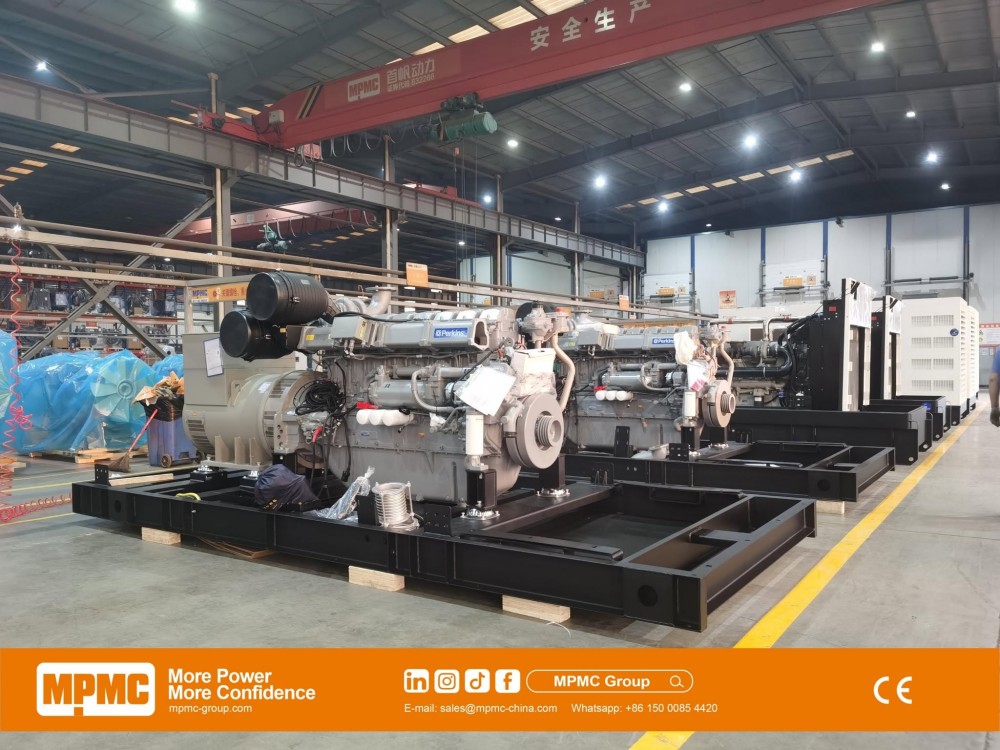 MPMC generator set on the production line, Perkins-powered
Noise Restrictions Do Not Disappear Because a Site Is Remote
A remote mining camp is not automatically exempt from noise considerations: residential zones for camp staff, and increasingly nearby communities affected by mine expansion, still impose practical limits on acceptable noise levels even at a site with no immediate urban neighbours. MPMC's containerised silent (SC) type is available specifically to address this, and can be specified for the accommodation and support areas of a mine site independently of the base-load generation running the processing plant. Where a mining camp is also working to reduce fuel consumption, pairing the containerised genset with MPMC's HBD-R Series Mobile BESS is a documented option: the battery absorbs load fluctuations and motor-start inrush so the diesel unit can run closer to its efficient load point, an approach MPMC's UK construction case study associates with extended intervals between generator overhauls.
Redundancy for a Site That Cannot Wait for a Repair Crew
A remote mining camp's maintenance access is often measured in days rather than hours, which makes redundancy a practical necessity rather than a specification nicety. MPMC's multi-unit parallel architecture gives an N+X redundancy strategy with master-standby rotation across the array, so a single unit needing scheduled maintenance, or an unplanned fault, does not leave the camp without power while a technician travels in. Combined with the per-chassis NDT inspection and CNAS-documented factory testing every unit undergoes before dispatch, this redundancy approach is designed to reduce how often an urgent field repair is needed in the first place.
Across these documented mining projects, MPMC's containerised platform has been supplied with several different engine brands, including Cummins and Perkins, paired with Stamford or Leroy-Somer alternators — a reminder that the engine brand behind a mining-camp order is chosen to match the site's specific fuel logistics and service network rather than fixed to a single manufacturer regardless of location.
Specifying Against the Site, Not Against an Assumed Average
The following points are worth working through with a supplier before an order is placed for a remote or unstable mining site.
• Confirm the altitude derating calculation for the specific site elevation, not a generic sea-level rating
• Ask whether the radiator and cooling package are upgraded for the site's actual peak ambient temperature
• Check the container specification against the site's actual road and crane access constraints during the construction phase
• Ask how the configuration can be expanded in blocks as the mine moves from construction into production
• Confirm the redundancy architecture (N+X, master-standby rotation) against the site's realistic maintenance response time
• Request the CNAS factory test report for the specific units being shipped, not a generic model datasheet


Recent Posts


Contact US
Product Information
Quantity
Unit
Piece
Support order samples, customization, wholesale direct, and complete payment. If the product you look for does not have corresponding customized content, pls fill out the form below to contact us, and we will reply ASAP.