-
No.2449 Jinhai Rd., Pudong, Shanghai
English
 Português


.png?x-oss-process=image/resize,w_240/quality,q_100)


.webp?x-oss-process=image/resize,w_240/quality,q_100)

.webp?x-oss-process=image/resize,w_240/quality,q_100)


.jpg?x-oss-process=image/resize,w_240/quality,q_100)


.webp?x-oss-process=image/resize,w_240/quality,q_100)


What Containerised Diesel Generator Set Configuration Is Suitable for 24/7 Critical Operations?
Sep 10, 2026
"24/7 critical" covers a wide range of applications, but the most demanding version of it is found in oil and gas field power, where MPMC's own framing is direct: these systems must satisfy the most stringent combination of requirements found in any industrial application. That combination — continuous operation, intrinsic safety in hazardous atmospheres, extreme ambient temperatures, remote locations with limited maintenance access, and zero tolerance for single-point failure — is a useful reference point for any facility asking what a genuinely continuous-duty configuration looks like, whether or not the site itself involves hydrocarbons.
Why Continuous Duty Is a Different Design Brief Than Standby
A standby generator set is specified to sit idle and then accept a load reliably when called on. A continuous-duty unit is specified to run for extended periods without the recovery windows a standby unit gets between test cycles, which changes the engineering priorities toward duty-rated cooling, extended-interval maintenance planning, and redundancy architecture that assumes a unit will eventually need to come offline for service while the site keeps running. MPMC's large containerised range designs its continuous-duty configurations to ISO 8528 for exactly this operating profile, with cooling systems optimised for 50°C-plus ambient rather than the intermittent-use assumptions behind a standby specification.
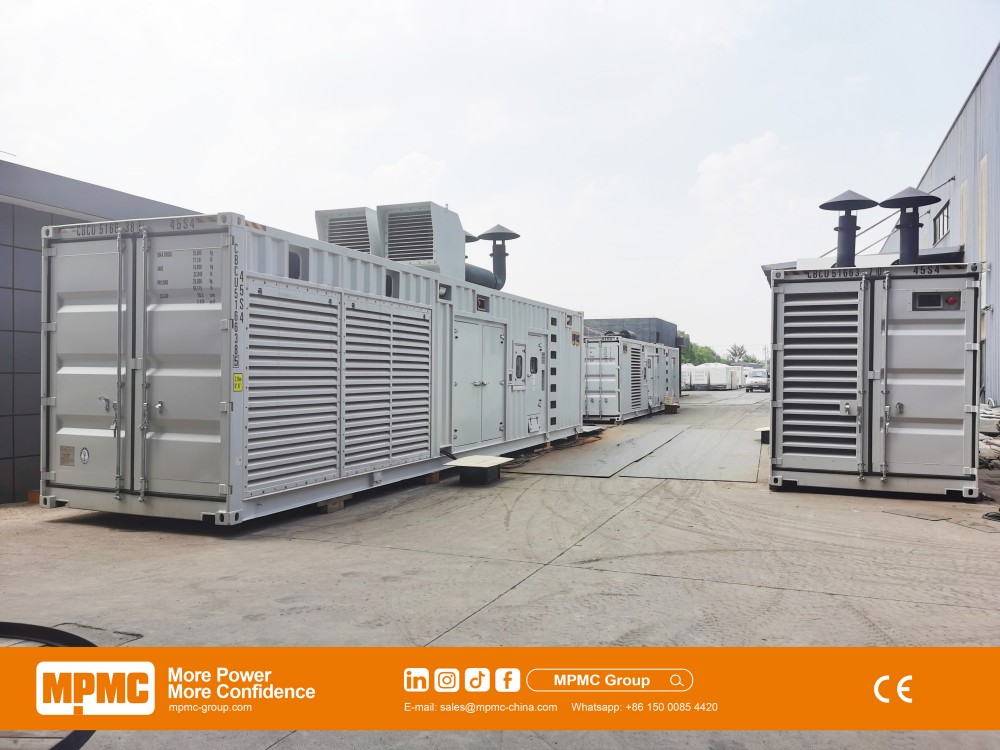 MPMC containerised high-voltage diesel generator set, Perkins-powered, from a 6 MW oil and gas field installation.
The Oilfield Standard: What 'Zero Tolerance for Downtime' Requires
MPMC's Middle East oilfield HV island-mode system illustrates the safety architecture this level of continuous duty demands: a dual-start explosion-proof system combining primary compressed-air start with an emergency electric backup to eliminate single-mode starting failure, SF₆ gas-insulated switchgear for arc quenching and airtight protection against dust and sand ingress, a neutral grounding resistor to suppress transient overvoltage, multi-dimensional fire detection using smoke, temperature and UV/IR flame sensors for millisecond-level alarm response, and an automatic CO₂ fire suppression system that triggers emergency shutdown and ventilation louvre closure without damaging high-voltage electronics. The installation itself — a 1×800 kW/1,000 kVA unit plus 2×1,800 kW/2,250 kVA HV units in 20 ft and 40 ft high-cube containers — runs on N+X redundancy with master-standby rotation, balancing operating cost against reliability across the array rather than depending on any single unit.
Documented Continuous-Duty Deployments
Beyond the Middle East HV island-mode system, MPMC's Brazil offshore oil and gas rig project, at 10.28 MW on Cummins KTA50-G12 engines, and its Saudi Arabia oil and gas camp project, at 3.3 MW on a Cummins KTA50-G3 engine, are both containerised for continuous field operation. For sites transitioning toward lower emissions, MPMC's HBD-R Series BESS can run in parallel with existing gensets as what MPMC terms a "Genset Mate," handling peak shaving, transient load absorption, and selective shutdown of gensets during low-demand periods to cut fuel use and emissions without compromising the intrinsic safety features — CE-certified aerosol fire suppression, off-gas detection, and water spray inlets on larger models — that a hazardous-atmosphere site requires.
| Project | Capacity | Configuration |
|---|---|---|
|
Middle East HV Island-Mode |
1×800 kW + 2×1,800 kW HV |
Dual-start explosion-proof, SF₆ switchgear |
|
Brazil Offshore Oil & Gas Rig |
10.28 MW |
Cummins KTA50-G12 |
|
Saudi Arabia Oil & Gas Camp |
3.3 MW |
Cummins KTA50-G3 |
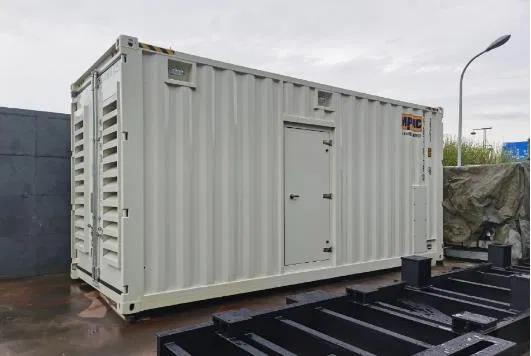 MPMC containerised diesel generator set from a 1,500 kVA oilfield installation, Perkins-powered.
Balancing Operating Cost Against Reliability Across the Array
MPMC describes its multi-unit parallel architecture, using DSE or DEIF controllers for load sharing and master-standby rotation, as an N+X redundancy strategy that balances operating cost against system reliability, rather than simply running every unit in the array continuously at all times. In practice this means a subset of units carries the live load while others rotate into standby, reducing cumulative running hours across the array of generator sets and extending the interval before each individual unit needs a major service — a meaningful saving at a site where every maintenance visit involves significant travel time. MPMC's CNAS-certified load test protocol, covering 0%, 25%, 50%, 75%, 100% and 110% of rated load, is run on each unit before dispatch specifically so this rotation strategy can be planned against a verified performance curve rather than an assumed one.
For a continuous-duty site with a large electrical footprint spread across several terminal loads, MPMC's HV-capable containerised models can supply power directly at 10–11 kV and distribute it through a ring or radial architecture to terminal loads, reducing transmission losses over the distances a large field site typically covers compared with distributing at standard low voltage from a single point.
Building a Continuous-Duty Specification From the Oilfield Standard
Not every 24/7 critical site needs the full hazardous-atmosphere safety package an oilfield demands, but the underlying design questions carry across to any genuinely continuous-duty application. The following points are worth confirming before a configuration is finalised.
• Confirm the unit is rated to ISO 8528 for continuous duty, not only for prime or standby operation
• Ask whether the starting system has a backup start path in case the primary method fails
• Confirm the redundancy architecture (N+X, master-standby rotation) allows scheduled maintenance without an outage
• Check whether the switchgear and enclosure are rated against dust or sand ingress if the site is exposed to airborne particulates
• Ask what fire detection and suppression systems are fitted, and whether they are appropriate for the site's specific hazard profile
• Request the cooling system's rated ambient temperature against the site's actual peak conditions, not a standard-climate default


Recent Posts


Contact US
Product Information
Quantity
Unit
Piece
Support order samples, customization, wholesale direct, and complete payment. If the product you look for does not have corresponding customized content, pls fill out the form below to contact us, and we will reply ASAP.