-
No.2449 Jinhai Rd., Pudong, Shanghai
English
 Português


.png?x-oss-process=image/resize,w_240/quality,q_100)


.webp?x-oss-process=image/resize,w_240/quality,q_100)

.webp?x-oss-process=image/resize,w_240/quality,q_100)


.jpg?x-oss-process=image/resize,w_240/quality,q_100)


.webp?x-oss-process=image/resize,w_240/quality,q_100)


How to Choose Large Power Diesel Generator Sets for an Off-Grid Island Power Station
Sep 17, 2026
An island power station is not simply a large generator sitting further from the grid than usual — it is a facility that must generate every kilowatt-hour it consumes, indefinitely, with no utility backstop to fall back on when a unit trips. That distinction changes the specification: continuous-duty design, multi-unit redundancy, and the ability to black-start independently matter more than they would for a temporary backup installation, and fuel logistics to a remote or island location become a design constraint in their own right.
A Documented 21.6 MW Island Power Station
MPMC's island power station project in Indonesia, rated at 21.6 MW, is built on Cummins KTA50-GS8 engines paired with Leroy-Somer LSA50.2 L8 alternators and runs on biodiesel, giving the installation zero fossil-fuel dependency on a fully renewable-sourced fuel. A related 18 MW biodiesel power project, also in Indonesia, uses the same engine and alternator pairing across 18 containerised 1 MW units running on B35 biodiesel, lowering lifecycle CO2 by up to 85% compared with petroleum diesel while complying with RED II and RFS standards — MPMC's own documentation records rapid deployment upon arrival and stable continuous operation in a tropical environment.
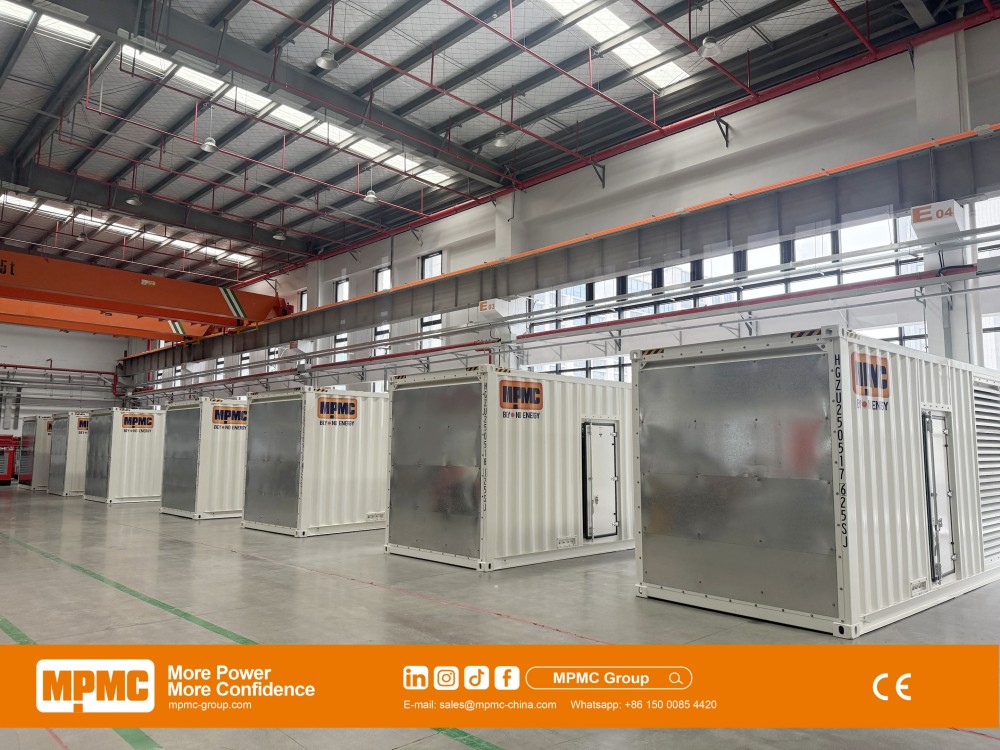 MPMC containerised biodiesel generator sets from an 18 MW biodiesel power project in Indonesia, sharing the same platform as MPMC's documented island power station deployment.
Scaling the Containerised Platform for Island Duty
For larger-scale island or remote power plants, MPMC's containerised platform supports single-engine configurations from 800 kVA to 3,750 kVA, dual-engine configurations from 1,250 kVA to 3,000 kVA powered by Baudouin, Scania, or Perkins, and four-engine configurations at 1,600 kVA powered by Scania. Multi-unit parallel operation with intelligent load sharing, coordinated through DSE or DEIF AGC controllers, delivers N+X redundancy and master-standby rotation, so that a single unit's scheduled maintenance or unplanned fault does not interrupt supply to the island.
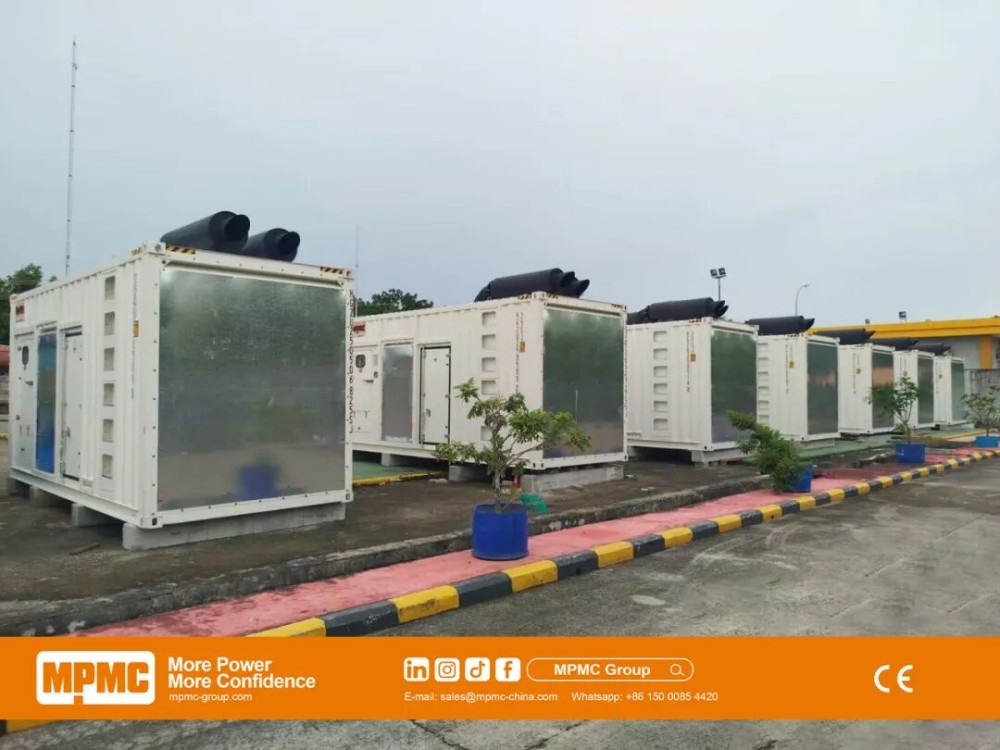 MPMC containerised biodiesel generator units, part of an 18 MW biodiesel power project supplying continuous island-scale power.
Adding Battery Storage for Redundancy and Black Start
MPMC's HBD-A Series BESS (125 kW–1,125 kW AC output, 261 kWh–2,170 kWh capacity) can integrate with the genset array as a power buffer, enabling VSG (Virtual Synchronous Generator) mode, black-start capability, and grid-forming, PQ, and VF control modes. The same platform's EMS and self-developed SCADA support real-time remote monitoring, ten-year data retention, Starlink satellite communication backup, and an SL3 cybersecurity framework — a combination that matters specifically on a remote island site where on-site technical staffing is limited and a communications outage cannot be resolved by sending someone across the water.
| Project | Capacity | Configuration |
|---|---|---|
|
Island Power Station, Indonesia |
21.6 MW |
Cummins KTA50-GS8 / Leroy-Somer LSA50.2 L8, biodiesel, zero fossil-fuel dependency |
|
18 MW Biodiesel Power Project, Indonesia |
18 MW (18×1 MW units) |
Same engine/alternator pairing, B35 biodiesel, up to 85% lifecycle CO2 reduction |
|
Off-Grid Long-Running Power Station, Kenya |
4 MW |
Cummins KTA50-G3 / Stamford S6L1D-G4, continuous off-grid duty |
High-Voltage Output for Island-Scale Distribution
Where an island industrial zone or a large factory needs high-voltage distribution, MPMC's MCLS2000H(S)-1 delivers 2,000 kVA prime power at 11,000 V and 50 Hz, powered by a Cummins QSK50-G17 engine with a Leroy-Somer LSA 53.2 VL7 alternator, enabling direct high-voltage distribution with reduced transmission losses over the long cable runs typical of an extended island or remote campus layout.
Fuel Logistics as a Design Constraint
On an island or genuinely remote site, fuel delivery is frequently the binding constraint on system design rather than generation capacity itself — a barge or air-freight fuel supply chain is slower, less frequent, and more expensive per litre than a mainland road-tanker delivery. This is a large part of why MPMC's documented island projects favour biodiesel where locally available, and why pairing the genset array with HBD-A Series battery storage to reduce total generator runtime carries a direct fuel-logistics benefit on an island site that a mainland deployment would not realise to the same degree.
Specifying Power for an Off-Grid Island Station
• Confirm the platform is designed for continuous-duty operation, not standby-rated duty cycles
• Verify N+X redundancy and master-standby rotation are supported across multiple units
• Ask whether biodiesel or alternative fuel compatibility is available if diesel logistics to the island are constrained
• Confirm black-start and grid-forming capability if battery storage will be added to the architecture
• Request remote monitoring and satellite communication backup for sites with limited on-site staffing
• Confirm high-voltage output options if the site has long internal distribution cable runs

Recent Posts



Contact US
Product Information
Quantity
Unit
Piece
Support order samples, customization, wholesale direct, and complete payment. If the product you look for does not have corresponding customized content, pls fill out the form below to contact us, and we will reply ASAP.