-
No.2449 Jinhai Rd., Pudong, Shanghai
English
 Português


.png?x-oss-process=image/resize,w_240/quality,q_100)


.webp?x-oss-process=image/resize,w_240/quality,q_100)

.webp?x-oss-process=image/resize,w_240/quality,q_100)


.jpg?x-oss-process=image/resize,w_240/quality,q_100)


.webp?x-oss-process=image/resize,w_240/quality,q_100)


How to Choose Large Power Diesel Generator Sets for Data Centre Backup Power
Sep 17, 2026
A data centre's power specification is built around one figure that most other applications do not need to meet: the time between a mains failure and a fully loaded generator picking up critical IT load, measured in seconds rather than minutes. Getting this specification wrong does not simply cost efficiency, as it might in a commercial building — it risks the workload the entire facility exists to protect.
One-Step Load Acceptance as the Core Requirement
MPMC's standby genset configuration for data centres is built around one-step load acceptance per ISO 8528-5, paired with fast automatic mains failure (AMF) response through DSE or DEIF controllers and multi-unit parallel synchronisation using ABB or Schneider motorised circuit breakers. This combination is what allows a data centre operator to bring a full IT load onto the generator in a single step rather than a phased ramp, which is the standard most colocation and hyperscale specifications require.
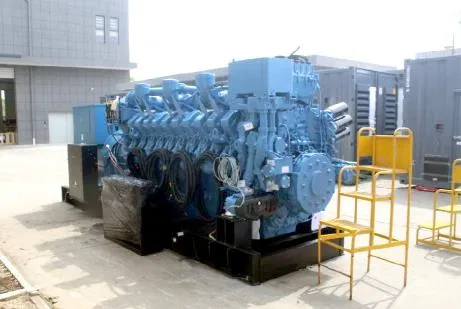 MPMC large-capacity generator set from a documented data centre backup deployment.
Documented Data Centre Deployments Across Scales
MPMC's data centre reference base spans a wide range of capacities: a 3 MW data centre project in the UAE built on MTU 20V4000 G63LF engines with Leroy-Somer LSA 53.2 XL13 alternators at 50 Hz and 6 kV, a 12 MW installation at the Changhang Power Station data centre also in the UAE on the same engine and alternator pairing, a 36 MW large-scale data centre backup deployment in the United States, and a related 4.2 MW factory power-expansion project in the UAE combining peak shaving with backup duty on MTU 16V4000G63 engines synchronised with the grid via DSE8620 controllers and an ABB 3200A breaker.
| Project | Capacity | Configuration |
|---|---|---|
|
Data Centre, UAE |
3 MW |
MTU 20V4000 G63LF / Leroy-Somer LSA 53.2 XL13, 50Hz/6kV, space heater, RTD |
|
Changhang Power Station (Data Centre), UAE |
12 MW |
MTU 20V4000 G63LF / Leroy-Somer LSA 53.2 XL13 |
|
Data Centre Backup, US |
36 MW |
Large-scale data centre backup power |
Testing That Simulates Hot-Aisle Conditions
Every unit is factory load-tested at 0%, 25%, 50%, 75%, 100%, and 110% of rated load inside a CNAS-certified constant-temperature room capable of simulating 40°C and 50°C ambient conditions — a test protocol that directly replicates the elevated ambient temperatures found around a data centre's generator yard or hot-aisle containment. MPMC's containerised units are rated for continuous operation up to 50°C ambient with copper radiator options, which matters for a generator yard positioned near heat-rejection equipment or in a warm climate.
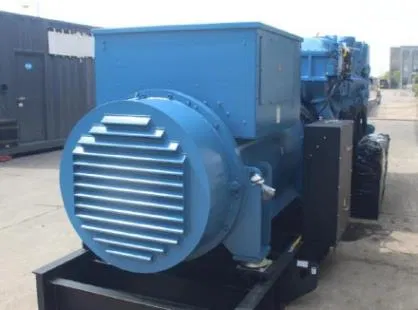 MPMC large-capacity MTU-powered generator set, representative of the platform used on MPMC's documented UAE data centre projects.
Reducing Standby Runtime With a Hybrid BESS Layer
For data centres pursuing hybrid renewable energy ambitions, MPMC's HBD-A Series BESS can integrate with rooftop PV and the genset array to provide peak shaving, UPS-level millisecond response, and grid frequency regulation, reducing reliance on standby generator runtime while maintaining zero-downtime availability. This layered architecture is the same pattern MPMC applies across its containerised platform, allowing a data centre operator to add battery buffering to an existing genset installation rather than replacing it.
Manufacturing Scale for Large-Capacity Orders
A 12 MW or 36 MW data centre order is rarely a single-unit purchase — it is a multi-unit, phased delivery that depends on a manufacturer's production capacity and quality consistency across dozens of units built to the same specification. MPMC's CNAS-certified 22,000 square-metre smart factory in Haimen, Jiangsu, with end-to-end CNC fabrication and CNAS-accredited load testing, is built specifically for this kind of consistent, multi-unit production, and the same facility's certified quality systems (ISO 9001:2015, ISO 45001, ISO 14001) apply uniformly across an order regardless of its total scale.
Specifying a Data Centre Backup Generator
• Confirm one-step load acceptance is certified per ISO 8528-5, not only rated output
• Verify AMF response time and controller compatibility (DSE, DEIF) against your site's transfer switch design
• Confirm multi-unit parallel synchronisation is documented for N+1 or 2N architectures
• Request factory load-test records across the full 0–110% range at simulated ambient temperature
• Ask whether a hybrid BESS layer can reduce standby runtime and support peak shaving
• Request a documented data centre reference at a comparable capacity
Recent Posts


Contact US
Product Information
Quantity
Unit
Piece
Support order samples, customization, wholesale direct, and complete payment. If the product you look for does not have corresponding customized content, pls fill out the form below to contact us, and we will reply ASAP.