-
No.2449 Jinhai Rd., Pudong, Shanghai
English
 Português


.png?x-oss-process=image/resize,w_240/quality,q_100)


.webp?x-oss-process=image/resize,w_240/quality,q_100)

.webp?x-oss-process=image/resize,w_240/quality,q_100)


.jpg?x-oss-process=image/resize,w_240/quality,q_100)


.webp?x-oss-process=image/resize,w_240/quality,q_100)


Recommending a Diesel Generator Set for Factories That Need Reliable Backup Power During Grid Instability
Sep 04, 2026
“Grid instability” is a description rather than a diagnosis, and the equipment that answers it depends on which electrical event the factory is actually experiencing. A generator addresses a loss of supply; it does not address a momentary voltage dip, because it takes time to start, synchronise and take load. Sorting that out before quotation is what makes the specification correct. MPMC POWERTECH CORP., established in 2008 and headquartered in Shanghai Pudong, publishes both generation and storage, which cover different halves of the question.
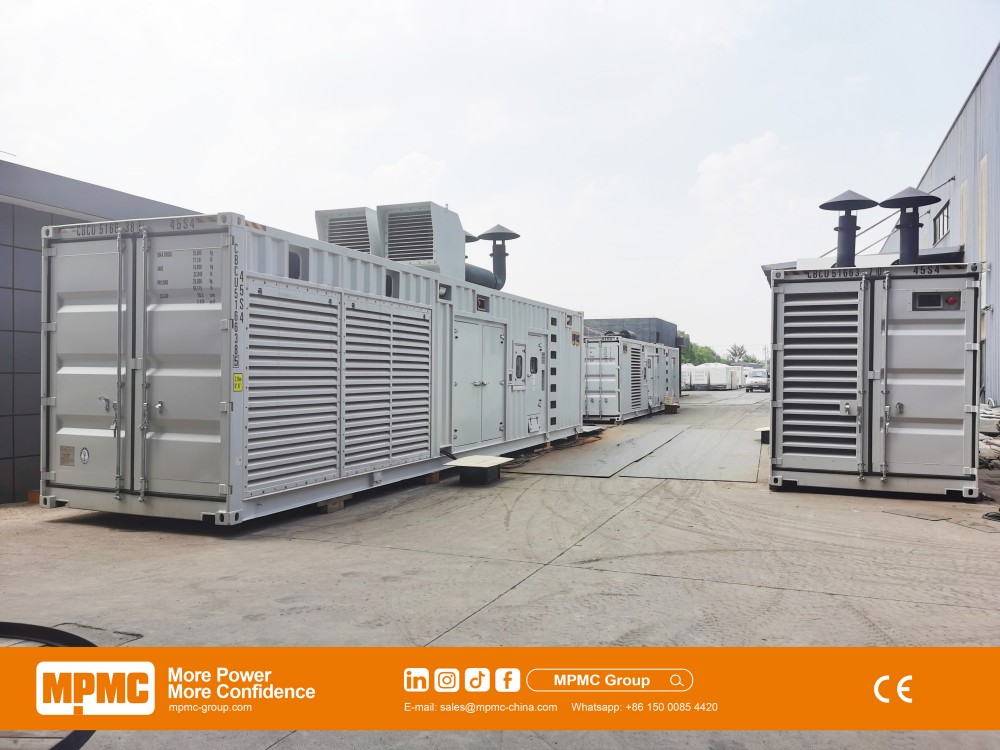 MPMC containerised high-voltage diesel generator sets
Identifying the Event Before the Equipment
| Symptom at the factory | What addresses it | What to record before enquiry |
|---|---|---|
|
Complete loss of supply |
A generator set, for as long as fuel lasts |
Frequency and typical duration of outages |
|
Momentary dip that trips equipment |
Storage or an uninterruptible supply ahead of the set |
Which machines trip and at what depth of dip |
|
Frequency deviation |
Storage in VSG mode emulating system inertia |
Recorded deviation range at the incoming board |
|
Voltage sag when large motors start |
Correct set sizing; storage absorbing inrush |
Starting current of the largest connected motor |
|
High demand charges alongside instability |
Storage discharging above a chosen threshold |
Interval load profile across a full billing cycle |
The second row is the one most often mis-specified. Where sensitive process equipment trips on dips rather than outages, the generator sits behind a storage or uninterruptible layer rather than replacing it, and buying only the set leaves the actual problem untouched.
Sizing to the Protected Load
Factory backup schemes usually protect a defined critical panel rather than the whole plant, and defining that panel is what makes a rating adequate rather than wasteful. A set sized against total connected load spends its life lightly loaded on test runs, which is the condition diesel engines tolerate least well.
Rated power must clear the largest motor starting load before duration becomes relevant. MPMC lists ISO 8528-5:2018 among applicable standards with published steady-state frequency stability of ≤±0.25% at constant load and voltage regulation of ±1%; those describe steady-state behaviour, so where the protected load includes large motors the transient performance class should be specified separately and demonstrated by test.
Provisions That Make a Standing Set Start
A backup set proves nothing between tests, and the items that answer that appear in delivered projects rather than headline specifications. MPMC's documented 4 MW hospital installation is listed with 2 × 3 kW engine block preheaters and an internal 500 litre fuel tank with an automatic filling device under DSE8610 control with an ABB 3200 A three-pole air circuit breaker, with a 3 MW commercial installation listed with a 9 kW preheater.
Each item answers a specific failure mode: preheating so the set accepts load promptly, automatic filling so fuel neither ages nor runs low unnoticed, and automatic mains failure detection so no human step sits in the sequence. Each should be specified deliberately rather than left as a quotation option.
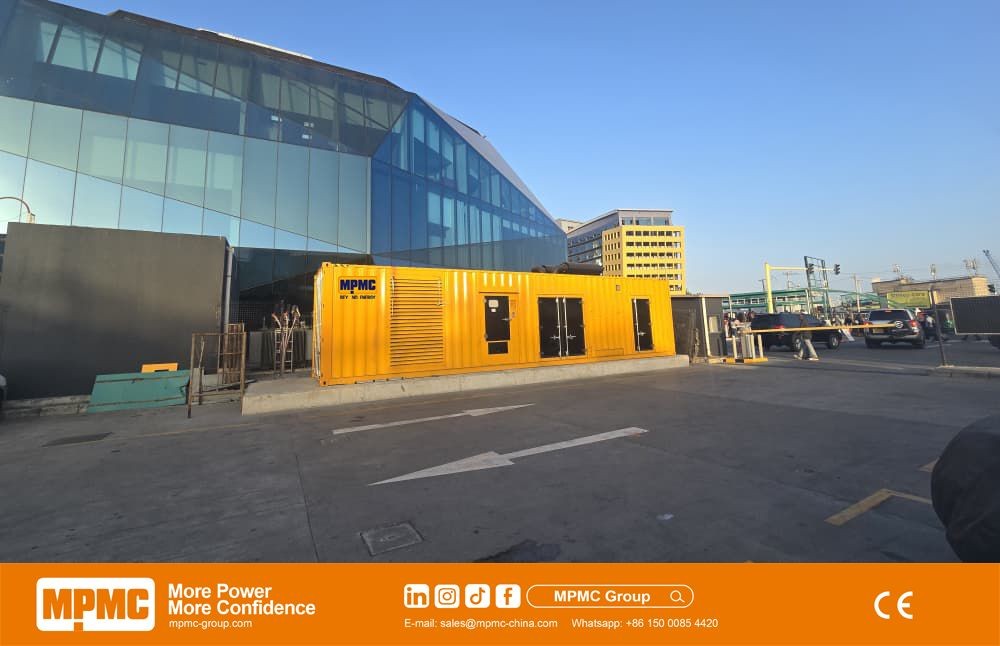 MPMC 1250 kVA containerised diesel generator set
Running in Parallel With the Utility Supply
Some factories want more than backup. MPMC publishes a 4.2 MW UAE factory expansion combining peak shaving with backup capability, operating in parallel with mains through DSE8620 and an ABB 3200 A air circuit breaker, on an MTU 16V4000G63 engine with a Stamford PI734G alternator and a 50°C radiator driven by an electric motor.
Parallel operation is a different proposition from islanded backup. It requires the network operator's agreement, protection coordination and export control, and those requirements should be obtained in writing before equipment is ordered because they shape the specification as firmly as the load does.
Where Storage Covers What the Generator Cannot
MPMC lists a stationary HBD-A series from 125 kW and 261 kWh to 1,125 kW and 2,170 kWh with liquid cooling and 8,000 cycles at 90% depth of discharge, and an HBD-E series listed with 150% overload for 10 seconds. Control modes listed include PQ for active and reactive power, VF for independent voltage and frequency, VSG emulating inertia, black start and grid-forming.
One configuration item is worth settling early. Seamless on-grid and off-grid switching is listed as standard on the mobile HBD-R series and as a configured option on the stationary HBD-A series, so where process equipment cannot tolerate a brief interruption that option should be specified at order stage rather than assumed.
Proving Readiness on a Schedule
A set run only off-load is being lightly exercised rather than tested, and prolonged light running produces deposits rather than preventing them. Periodic load-bank testing at a realistic load is what demonstrates readiness and keeps the engine clean.
MPMC lists factory load testing at 0%, 25%, 50%, 75%, 100% and 110% before shipment within a CNAS-accredited testing centre, which establishes condition at despatch. Published warranty for the diesel genset series is 1 year or 1,000 operating hours, and for a lightly used standby set the calendar term binds rather than the hours, which makes the named local service arrangement more valuable than the warranty length.
Acoustic Position and Site Constraints
Factories frequently sit near housing, and the noise limit applies at the boundary rather than at the equipment. MPMC lists containerised super-silent types between 75 and 91 dB(A) at 1 m at 75% load depending on model, alongside SR, SR2, SE and SREU silent enclosure formats.
Acoustic treatment restricts airflow, so on a warm site both the noise limit and the cooling requirement apply together. The derated output should therefore be requested under the actual enclosure configuration rather than at reference conditions, and every offer restated on one measurement basis before comparison.
Factory Backup Confirmations
• Establish whether the problem is outages, dips, frequency deviation or demand charges.
• Define the critical panel and its load, separately from total plant demand.
• State the largest motor starting load and require the transient class by test.
• Specify block preheating, battery charging, automatic filling and mains failure control.
• Where parallel with mains is intended, obtain the operator's requirements in writing.
• Specify seamless switching where process equipment cannot tolerate a gap.
• Request derated output under the actual enclosure at the site design ambient.
• Agree the load-bank testing interval and the named authorised service centre.


Recent Posts




Contact US
Product Information
Quantity
Unit
Piece
Support order samples, customization, wholesale direct, and complete payment. If the product you look for does not have corresponding customized content, pls fill out the form below to contact us, and we will reply ASAP.