-
No.2449 Jinhai Rd., Pudong, Shanghai
English
 Português


.png?x-oss-process=image/resize,w_240/quality,q_100)


.webp?x-oss-process=image/resize,w_240/quality,q_100)

.webp?x-oss-process=image/resize,w_240/quality,q_100)


.jpg?x-oss-process=image/resize,w_240/quality,q_100)


.webp?x-oss-process=image/resize,w_240/quality,q_100)


How Do I Choose Large Power Generator Sets for Industrial Infrastructure Projects?
Sep 10, 2026
An infrastructure project's power needs look nothing like a finished facility's. Construction sites and municipal infrastructure projects share a distinctive profile: there is no permanent grid connection during the build, the load topology changes rapidly as work progresses through different phases, regulators increasingly expect lower diesel emissions and noise near occupied areas, and the equipment itself needs to be able to redeploy as the project advances rather than staying fixed in one place for years. Choosing a generator set for this kind of project means choosing for change, not for a single steady-state load.
What Makes an Infrastructure Project's Power Needs Different From a Fixed Facility's
A factory or data centre specifies its backup power once and expects the load profile to stay broadly consistent for years. An infrastructure project's load moves through distinct phases — site clearance, foundation work, structural build, fit-out — each drawing a different mix of power, and the equipment supplying it often needs to relocate to a new phase of the same project or to an entirely different site once the current phase finishes. MPMC addresses several of the specific pain points this creates directly: generator oversizing is corrected through BESS parallel operation that right-sizes the genset to the actual load; high refuelling frequency on remote sites is reduced by battery storage extending the interval between fills; noise ordinance compliance is met by battery-only operation bridging silent-hour requirements; and reliable backup for safety-critical systems such as cranes, elevators and formwork is delivered through the battery's UPS-style function.
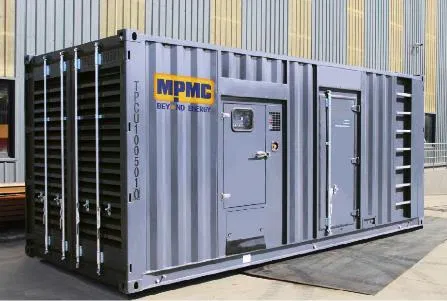 MPMC 3 MW containerised generator sets, 20 ft high-cube super-silent type, from a commercial and industrial building power backup project in New Zealand.
Documented Infrastructure and Construction Deployments
MPMC's New Zealand commercial and industrial building power backup project, at 3 MW across four 750 kVA units powered by Doosan DP222LC engines with Stamford S5L1D-H4 alternators, was built in 20 ft high-cube super-silent containers rated at 75 dB(A) at 7 m at full load, with parallel and load-sharing control through DSE8610 and ABB 1,250 A motorised breakers. At a considerably larger scale, MPMC's Saudi Arabia rental construction project, documented at 33.5 MW on a Cummins platform, demonstrates the same containerised approach applied to a major construction programme rather than a single building. MPMC's Libya municipal electricity backup project, at 2.4 MW on a Perkins 4012-46TAG2A engine with a Stamford S7L1D-C41 alternator, shows the same platform supporting municipal infrastructure specifically rather than a private construction site.
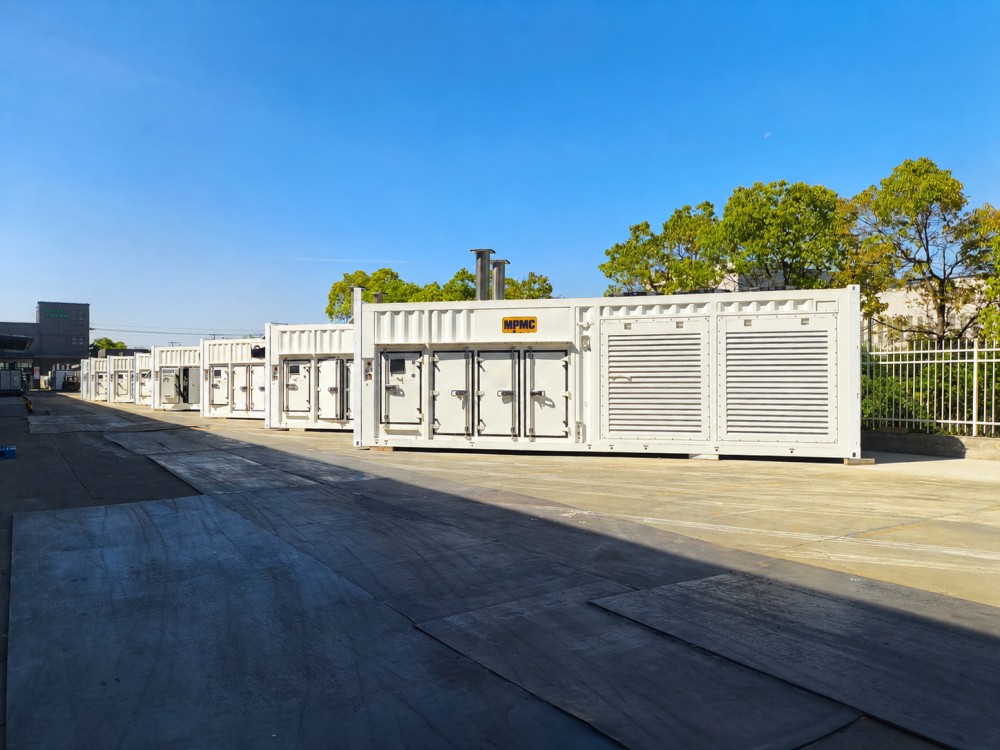 MPMC containerised diesel generator sets, Cummins-powered, from a 33.5 MW rental construction project in Saudi Arabia.
A Small Project Benefits From the Same Logic as a Large One
The oversizing problem is not limited to large infrastructure programmes. MPMC's UK construction site case study documents a 56 kW diesel generator that had been oversized for a 3–6 kW night load, corrected by adding a 30 kW / 60 kWh HBD-R energy storage unit in a hybrid configuration; the result extended fuel refill frequency from every two days to every seven, and the maintenance interval from every 10 days to every 60. MPMC's Australian building construction project applied the same logic using a GSB Series all-in-one solar, diesel and storage solution at 1.08 MWh, and a separate Australian HBD-R rental deployment, at 560 kW / 920 kWh, was assembled from multiple smaller HBD-R units specifically for a construction-site carbon-reduction project. A small infrastructure project can apply the same right-sizing principle as a 33.5 MW programme, just at a scale matched to its actual load.
| Before Hybrid Retrofit | After Hybrid Retrofit | Change |
|---|---|---|
|
Refuel every 2 days |
Refuel every 7 days |
3.5× longer interval |
|
Maintenance every 10 days |
Maintenance every 60 days |
6× longer interval |
Redeployable Equipment for a Project That Moves
Containerisation itself is what makes a generator set genuinely redeployable: the same unit that powers a site clearance phase can be relocated by standard container-handling equipment to a later phase, or to an entirely different project, without the site-specific civil works a permanently installed generator would require. Pairing the containerised genset with an HBD-R or GSB Series battery buffer extends this flexibility further, since the battery absorbs load fluctuations from changing site activity and lets the diesel unit run closer to its efficient load point regardless of which construction phase is currently underway.
Matching the Configuration to the Project's Full Timeline
An infrastructure project's power specification should account for its full timeline, not just its opening phase. The following points are worth settling with a supplier before equipment is ordered.
• Map the load profile across each construction phase, not only the peak load expected at any single point
• Ask whether a battery pairing is available to right-size the genset and bridge noise-restricted hours
• Confirm the container specification supports relocation to a later phase or a different project without major rework
• Check the noise rating against the nearest occupied building for each phase of the project, since site boundaries can change as work progresses
• Request documented references from comparable municipal or construction infrastructure projects
• Confirm what backup arrangement protects safety-critical systems such as cranes, hoists and formwork during a genset service interval


Recent Posts


Contact US
Product Information
Quantity
Unit
Piece
Support order samples, customization, wholesale direct, and complete payment. If the product you look for does not have corresponding customized content, pls fill out the form below to contact us, and we will reply ASAP.