-
No.2449 Jinhai Rd., Pudong, Shanghai
English
 Português


.png?x-oss-process=image/resize,w_240/quality,q_100)


.webp?x-oss-process=image/resize,w_240/quality,q_100)

.webp?x-oss-process=image/resize,w_240/quality,q_100)


.jpg?x-oss-process=image/resize,w_240/quality,q_100)


.webp?x-oss-process=image/resize,w_240/quality,q_100)


Which Silent Generator Sets Are Suitable for Hotels and Hospitals?
Sep 11, 2026
Hotels and hospitals both need a standby generator set that is heard as little as possible, but for different reasons. A hotel's noise limit is set by guest comfort and reputation — a generator audible in a guest room is a complaint waiting to happen. A hospital's noise limit is set by patient recovery and, in some areas, by the sensitivity of diagnostic or clinical equipment nearby. Both outcomes point to the same enclosure decision, even though the underlying reason for wanting quiet is not identical.
Why Hotels and Hospitals Set a Tougher Noise Bar Than a Factory
MPMC's product portfolio explicitly lists backup power for commercial and industrial applications including supermarkets, hotels and clinics as a served sector, alongside its more heavily documented hospital and healthcare deployments. What sets both apart from a typical industrial site is occupancy pattern: a factory's noise-sensitive hours are usually limited to a shift change or a specific ordinance window, while a hotel or hospital is occupied around the clock by people who are resting, sleeping or recovering, which removes the option of scheduling a loud test run for a quiet time of day.
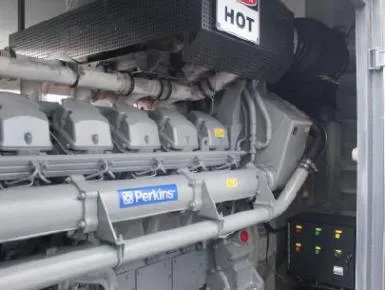 MPMC 40 ft high-cube super-silent containerised generator set, Perkins-powered, from a 4 MW hospital critical-load backup project.
A Documented Hospital Reference at 85 dB(A)
MPMC's New Zealand hospital critical-load backup project, at 4 MW, was built from Perkins 4016-61TRG3 engines and Stamford S71D G41 alternators housed in 40 ft high-cube super-silent enclosures, achieving 85 dB(A) at 1 m at full load — a documented figure a hotel or hospital buyer can use as a reference point when specifying an equivalent installation. The same project fitted twin 3 kW engine block preheaters for fast-start readiness and an internal 500 litre fuel tank with automatic filling, features relevant to any occupied-building site where the plant room needs to be self-sufficient between routine visits.
MPMC's Enclosure Options for Noise-Sensitive Sites
MPMC's diesel generator sets are available across several distinct enclosure types, from an open type built for standard industrial application through to a containerised super-silent type built for the acoustic and weather protection a hotel or hospital plant room needs. Within this range, MPMC's containerised silent (SC) type is documented as low as 75–91 dB(A) at 1 m at 75% load depending on model, giving a hotel or hospital buyer a meaningful spread of options rather than a single fixed noise figure to accept or reject.
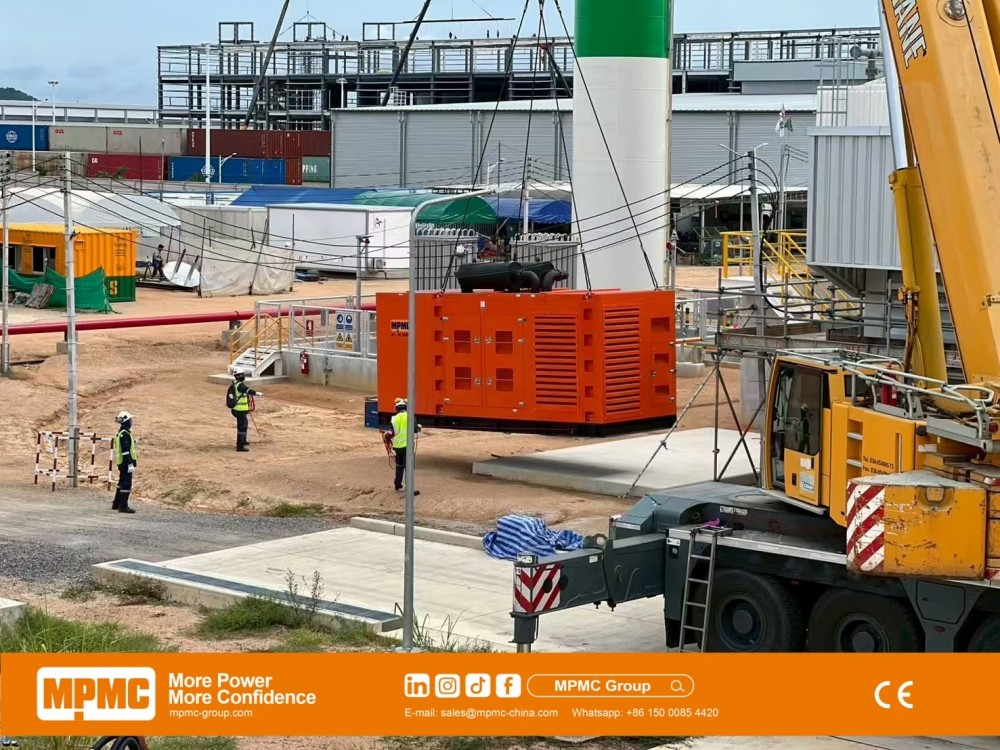 MPMC SR2-series 1,000 kVA silent generator set (Perkins engine, Stamford alternator)
| Reference | Enclosure / Noise Level | Engine / Alternator |
|---|---|---|
|
New Zealand 4 MW Hospital Project |
40 ft high-cube super-silent, 85 dB(A) at 1 m (full load) |
Perkins 4016-61TRG3 / Stamford S71D G41 |
|
MPMC Containerised Silent (SC) Type |
75–91 dB(A) at 1 m (75% load), model-dependent |
Model-dependent |
A Warranty and Testing Baseline for Either Setting
MPMC's diesel genset range carries a standard warranty of 1 year or 1,000 hours, whichever comes first, with the engine, alternator and controller separately covered under each OEM's own brand warranty. Every unit is tested against a load profile covering 0%, 25%, 50%, 75%, 100% and 110% of rated capacity in a CNAS-certified facility before shipment, including a constant-temperature room simulating 40°C and 50°C ambient conditions. For a hotel or hospital procurement team less familiar with generator set specifications than an industrial buyer might be, this combination of a documented warranty period and an independently verifiable test protocol gives a concrete basis for comparing suppliers beyond the acoustic figure alone.
What a Hotel Adds That a Hospital Does Not
A hospital's standby plant is judged primarily on reliability and switching speed, with noise as an important but secondary requirement layered on top. A hotel, by contrast, may treat the acoustic enclosure as close to the primary specification, since a hotel rarely runs its generator during an actual emergency in the way a hospital does, but is far more likely to run it during a scheduled test while guests are in-house. This makes enclosure placement relative to guest rooms, and the noise figure at the specific distance those rooms sit from the plant room, worth confirming explicitly rather than relying on a generic 1 m or 7 m test figure that may not reflect the guest-facing distance that actually matters.
Settling the Acoustic Specification Before Enclosure Selection
The following points are worth confirming with a supplier before choosing an enclosure type for a hotel or hospital project.
• Confirm the dB(A) figure at the actual distance from the plant room to the nearest guest room or patient area, not only a standard 1 m or 7 m test distance
• Ask which enclosure type the quoted noise figure applies to, since the difference between types can exceed 10 dB(A)
• For a hospital, prioritise switching speed and redundancy alongside the noise figure, since reliability during an actual outage is the primary requirement
• For a hotel, confirm whether scheduled test runs can be timed and enclosed to minimise guest-facing noise
• Request a documented reference from a comparable occupied-building project, such as a hospital or healthcare site
• Check whether block preheaters and automatic fuel filling are fitted, since both reduce how often staff need to visit the plant room


Recent Posts


Contact US
Product Information
Quantity
Unit
Piece
Support order samples, customization, wholesale direct, and complete payment. If the product you look for does not have corresponding customized content, pls fill out the form below to contact us, and we will reply ASAP.