-
No.2449 Jinhai Rd., Pudong, Shanghai
English
 Português


.png?x-oss-process=image/resize,w_240/quality,q_100)


.webp?x-oss-process=image/resize,w_240/quality,q_100)

.webp?x-oss-process=image/resize,w_240/quality,q_100)


.jpg?x-oss-process=image/resize,w_240/quality,q_100)


.webp?x-oss-process=image/resize,w_240/quality,q_100)


Solar Powered Lighting Towers for Nighttime Construction and Emergency Projects
Sep 01, 2026
A solar lighting tower changes what a site has to plan for. There is no fuel to deliver, no engine to service and no noise to manage, and in exchange the design has to account for one thing a diesel tower never does: the recharge that has to happen before the next night. From a procurement perspective that single dependency organises the whole specification. MPMC POWERTECH CORP., established in 2008 and headquartered in Shanghai Pudong, publishes an HSL solar lighting range with run times from 12 to 40 hours depending on model.
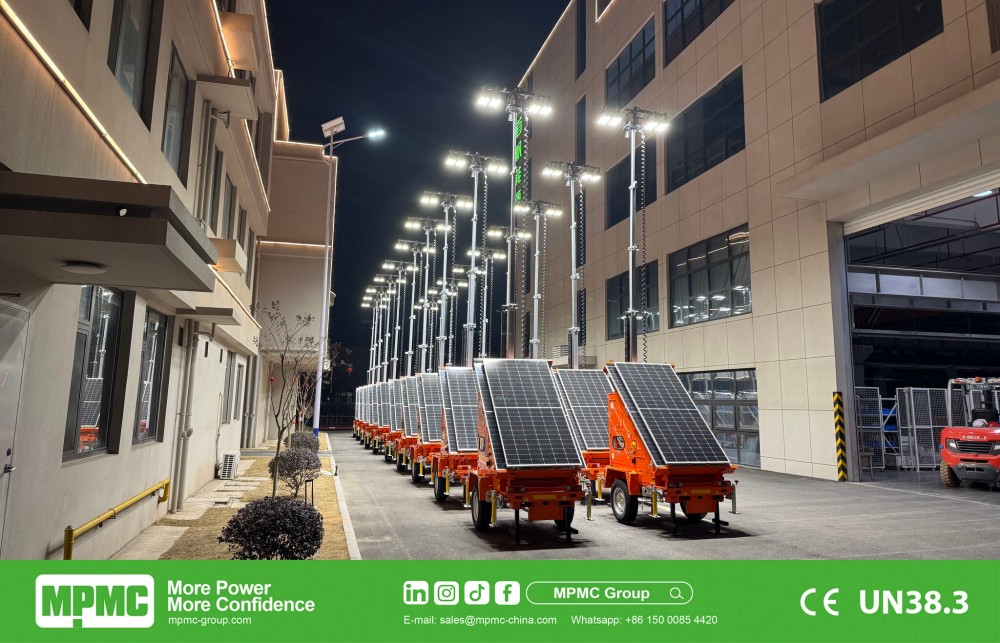 MPMC HSL Series solar light towers
Run Time Is Bought With Battery, Not Only With Panels
MPMC's published HSL range makes the relationship explicit, and reading it correctly is what prevents an undersized specification.
| Model | Coverage at 5 lux avg | Battery | Run time | Solar array |
|---|---|---|---|---|
|
HSL-1000A |
12,000 m² |
4.8 kWh GEL |
12 h |
1,170 W (3 × 390 W) |
|
HSL-1000B |
12,000 m² |
5.12 kWh LFP |
12 h |
1,170 W (3 × 390 W) |
|
HSL-1500B |
12,000 m² |
8.0 kWh LFP |
20 h |
1,525 W integrated |
|
HSL-1440B |
18,000 m² |
16.07 kWh LFP |
26 h |
1,440 W (3 × 480 W) |
|
HSL-1920B |
18,200 m² |
16.07 kWh LFP |
26 h |
1,920 W (4 × 480 W) |
|
HSL-2880B |
24,100 m² |
16.07 kWh LFP |
20 h |
2,880 W (6 × 480 W) |
|
HSL-3840B |
24,100 m² |
32.14 kWh LFP |
40 h |
3,840 W (8 × 480 W) |
The HSL-2880B and HSL-3840B share coverage and lamp count, and the difference between 20 and 40 hours is the battery and array together. A specification written around coverage alone can therefore select a tower that lights the area correctly and runs out before the shift ends.
Specifying for Consecutive Nights Rather Than One
Published run times assume the battery starts charged. On a construction programme running through winter, or an emergency deployment where the duration is unknown, the useful figure is how many nights the tower covers before recharge conditions have to cooperate.
Choosing a run time longer than a single night is what provides that margin. A 26 or 40 hour model covers a long night and retains reserve for a poor charging day, which is why those models are published alongside units offering 12 or 20 hours at the same coverage. Where a scheme cannot depend on recharge at all, MPMC also lists an HBL-600D-S battery-only variant and diesel-battery hybrids in the same lighting family.
Deployment Speed on an Emergency Call
For incident response the interval that matters is between arrival and usable light. MPMC lists mast heights of 7.2 m on the HSL-1000A, HSL-1000B and HSL-1440B, 7.5 m on the HSL-1500B and 9.0 m on the HSL-1920B, HSL-2880B and HSL-3840B, with hydraulic masts on several models and the HSL-1500B listed with a trailer rated for road travel at 80 km/h, one-button mast raising, 355° rotation and a lighting head adjustable through 90° vertically.
A crew raising a manual mast in darkness is spending time the incident does not have. Where towers are deployed at night by one or two people, the mast type and the one-button arrangement decide how many positions a shift can establish.
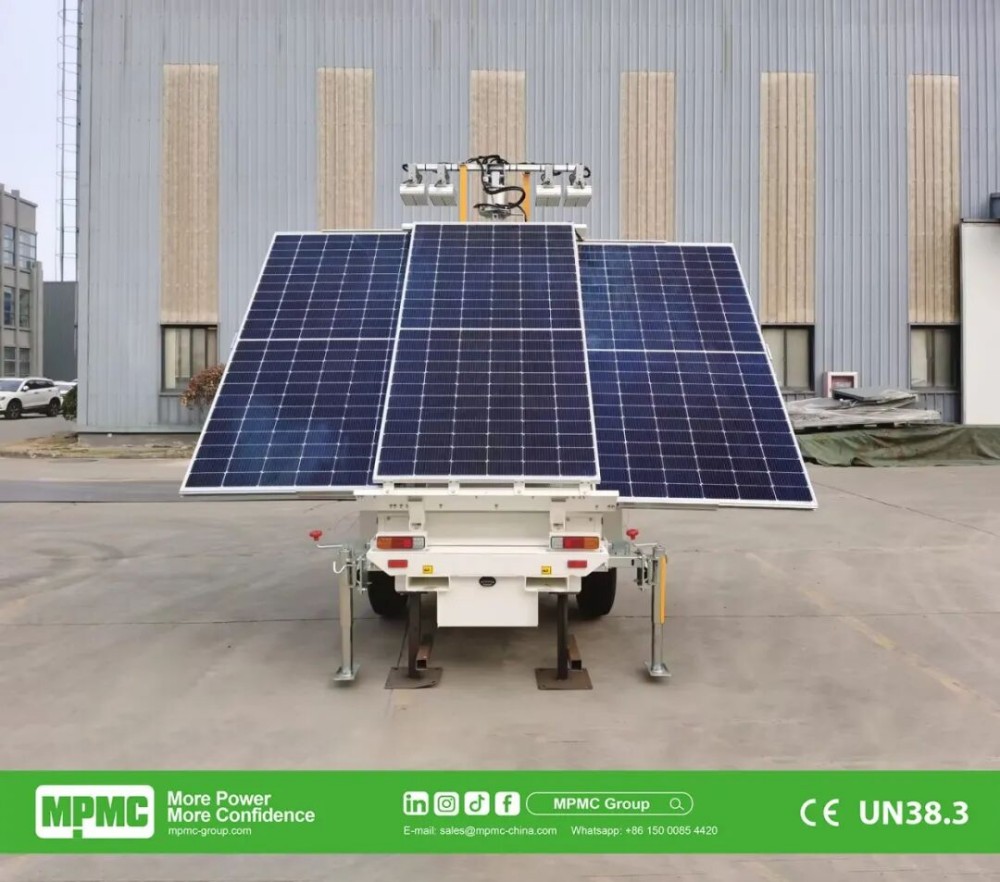 MPMC HSL Series solar light tower
Lighting a Corridor Rather Than a Compound
Published coverage figures state an area at an average lux level, which describes an open compound well. Roadworks and linear construction light a corridor, where light thrown beyond the working width is wasted and may affect passing traffic.
For those schemes the useful exercise is to convert the corridor into an equivalent area at the required lux level, then check the resulting tower spacing against the mast height offered. Where a task needs a defined level at a working position rather than an average, that figure should be stated in lux at the position and the layout checked against it.
Deployment Provisions Across the Range
| Provision | Why it matters at night | Published MPMC position |
|---|---|---|
|
Mast height |
Sets coverage per position and spacing |
7.2 m, 7.5 m and 9.0 m depending on model |
|
Mast type |
Decides set-up time and crew required |
Hydraulic on several models; manual on others |
|
Rotation and aim |
Light placed where the work is |
355° rotation; head adjustable through 90° vertically |
|
Road travel |
Whether it can be towed between positions |
HSL-1500B listed with a trailer rated at 80 km/h |
|
Raising method |
One person working in darkness |
One-button mast raising listed on the HSL-1500B |
|
Lamp configuration |
Coverage and light level at the face |
Four 100 W, 150 W or 200 W LED lamps by model |
Standing Unattended Between Shifts
Equipment left on a verge or an open site overnight is exposed, and conserving battery matters as much as protecting the asset. MPMC lists dual-mode colour temperature switching, adaptive brightness control and a light-controlled timer across its hybrid lighting range.
Those features reduce unnecessary running as well as extending the interval before intervention. Lowering the mast when the tower is not in use, and choosing positions visible from a road, are practical measures that cost nothing and are easier to arrange at deployment than afterwards. On a scheme running several towers, agreeing a single routine for these checks keeps them short enough that crews actually complete them at the end of a shift.
Warranty and Consistency Across a Group
MPMC lists the HSL solar series at 2 years or 1,000 charge-discharge cycles. A tower cycling every night approaches 365 cycles a year, so the cycle allowance rather than the calendar term is what applies on a well-used asset, and expected nightly use should be checked against it before purchase.
For a contractor running several towers, consistency across the group matters as much as the specification of any one. Common mast type, common connectors and one battery family reduce the training burden on crews rotating between schemes and keep the spares holding small enough to travel with the works.
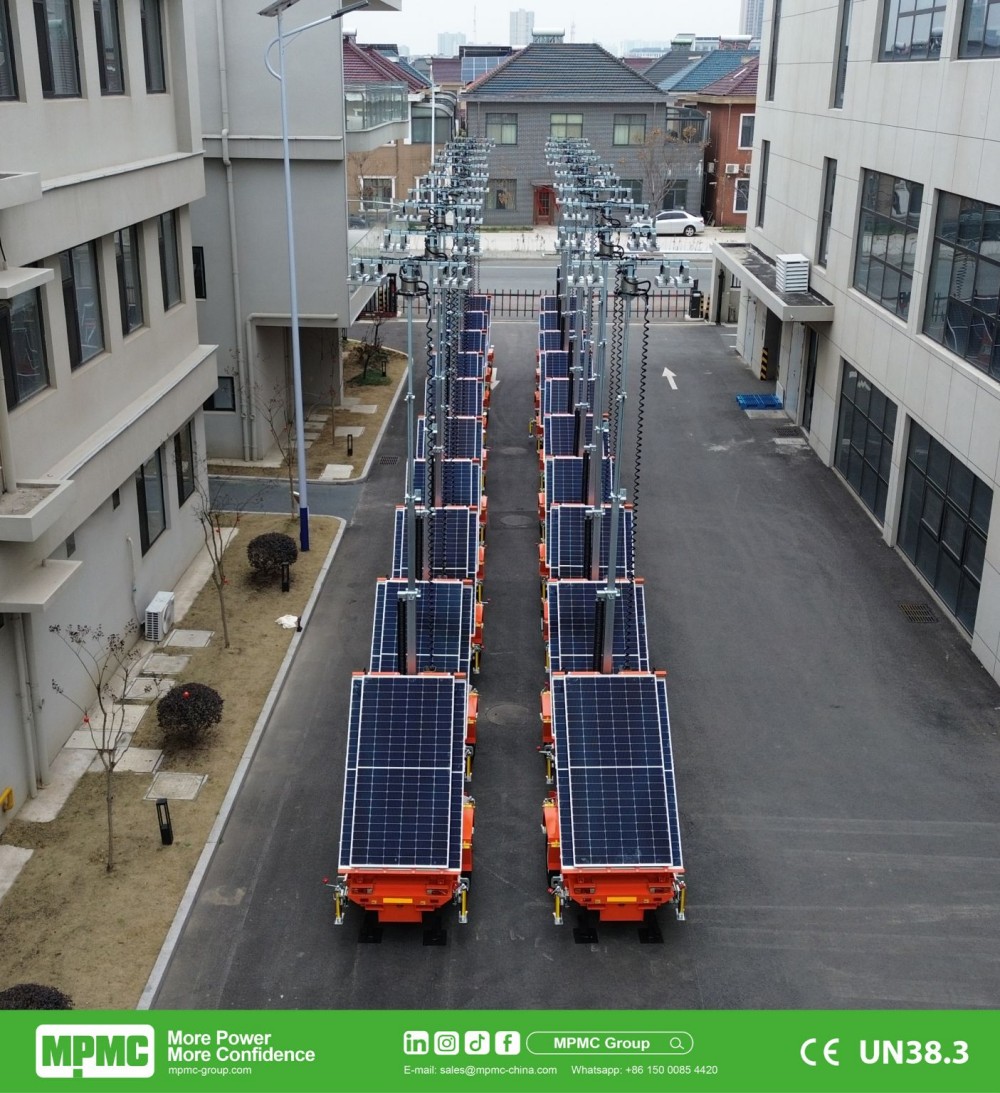 MPMC HSL Series solar light towers
Where the Wider Lighting Range Fits
Alongside the HSL solar series MPMC lists an HBL diesel-battery hybrid range, including the HBL-600D-M with four 150 W LED lamps at 200 lumens per watt covering 18,200 m² at an average of 5 lux, an 8 kWh LiFePO₄ battery, a 6 kW Kubota Z482-3B engine and a 130-litre tank with a stated autonomy of 420 hours, offering up to 53 hours of battery-only run time.
That gives a contractor two formats from one supplier: solar where the site allows recharge and quiet operation is required, and hybrid where deployments run through seasons or durations that recharge cannot be relied upon. Positions can then be classified by the condition that governs them rather than standardised on one technology.
Verification Points Before Ordering
• State the area to be lit and the lux level required at the working position.
• Check the recharge assumption against deployment latitude and season.
• Specify run time for the longest expected night, allowing margin for a poor charging day.
• Count consecutive nights that must be covered before recharge conditions improve.
• Choose mast type against deployment speed and the crew available at night.
• Confirm trailer specification and road-legal towing in the destination market.
• For corridor lighting, convert the working width into an equivalent area at the required lux.
• Check the cycle allowance against expected nightly use.
• Standardise mast type, connectors and battery family across the group.
• Classify positions by governing condition before selecting between solar and hybrid formats.
Frequently Asked Questions
MPMC lists published run times from 12 hours on the HSL-1000B to 40 hours on the HSL-3840B, with batteries from 5.12 kWh to 32.14 kWh and arrays from 1,170 W to 3,840 W. Run time follows battery capacity as much as array size, which is why two models with identical coverage can differ by twenty hours.
Published run times assume the battery starts charged, so recharge depends on latitude, season and weather. Specifying a run time longer than a single night provides margin across a poor charging day, and MPMC's 26 and 40 hour models exist for that reason. Where recharge cannot be relied on at all, the HBL hybrid or battery-only formats apply.
MPMC lists the HSL-2880B and HSL-3840B at 24,100 m² coverage at an average of 5 lux with four 200 W lamps. Coverage figures assume an average level across an area, so where a task needs a defined level at a working position that requirement should be stated in lux at that position.
That follows the mast arrangement. MPMC lists hydraulic masts on several models, with the HSL-1500B listed with one-button mast raising, 355° rotation, a 90° adjustable lighting head and a trailer rated for road travel at 80 km/h. For crews working in darkness those provisions determine how many positions a shift can establish.
MPMC lists the HSL solar series at 2 years or 1,000 charge-discharge cycles. A tower used nightly approaches 365 cycles a year, so the cycle allowance rather than the calendar term normally applies, and expected nightly use should be checked against it during the purchase decision.


Recent Posts


Contact US
Product Information
Quantity
Unit
Piece
Support order samples, customization, wholesale direct, and complete payment. If the product you look for does not have corresponding customized content, pls fill out the form below to contact us, and we will reply ASAP.