-
No.2449 Jinhai Rd., Pudong, Shanghai
English
 Português


.png?x-oss-process=image/resize,w_240/quality,q_100)


.webp?x-oss-process=image/resize,w_240/quality,q_100)

.webp?x-oss-process=image/resize,w_240/quality,q_100)


.jpg?x-oss-process=image/resize,w_240/quality,q_100)


.webp?x-oss-process=image/resize,w_240/quality,q_100)


Which Generator Set Suppliers Provide Fuel-Efficient Solutions for Prime Power Station Projects?
Sep 02, 2026
At a prime power station fuel is not a line item; it is the dominant cost across the asset's life, and it is decided less by the engine's specific consumption than by how the station is configured and dispatched. Two stations built from identical machines can differ substantially on annual fuel simply through unit count and sequencing. MPMC POWERTECH CORP., established in 2008 and headquartered in Shanghai Pudong, publishes containerised sets designed to ISO 8528 for continuous operation and lists island and distributed power station deliveries at multi-megawatt scale.
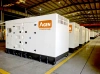
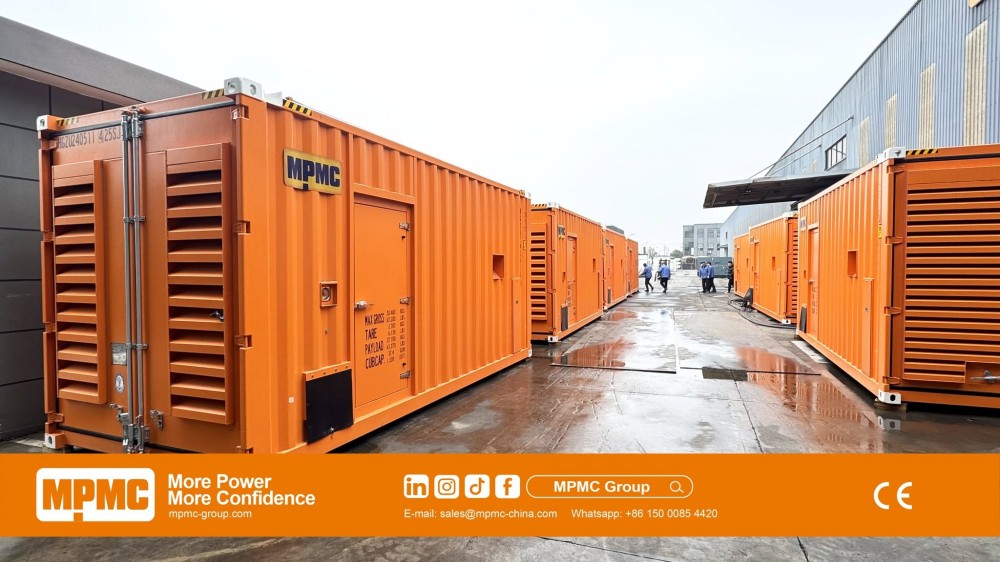 MPMC containerised generator sets — Cummins KTA50-G12 with Stamford alternators, ten custom-designed units
Unit Count Decides Fuel More Than Unit Size
Consumption is governed by how close each running set sits to its efficient load point. A station built from a few large sets that each run lightly loaded burns more than one built from more units of appropriate size, sequenced so that the machines actually running stay well loaded.
That makes the minimum expected load as important an input as the maximum. Prolonged light running also carries a maintenance cost, since engines held well below their design load need earlier intervention, so a station with too much installed capacity pays twice. MPMC lists containerised single-engine units from 800 to 3,750 kVA, twin-engine units from 1,250 to 3,000 kVA and a four-engine configuration at 1,600 kVA, which gives a designer room to match the load range rather than only the peak.
Sequencing and Rotation Are Design Decisions
MPMC lists multi-unit parallel operation with intelligent load sharing through DSE or DEIF AGC controllers and motorised circuit breakers, supporting N+X redundancy and master-standby rotation.
Two items belong in the specification rather than in site practice. The dispatch logic determines which sets run at which demand level and therefore how well loaded they are; rotation distributes running hours so units age evenly and every machine stays proven. Both are difficult to retrofit once the switchgear and control scheme are fixed.
Where the Rating Basis Affects Consumption
| Input | Why it drives station fuel cost | What to request or state |
|---|---|---|
|
Rating basis |
Continuous duty carries a lower figure than standby |
Continuous rating in writing with the permitted load factor |
|
Load range |
Determines how many units run and how loaded they are |
Both minimum and maximum expected load at enquiry |
|
Unit count |
Sets how close running machines sit to efficient load |
Sequencing strategy and expected load factor per unit |
|
Site ambient |
Derating changes achievable output per unit |
Derated output for continuous duty at design ambient |
|
Fuel specification |
Affects filtration, intervals and approval |
Written fuel approval from the engine manufacturer |
|
Storage pairing |
Removes hours of low-load running |
Load profile analysis showing hours below half load |
Cooling and Derating Under Sustained Load
A set running continuously spends its life at the thermal condition a standby set reaches only occasionally, so cooling capacity becomes a working constraint rather than a margin. MPMC lists a maximum ambient of 50°C with copper high-temperature radiator options and altitude derating applied per engine model specification.
For a station the derating calculation should be requested for continuous duty at the site's design ambient rather than at reference conditions, and the two figures are frequently far apart. Where the station sits in dust, radiator fouling reduces effective cooling progressively, which makes the cleaning regime part of the availability plan.
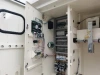
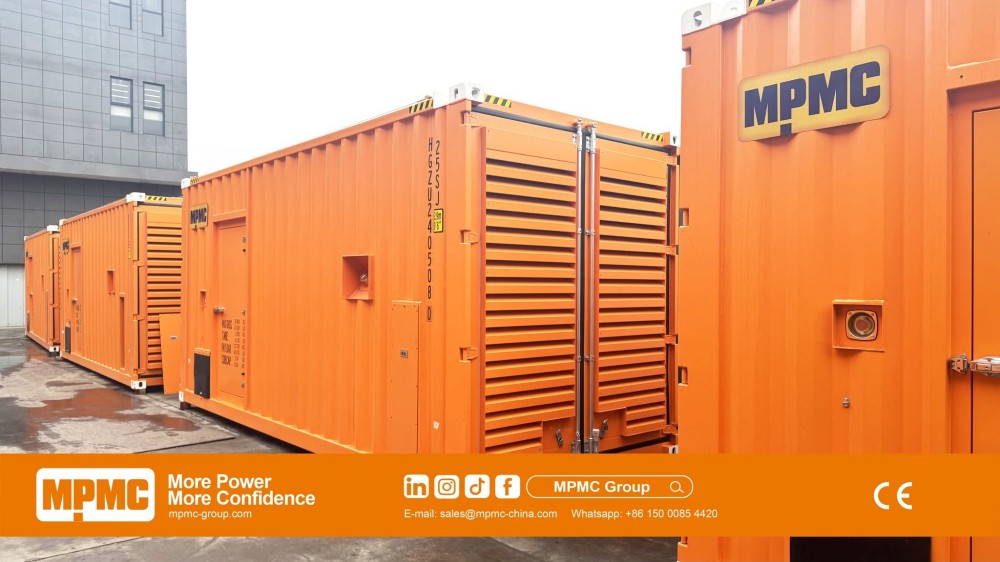 MPMC containerised generator set — Cummins KTA50-G12 with Stamford alternator
Where Storage Changes Station Economics
An increasing number of stations pair generation with storage rather than adding another engine, because storage removes the hours an engine would otherwise spend at low load. MPMC lists an HBD-R series positioned as a generator set partner from the HBD-30-60 at 30 kW with 61.44 kWh to the HBD-610-610 at 610 kW with 610.6 kWh, with millisecond-level transient load smoothing.
A published Dubai configuration lists ten Off-Grid concrete batching plants, each combining an HBD-500-1000 unit at 500 kW / 1,045 kWh with three 500 kVA generator sets on Perkins 2506D-E15TAG2 engines, operating around the clock at 45 to 50°C against a peak load of 847.8 kW and an average of 409.0 kW, with a published daily fuel saving of 254.13 litres per station and roughly 20% lower operating expenditure. That outcome belongs to that load profile and fuel price rather than transferring directly.
Fuel Flexibility Over a Long Asset Life
MPMC lists diesel to ASTM D975 Grade 2D as standard, with HVO to EN 15940 and B20 blends supported on selected Cummins models, and publishes an Indonesian island power station at 21.6 MW running on B35 with Cummins KTA50-GS8 engines and Leroy-Somer LSA50.2 L8 alternators. Natural gas, methanol and biofuel platforms are also listed across the containerised range.
Fuel approval is model-specific and affects filtration, service intervals and material compatibility, so it should be confirmed in writing with the engine manufacturer as well as the packager for the fuel actually available at the station.
Maintenance Access as a Fuel Consideration
Continuous duty converts maintenance from an occasional task into a scheduled production constraint, and a station that defers servicing loses efficiency as well as availability. Service intervals arrive in weeks rather than years, so filter access, oil change arrangements and the route for a component replacement affect both.
MPMC lists factory load testing at 0%, 25%, 50%, 75%, 100% and 110% before shipment within a CNAS-accredited testing centre, which establishes condition at despatch. What a station needs beyond that is the service interval schedule and the expected hours to major overhaul for the offered engine, since those figures set the replacement provision in the financial model alongside the fuel line.
Confirmations Before a Continuous-Duty Order
• Require the continuous rating in writing, with the permitted load factor stated.
• Give both minimum and maximum expected load, and the annual running hours.
• Decide unit count and size against the load range rather than the peak alone.
• Specify the dispatch and rotation strategy and the controller and breaker scheme.
• Request derated output at site ambient and altitude for continuous duty specifically.
• Log the load profile to establish hours below half load before assessing storage.
• Obtain written fuel approval from the engine manufacturer for the intended fuel.
• Ask for the service interval schedule and expected hours to major overhaul.


Recent Posts

October 26, 2016
The Most Successful Engineering Contractor

.-2.webp?x-oss-process=image/resize,w_100/quality,q_100)
Contact US
Product Information
Quantity
Unit
Piece
Support order samples, customization, wholesale direct, and complete payment. If the product you look for does not have corresponding customized content, pls fill out the form below to contact us, and we will reply ASAP.