-
No.2449 Jinhai Rd., Pudong, Shanghai
English
 Português


.png?x-oss-process=image/resize,w_240/quality,q_100)


.webp?x-oss-process=image/resize,w_240/quality,q_100)

.webp?x-oss-process=image/resize,w_240/quality,q_100)


.jpg?x-oss-process=image/resize,w_240/quality,q_100)


.webp?x-oss-process=image/resize,w_240/quality,q_100)


What Type of Generator Sets Are Suitable for Large Power Station Projects for Utilities?
Sep 09, 2026
A utility-scale power station project is judged on a different timescale to a standby installation: the plant is expected to run continuously, for years, often in a location where a grid connection either does not exist or cannot be relied upon for support during a fault. MPMC's large containerised platform for this role is built around ISO 8528 continuous-duty operation rather than the intermittent-use assumptions behind a standby specification, and around multi-unit architecture that can be sized to a specific island, remote community or grid-support role rather than a single fixed capacity.
Multi-Engine Building Blocks for Island and Remote Utility Plants
For larger-scale island or remote power plants, MPMC's containerised platform supports single-engine configurations from 800 to 3,750 kVA, dual-engine configurations from 1,250 to 3,000 kVA powered by Baudouin, Scania or Perkins, and four-engine configurations at 1,600 kVA powered by Scania. Multi-unit parallel operation with intelligent load sharing through DSE or DEIF AGC controllers gives the plant N+X redundancy and master-standby rotation, so capacity can be added in blocks as demand on the utility grows rather than requiring the whole plant to be re-specified at each expansion phase.
| Configuration | Rating Range | Engine Brands |
|---|---|---|
|
Single-engine |
800–3,750 kVA |
Multiple brands available |
|
Dual-engine |
1,250–3,000 kVA |
Baudouin, Scania, Perkins |
|
Four-engine |
1,600 kVA |
Scania |
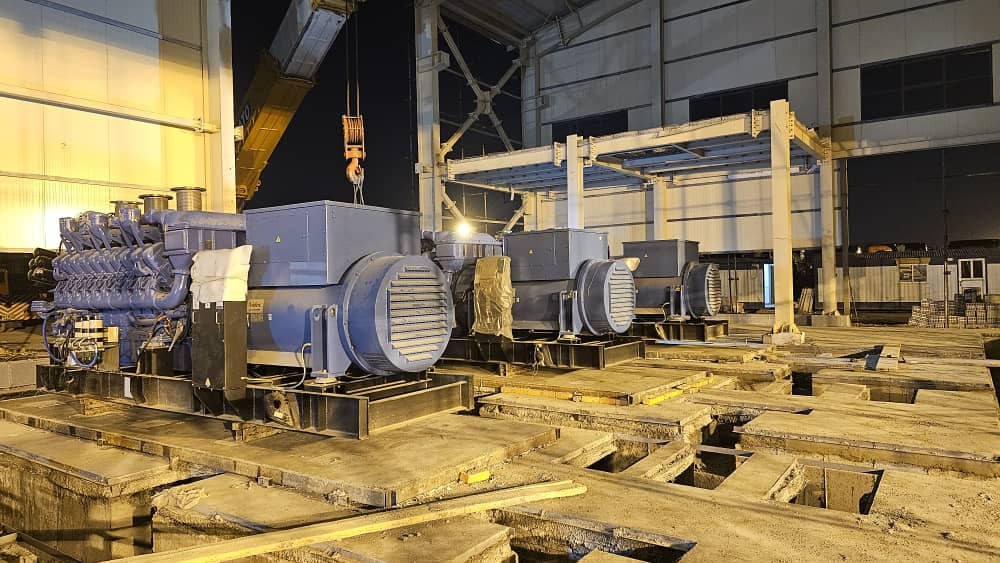 MPMC 15 MW power station installation, MTU-powered — a multi-unit utility-scale reference configuration.
A Documented 18 MW Biodiesel Power Plant
MPMC's 18 MW biodiesel power project in Indonesia is a directly documented utility-scale reference: 18 containerised units of 1 MW each (1,200 kW prime / 1,000 kW continuous), powered by Cummins KTA50-GS8 engines and Leroy-Somer LSA50.2 L8 alternators, running on Biodiesel B35, delivered on a full design, manufacturing, testing and commissioning scope. MPMC states this configuration lowers lifecycle CO₂ emissions by up to 85% compared to petroleum diesel and complies with RED II and RFS renewable-fuel standards, while the project's documented outcome cites rapid deployment on arrival and stable continuous operation in a tropical environment. MPMC's separate Indonesian island power station project, at 21.6 MW and also run on biofuel with Cummins KTA50-GS8 engines, demonstrates the same continuous-duty biofuel platform applied at an even larger scale.
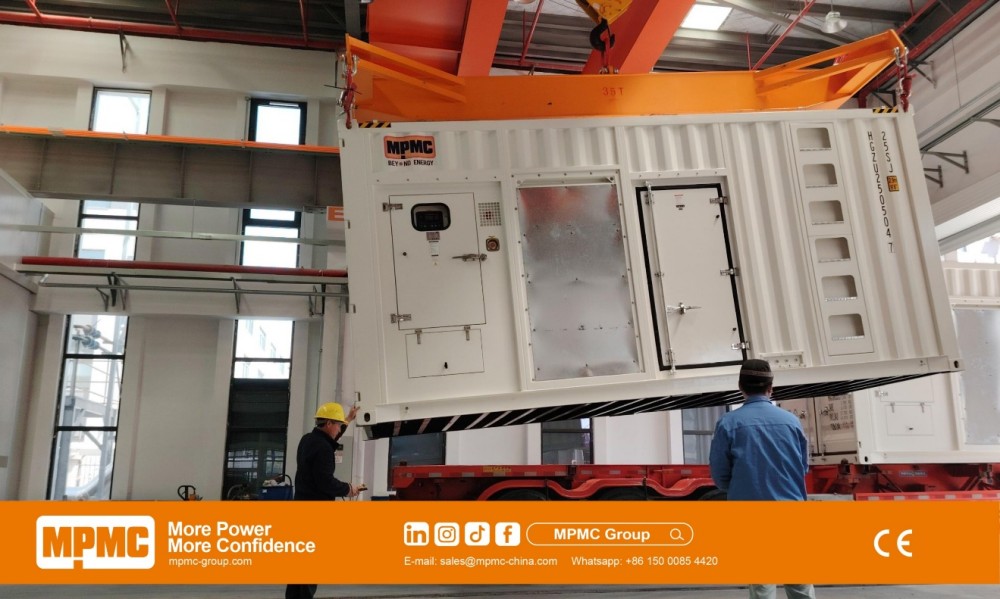 Part of MPMC's 18 MW biodiesel containerised power plant in Indonesia — 18 units of 1 MW each, Cummins-powered, running on Biodiesel B35.
An Authority Reference Worth Knowing About
MPMC serves as the Chinese National Standards developer for Mobile Hybrid Power Stations, a role that sits behind the same hybrid diesel-battery architecture used in its microgrid and island projects. Combined with MPMC's status as the largest generator-OEM by volume for Perkins and Stamford in recent years, and among the top three for DCEC and Kubota, this gives a utility buyer a way to check a supplier's standing beyond its own marketing material before committing to a multi-year, multi-unit order at this scale.
Black-Start and Grid-Forming Where the Grid Cannot Help
A utility power station serving an island or remote community frequently has no external grid to lean on during a restart, which makes independent black-start capability a design requirement rather than a convenience. MPMC's HBD-A Series BESS supports Virtual Synchronous Generator (VSG) mode, black start, grid-forming, and PQ/VF control modes when paired with the genset array, allowing the plant to re-establish a stable local network after an outage without external support. This architecture is demonstrated in MPMC's Kenya microgrid project, built from four sites each combining more than 1 MW of PV, at least 1 MWh of DC-coupled battery storage, and 2×500 kW plus 2×250 kW diesel generator sets as backup, with MPMC's self-developed EMS handling weather-driven dispatch to keep diesel runtime to a minimum while maintaining continuous 24/7 supply.
The Kenya microgrid architecture also illustrates why the diesel and battery layers are specified as one system rather than two separate purchases: MPMC's self-developed EMS uses weather forecasting to decide, site by site, when solar generation alone can cover the load, when the battery should discharge, and when a diesel unit needs to start, rather than leaving that decision to a fixed schedule. For a utility planning a similar remote deployment, this dispatch logic is arguably as important to evaluate as the generator set hardware itself, since it determines how much of the rated diesel capacity actually gets used over the life of the project.
High-Voltage Output for Grid Interconnection
Where a utility project needs to interconnect with an existing distribution network rather than serve an isolated load, MPMC's HV-capable containerised models can deliver output directly at 10–11 kV, reducing the step-up transformer capacity an interconnection agreement would otherwise require and simplifying the point of common coupling design. This is worth raising with a supplier at the tender stage, since not every containerised platform at utility scale offers a factory-built HV option as standard.
Matching the Configuration to the Grid Role
A utility power station's specification should follow directly from the role it plays in the wider grid, whether that is a fully isolated island supply, a remote community microgrid, or a grid-interconnected support asset. The following points are worth confirming before a large utility order is finalised.
• Confirm whether the site is fully off-grid, a hybrid microgrid, or grid-interconnected, since each role calls for a different control and redundancy architecture
• Ask which multi-engine configuration (single, dual or four-engine) best matches the required capacity and future expansion plan
• Request documented fuel-type compliance evidence (such as RED II/RFS) if the project has a renewable-fuel or emissions-reduction requirement
• Confirm whether black-start and grid-forming capability is required, and whether a BESS pairing is needed to deliver it
• Ask whether an HV output option is available if the project will interconnect with an existing distribution network
• Request references from comparable island, remote-community or grid-support projects at a similar total capacity


Recent Posts


Contact US
Product Information
Quantity
Unit
Piece
Support order samples, customization, wholesale direct, and complete payment. If the product you look for does not have corresponding customized content, pls fill out the form below to contact us, and we will reply ASAP.