-
No.2449 Jinhai Rd., Pudong, Shanghai
English
 Português



Power Station Generator Sets With Remote Monitoring and Intelligent Control
Oct 26, 2026
MPMC POWERTECH CORP., established in 2008 and headquartered in Shanghai Pudong, pairs its containerized generator sets with a self-developed SCADA and EMS platform so that a power station operator can see and control every unit on site without a technician standing at each container. For continuous power stations, remote monitoring is not a convenience feature — it determines how many people a project needs to keep on staff, how quickly a fault is caught, and how confidently an operator can run a site unattended overnight. This article covers the generator platform behind MPMC power stations, what the SCADA/EMS layer actually monitors and controls, and a documented multi-site project built on that architecture.
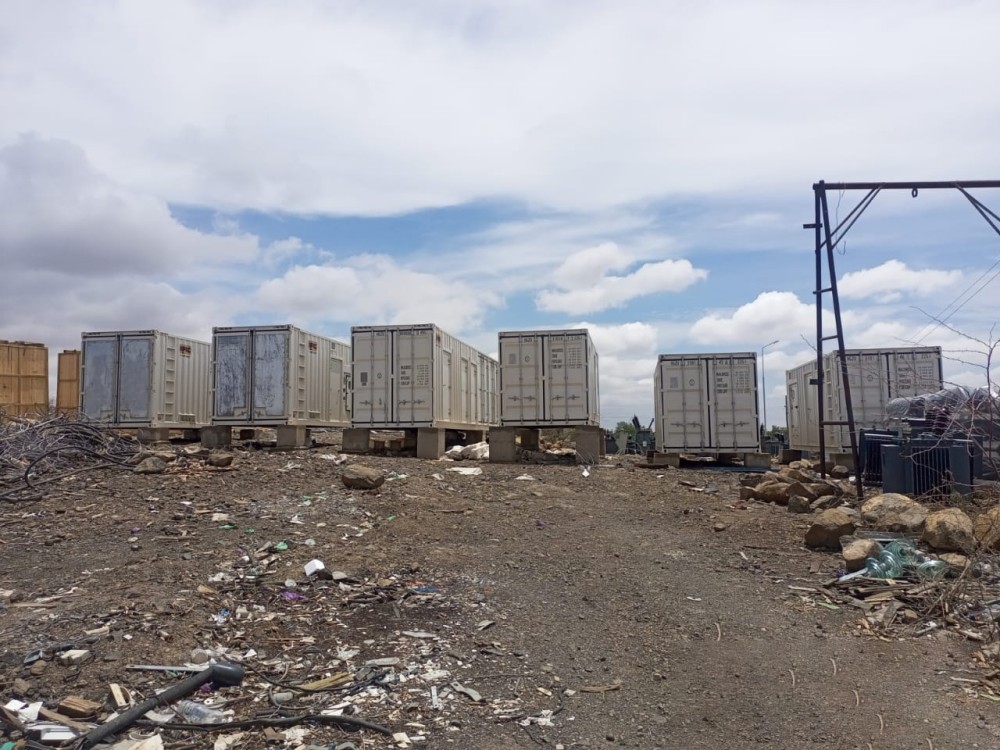 MPMC 3.9 MW Cummins-powered generator set configured for continuous power station operation
The Generator Platform Behind MPMC Power Stations
MPMC's containerized diesel and gas generator sets — powered by Cummins, Perkins, MTU, Baudouin or Scania engines paired with Stamford or Leroy-Somer alternators — form the generation backbone for continuous power stations. The platform covers single-engine configurations from 800 kVA to 3,750 kVA, dual-engine configurations from 1,250 kVA to 3,000 kVA, and four-engine configurations at 1,600 kVA, all rated for operation up to 50°C ambient with copper radiators and enclosures built to ISO 12944 C4/C5 anti-corrosion standards. Multi-unit parallel operation with intelligent load sharing, managed through DSE or DEIF AGC controllers, gives the plant N+X redundancy with master-standby rotation rather than a single point of failure. This is the same engine and control foundation used across MPMC's mining, island and data center power station projects, which means the remote monitoring layer described below does not need to be re-engineered for each application — it sits on top of a common generation platform.
Self-Developed SCADA and EMS: What Remote Monitoring Actually Covers
MPMC's EMS dynamically optimises the energy mix using multi-source data and weather forecasting where solar or storage is present, with core objectives of maximising generation efficiency, minimising diesel runtime, and maximising storage response flexibility. The EMS interfaces with MPMC's self-developed SCADA platform for automated dispatch, real-time monitoring, alarm management and remote control, all accessible via APP or web interface over 4G, 5G or WiFi. For genuinely remote sites, Starlink satellite communication provides a backup link so monitoring does not depend on local cellular coverage, and the platform is built to an SL3 cybersecurity framework with ten-year data retention.
| SCADA / EMS Function | Capability |
|---|---|
|
Monitoring |
Real-time remote monitoring and control across all sites |
|
Communication |
4G / 5G / WiFi with Starlink satellite backup |
|
Control modes |
PQ, VF, VSG (virtual synchronous generator), black start, grid-forming |
|
Data retention |
10-year historical data retention |
|
Security |
SL3 cybersecurity framework |
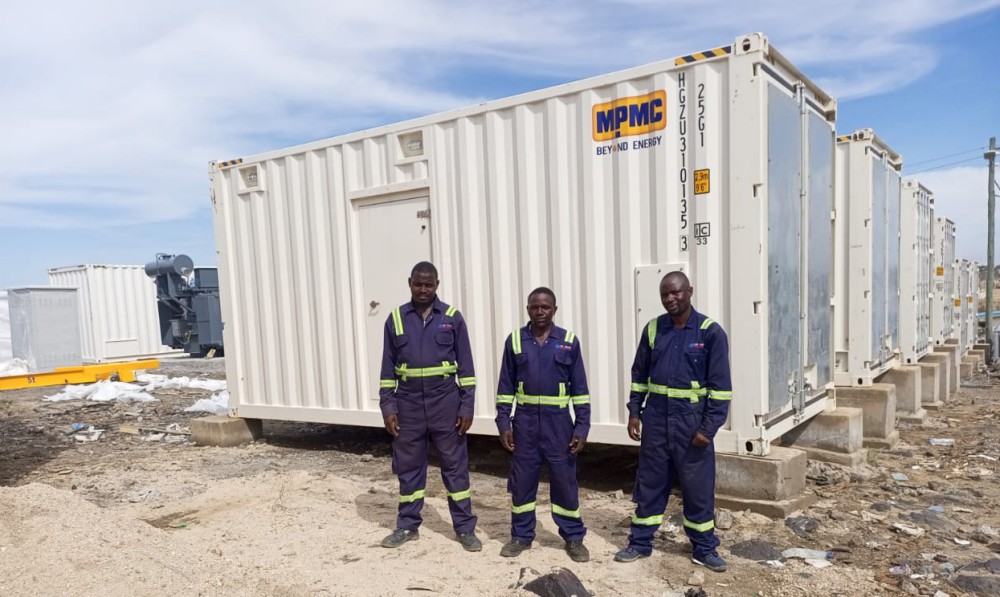 MPMC's 3.9 MW Cummins power-station generator installation
Case Reference: A 6 MW Microgrid Built on Weather-Driven Dispatch
MPMC's Kenya 6 MW microgrid project — four sites, each with more than 1 MW of solar PV, at least 1 MWh of DC-coupled battery storage at 80% depth of discharge over 6,000 cycles, and 2×500 kW plus 2×250 kW diesel genset backup — demonstrates this architecture at scale. The EMS runs weather-driven dispatch across all four sites, keeping diesel runtime to a minimum while maintaining stable 24/7 power, with the whole microgrid visible from a single monitoring interface rather than four separate site reports.
Where Remote Monitoring Changes the Maintenance Model
Integrated SCADA and EMS reduce labour costs through automated, intelligent energy management rather than manual round-the-clock attendance. For a power station operator, this typically means a smaller resident crew supplemented by remote technical support and diagnostics delivered through the SCADA/EMS cloud platform, with site visits scheduled around alarms and scheduled maintenance rather than routine walk-throughs of every container. Open protocols such as ESS Link keep the platform compatible with an operator's existing battery management or microgrid management systems, so adopting MPMC's SCADA does not necessarily mean replacing other monitoring tools already in use across a wider site.
Alarm handling is a practical example of what this changes day to day: instead of a fault being discovered on the next scheduled site visit, an out-of-range parameter — coolant temperature, fuel level, battery state of charge — triggers a remote alert that a technician can triage before deciding whether a site visit is actually required. Over a multi-unit power station, that shift from scheduled inspection to alarm-driven response is usually where the labour saving actually shows up.
Where MPMC Sits Against Other Power Station Suppliers
Among domestic brands, AGG (Fujian) and POWERLINK (Shanghai) are established competitors — AGG on distributor relationships and Scania engine availability, POWERLINK on a reputation for stable quality built primarily in the Australian market. Neither currently offers the same depth of native SCADA/EMS integration across genset and battery product lines that MPMC does. Against international competitors such as Himoinsa (Spain), which supplies both gensets and hybrid BESS but relies on third-party Victron controllers and Pylontech battery packs, MPMC's advantage is that the genset array and any HBD Series battery storage share one SCADA system from a single supplier — reducing the integration complexity a power station operator would otherwise carry.
| Dimension | Domestic (AGG / POWERLINK) | International (Himoinsa) | MPMC |
|---|---|---|---|
|
BESS integration |
Not standard on genset line |
Third-party sourced controllers |
Same SCADA/EMS as gensets |
|
Communication backup |
Cellular only, typically |
Cellular only, typically |
4G/5G/WiFi + Starlink |
|
Project scale documented |
Australia-focused |
Europe/N. America primary |
120+ countries, up to 33.5 MW single project |
Checklist: Evaluating Remote Monitoring for a Power Station Genset
• Confirm whether SCADA and EMS are self-developed by the supplier or sourced from a third party
• Ask which communication channels are supported and whether a satellite backup exists
• Check which control modes (PQ, VF, VSG, black start, grid-forming) the platform supports
• Confirm historical data retention period for compliance or troubleshooting purposes
• Ask what cybersecurity framework governs the remote access layer
• Verify whether genset and battery storage share one monitoring platform or two separate ones
• Request a reference project of similar scale with documented multi-site dispatch
• Confirm what remote diagnostics support is included versus billed separately
Questions Power Station Operators Ask
Yes. MPMC's Kenya 6 MW project runs four separate sites under weather-driven EMS dispatch, visible from a single monitoring interface, which is the same architecture applied to single-site power stations at larger scale.
MPMC's SCADA/EMS platform supports Starlink satellite communication as a backup link, so monitoring continuity does not depend solely on local 4G or 5G coverage.
Integrated SCADA and EMS are designed to minimise labour costs through automated energy management, typically supporting a smaller resident crew backed by remote technical diagnostics rather than continuous manual monitoring.
When paired with MPMC's HBD-A Series battery storage, the system supports black start capability and virtual synchronous generator (VSG) mode, allowing the plant to re-energise without an external reference source.
Suppliers such as Himoinsa integrate hybrid products using third-party Victron controllers and Pylontech battery packs, which relies on compatibility between separately sourced components. MPMC's genset and battery storage share the same self-developed SCADA/EMS platform, which reduces the integration risk of combining equipment from different vendors and gives a single point of contact for support across the whole monitored system.
For a power station buyer weighing that difference in practice, the question worth asking a shortlisted supplier is not simply whether remote monitoring exists, but who wrote the software behind it and how many separate vendors are involved if a fault spans both the generator controller and the battery management system — because that is usually where response time is lost.
Recent Posts



Contact US
Product Information
Quantity
Unit
Piece
Support order samples, customization, wholesale direct, and complete payment. If the product you look for does not have corresponding customized content, pls fill out the form below to contact us, and we will reply ASAP.