-
No.2449 Jinhai Rd., Pudong, Shanghai
English
 Português



Choosing Generator Sets for Island Power Stations That Need Stable Frequency and Continuous Supply
Oct 26, 2026
MPMC POWERTECH CORP., established in 2008 and headquartered in Shanghai Pudong, designs its containerized generator sets for island and remote power stations around a different set of priorities than temporary or backup power. An island grid has no neighbouring utility to fall back on, so the generation plant itself has to deliver continuous high availability, multi-unit redundancy, and the ability to black-start independently after a full shutdown. This article covers the multi-engine configurations MPMC uses for island-scale capacity, two documented biofuel projects in Indonesia, and where high-voltage output and battery storage fit into a frequency-stable island power plan.
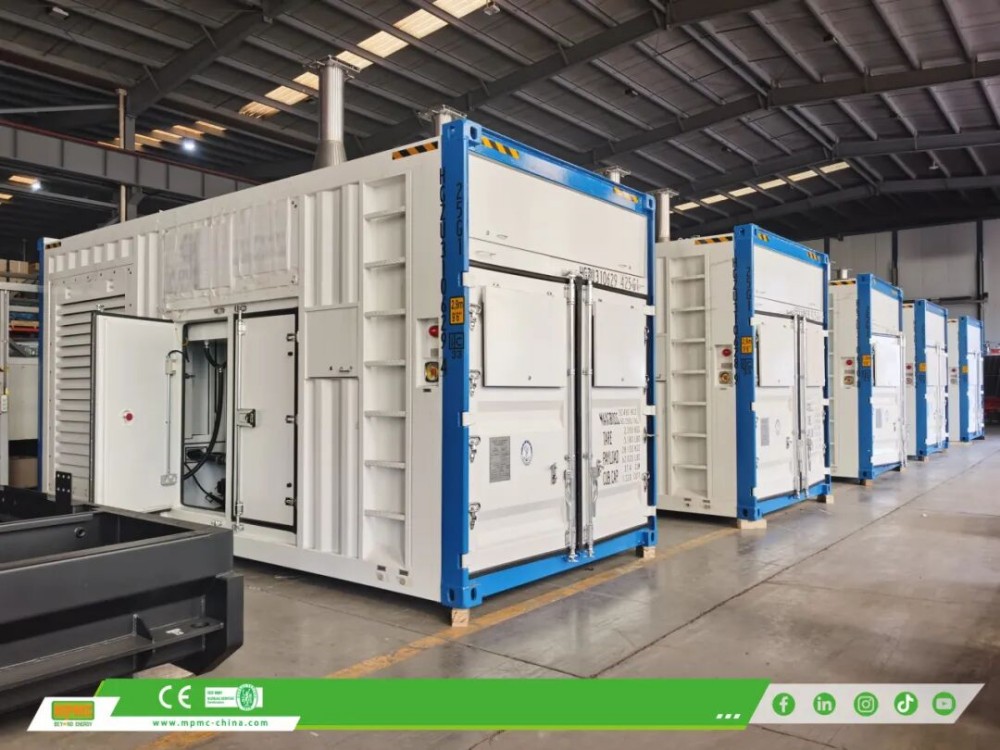 MPMC super-silent containerized generator sets configured for multi-unit continuous power supply
Why Island Power Stations Need a Different Design Philosophy
Island plants, remote communities and long-term off-grid industrial facilities are judged on continuous high-availability generation rather than occasional backup duty. That changes the design brief: instead of a single large unit sized for peak load, an island power station is typically built from several smaller or mid-sized units running in parallel, so that any one unit can be taken offline for maintenance without interrupting supply, and so the plant can restart from a dead grid without an external reference source to synchronise against. Fuel logistics add a further constraint specific to islands: delivery is often infrequent and weather-dependent, which is one reason biofuel and biodiesel blends sourced closer to the region — rather than imported petroleum diesel on a fixed shipping schedule — have become a practical option on several of MPMC's island projects.
Multi-Engine Configurations for Island-Scale Capacity
MPMC's containerized platform — powered by Cummins, Perkins, MTU, Baudouin or Scania engines with Stamford or Leroy-Somer alternators — supports single-engine configurations from 800 kVA to 3,750 kVA, dual-engine configurations from 1,250 kVA to 3,000 kVA, and four-engine configurations at 1,600 kVA. Multi-unit parallel operation with intelligent load sharing through DSE or DEIF AGC controllers delivers N+X redundancy with master-standby rotation, so the plant carries no single point of failure. All models are rated for operation up to 50°C ambient with copper radiators, and enclosures are built to ISO 12944 C4/C5 anti-corrosion standards for coastal and tropical exposure — a requirement most island sites cannot avoid.
| Project | Capacity / Configuration | Fuel |
|---|---|---|
|
Case 1 — Island Power Station, Indonesia |
21.6 MW; Cummins KTA50-GS8, Leroy-Somer LSA50.2 L8 |
Biodiesel, zero fossil fuel dependency |
|
Case 2 — Biodiesel Power Project, Indonesia |
18 MW (18 × 1 MW containerized units); 1,200 kW prime |
Biodiesel B35 |
Two Biofuel Power Projects Delivered in Indonesia
MPMC's 21.6 MW island power station project in Indonesia runs entirely on biodiesel, powered by Cummins KTA50-GS8 engines with Leroy-Somer LSA50.2 L8 alternators, achieving zero fossil fuel dependency on a fully renewable-sourced fuel. A second Indonesian project delivered 18 MW of capacity across eighteen containerized 1 MW units on the same engine and alternator combination, running on biodiesel B35 and covering design, manufacturing, testing and commissioning as a single scope. Compared with petroleum diesel, this biofuel approach lowers lifecycle CO2 by up to 85% and complies with RED II and RFS renewable fuel standards, with the project outcome documented as rapid deployment on arrival and stable continuous operation in a tropical environment.
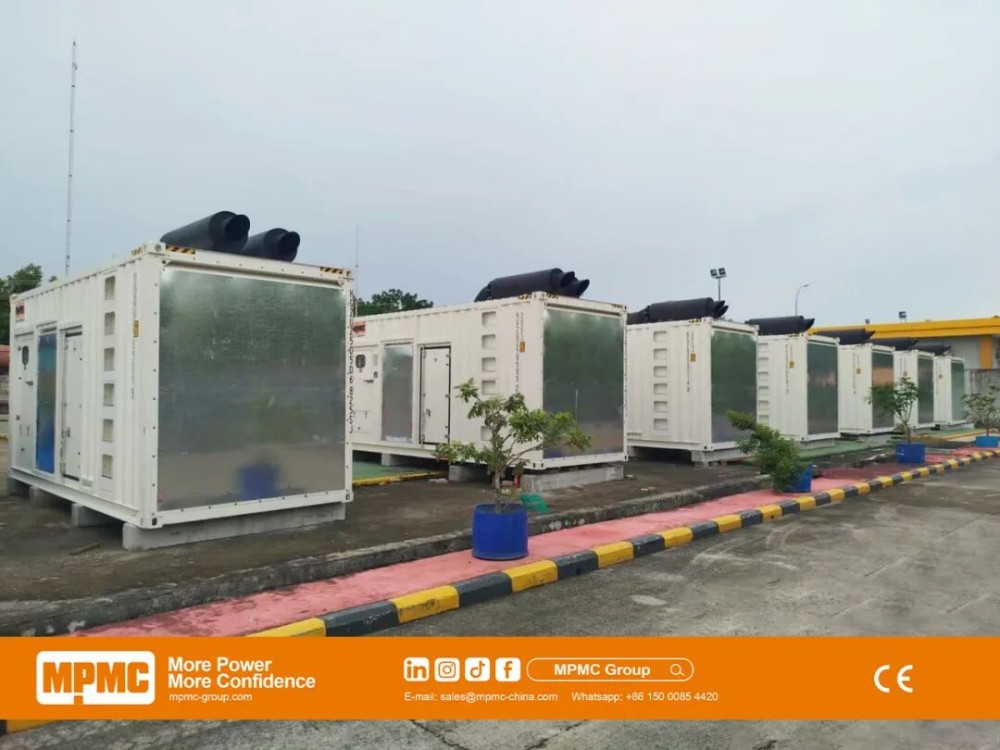 Multiple MPMC containerized generator sets deployed in parallel for continuous island power supply
Why Some Island Grids Specify 11 kV Output Directly
For island industrial zones or large factories with long internal cable runs, MPMC's MCLS2000H(S)-1 delivers 2,000 kVA prime power at 11,000 V / 50 Hz, powered by a Cummins QSK50-G17 engine with a Leroy-Somer LSA 53.2 VL7 alternator. Direct high-voltage distribution reduces transmission losses over extended island or remote campus layouts compared with stepping up from a low-voltage output at the generator terminals, which matters more on an island grid where every percentage point of line loss has no upstream utility to absorb it.
Adding Battery Storage for Frequency Stability
MPMC's HBD-A Series BESS (125 kW–1,125 kW AC output, 261 kWh–2,170 kWh capacity, liquid-cooled LFP cells) can integrate with the genset array as a power buffer, enabling virtual synchronous generator (VSG) mode, black-start capability, grid-forming operation, and both PQ and VF control modes. On an island grid, this buffering absorbs the frequency swings that a diesel-only system would otherwise pass straight through to connected loads, and the EMS/SCADA layer supports real-time remote monitoring with Starlink satellite backup — a meaningful advantage where on-site staffing is limited.
| HBD-A Parameter | Range | Notes |
|---|---|---|
|
AC output |
125 kW – 1,125 kW |
Supports VSG, black start, grid-forming |
|
Capacity |
261 kWh – 2,170 kWh |
LFP 314Ah cells, 8,000 cycles @90% DOD |
|
Warranty |
5-year system / 10-year battery performance |
EOL capacity retention ≥70% |
Where MPMC Sits Against Other Island Power Suppliers
MPMC's documented island and off-grid reference base — including the two Indonesian biofuel projects above and the Kenya 6 MW microgrid — gives buyers a level of scale evidence that smaller regional suppliers rarely have on file. Domestic competitors such as AGG and POWERLINK compete credibly on price and regional reputation, while international names such as Pramac and Generac bring brand recognition but limited multi-fuel flexibility on a single containerized platform. MPMC's combination of diesel, biofuel and methanol fuel options, paired with in-house BESS integration, addresses island procurement teams that want one supplier accountable for the whole generation-plus-storage system.
That single-supplier accountability matters most during commissioning, when a plant built from generators, battery storage and remote monitoring sourced from three different vendors can leave a project team unclear on who is responsible when the system as a whole underperforms, even though every individual component passed its own factory test.
Checklist: Specifying Generator Sets for an Island Power Station
• Confirm the multi-engine configuration (single, dual or four-engine) needed for the site's total capacity
• Verify anti-corrosion coating grade against the island's coastal salt exposure
• Ask whether biofuel or biodiesel blends are supported if renewable fuel targets apply
• Confirm whether high-voltage output (11 kV) is available for long internal cable runs
• Check black-start capability if the plant may need to restart without an external reference
• Confirm N+X redundancy design and master-standby rotation logic with the control system supplier
• Ask about remote monitoring communication options, including satellite backup, for limited-staffing sites
• Request documented reference projects of comparable scale and fuel type
Questions Remote Grid Operators Ask
Yes. MPMC's 21.6 MW Indonesian island power station and 18 MW biodiesel project both run on biodiesel (B35 in the second case), lowering lifecycle CO2 by up to 85% compared with petroleum diesel while meeting RED II and RFS standards.
High-voltage output reduces transmission losses over long internal cable runs, which matters more on an island grid or large industrial zone where distribution distances are greater and there is no upstream utility to compensate for line losses.
MPMC's HBD-A battery storage can operate in virtual synchronous generator (VSG) and grid-forming modes, buffering frequency swings and supporting black start, so the plant does not depend on an external grid reference to stabilise frequency.
It depends on total capacity and redundancy requirements, but MPMC's platform supports single-engine units up to 3,750 kVA, dual-engine configurations up to 3,000 kVA, and four-engine configurations at 1,600 kVA, allowing the plant to be built from multiple smaller units for N+X redundancy rather than one oversized unit.
Yes. MPMC's SCADA/EMS platform supports Starlink satellite communication as a backup link, so remote monitoring continuity does not depend solely on local cellular network availability.


Recent Posts

October 26, 2016
The Most Successful Engineering Contractor

Contact US
Product Information
Quantity
Unit
Piece
Support order samples, customization, wholesale direct, and complete payment. If the product you look for does not have corresponding customized content, pls fill out the form below to contact us, and we will reply ASAP.