-
No.2449 Jinhai Rd., Pudong, Shanghai
English
 Português


.png?x-oss-process=image/resize,w_240/quality,q_100)


.webp?x-oss-process=image/resize,w_240/quality,q_100)

.webp?x-oss-process=image/resize,w_240/quality,q_100)


.jpg?x-oss-process=image/resize,w_240/quality,q_100)


.webp?x-oss-process=image/resize,w_240/quality,q_100)


Finding a High-Power Genset Supplier With ISO 9001, CE, and Independent Inspection Support
Oct 14, 2026
ISO 9001, CE marking, and third-party inspection cover three different layers of assurance, and a buyer should understand what each one actually verifies before treating them as interchangeable checkboxes on a supplier questionnaire: ISO 9001 certifies the manufacturer's quality management process, CE marking certifies the product's conformity with European technical requirements, and third-party inspection verifies a specific unit or order against the buyer's own specification before it ships.
What Each Credential Actually Confirms
MPMC holds ISO 9001:2015 at the company level, covering the quality management system across its manufacturing entities, alongside ISO 45001 for occupational health and safety and ISO 14001 for environmental management. CE conformity applies at the product level for containerised and silent-type units sold into European and CE-recognising markets. Independent verification bodies including TUV and SGS provide third-party technical and safety checks distinct from MPMC's own in-house CNAS-accredited testing — the combination a high-power buyer should look for is company-level process certification, product-level conformity marking, and an independent body's separate verification, not any one of the three alone.
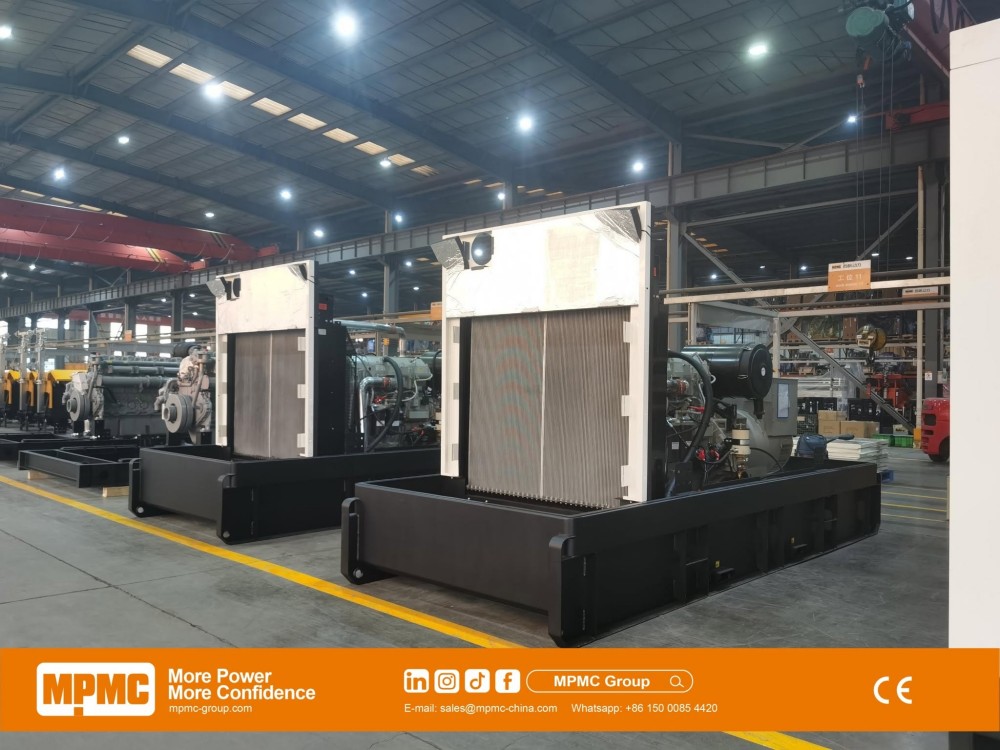 MPMC's Haimen, Jiangsu production base, where CNAS-accredited testing and independent inspection are carried out on high-power generator sets.
| Credential | What It Verifies | Practical Use for a Buyer |
|---|---|---|
|
ISO 9001:2015 |
Company-wide quality management system |
Confirms consistent manufacturing process, not a single unit's condition |
|
ISO 45001 / ISO 14001 |
Occupational safety and environmental management |
Relevant to corporate and ESG due-diligence requirements |
|
CE marking |
Product conformity with European technical directives |
Required for import into CE-recognising markets |
|
CNAS-accredited testing centre |
Independently accredited in-house testing standard |
Basis for MPMC's published load-test and noise data |
|
TUV / SGS third-party verification |
Independent technical and safety inspection |
Confirms conformity from a body with no manufacturing interest |
|
UN38.3, SABER, BV, SONCAP, and similar |
Destination-market-specific product conformity |
Confirms import eligibility for that specific country |
How Third-Party Inspection Fits Into a High-Power Order
For a high-power order, a buyer can typically arrange an independent pre-shipment inspection through a body such as SGS, TUV, or Bureau Veritas, carried out at MPMC's factory against the buyer's own purchase specification before the unit is released for shipment — a separate step from MPMC's own factory load testing at 0%, 25%, 50%, 75%, 100%, and 110% of rated output inside its CNAS-certified test room. Requesting this inspection explicitly, and specifying which inspection body the buyer prefers, is the practical way to add an independent verification layer on top of MPMC's own certification base.
 MPMC containerised generator set prepared for factory testing and inspection ahead of a high-power project delivery.
Full-Load Testing as the Foundation Beneath the Certifications
Every certification and inspection ultimately references the same underlying manufacturing process: laser cutting to a zero-burr standard, NDT magnetic particle flaw detection on every chassis, C3-C5 anti-corrosion coating with 500-700 hours of salt spray testing, and full-load testing across the complete 0-110% range in a constant-temperature room simulating 40°C and 50°C ambient. A buyer requesting third-party inspection should ask specifically for visibility into this load-test data alongside the inspection report, since the certifications confirm the process exists but the test record confirms it was actually applied to their specific order.
Where MPMC Sits Against Other High-Power Suppliers on Certification
Some Chinese manufacturers hold ISO and CE certification at a general level without offering the same depth of in-house CNAS-accredited testing or a documented full-load test protocol, which leaves a gap between what the certification confirms and what a buyer can actually verify unit by unit. MPMC's combination of company-level ISO certification, product-level CE and destination-market marks, an accredited in-house test facility, and openness to independent third-party inspection gives a high-power buyer a fuller verification chain to check against.
Questions to Ask About Certification and Inspection Support
• Confirm which ISO certifications apply at the company level versus which marks apply to your specific product
• Ask whether third-party pre-shipment inspection (SGS, TUV, BV) can be arranged against your own specification
• Request the factory load-test record for your specific unit, not a general certification statement
• Confirm which destination-market certifications (SABER, SONCAP, Customs Union, etc.) apply to your import country
• Ask whether you can nominate your preferred inspection body rather than accepting the manufacturer's default
• Request salt spray and anti-corrosion test data if your site has a demanding coastal or humid environment

Recent Posts



Contact US
Product Information
Quantity
Unit
Piece
Support order samples, customization, wholesale direct, and complete payment. If the product you look for does not have corresponding customized content, pls fill out the form below to contact us, and we will reply ASAP.