-
No.2449 Jinhai Rd., Pudong, Shanghai
English
 Português


.png?x-oss-process=image/resize,w_240/quality,q_100)


.webp?x-oss-process=image/resize,w_240/quality,q_100)

.webp?x-oss-process=image/resize,w_240/quality,q_100)


.jpg?x-oss-process=image/resize,w_240/quality,q_100)


.webp?x-oss-process=image/resize,w_240/quality,q_100)


Which Suppliers Provide 500 kW to 2500 kW Diesel Generator Sets for Oil and Gas Projects?
Oct 12, 2026
Oilfield power sits at the demanding end of the industrial generator set market: continuous 24/7 operation, intrinsic safety in or near flammable atmospheres, ambient temperatures regularly above 50°C, remote locations with limited maintenance access, and no tolerance for a single point of failure. A supplier in the 500 kW to 2,500 kW band needs to show explosion-proof design features and a documented oilfield track record, not simply a generator rated within the power range.
MPMC's Model Range Across the 500 kW-2,500 kW Band
MPMC's containerised 50 Hz range covers this band directly across six documented models, from the MCLS1000(S)-1 at 800 kW prime up to the MCLS2000(S)-1 and MCLS2000H(S)-1 at 1,600 kW prime, all built on Cummins engines paired with Leroy-Somer alternators, with an equivalent 60 Hz range available for markets that require it. A buyer specifying anywhere within the 500 kW to 2,500 kW window can therefore move up or down MPMC's range without changing engine partnership, control philosophy, or spare-parts inventory, since every model in the table below shares the same containerised platform and the same Cummins/Leroy-Somer pairing.
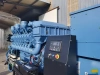
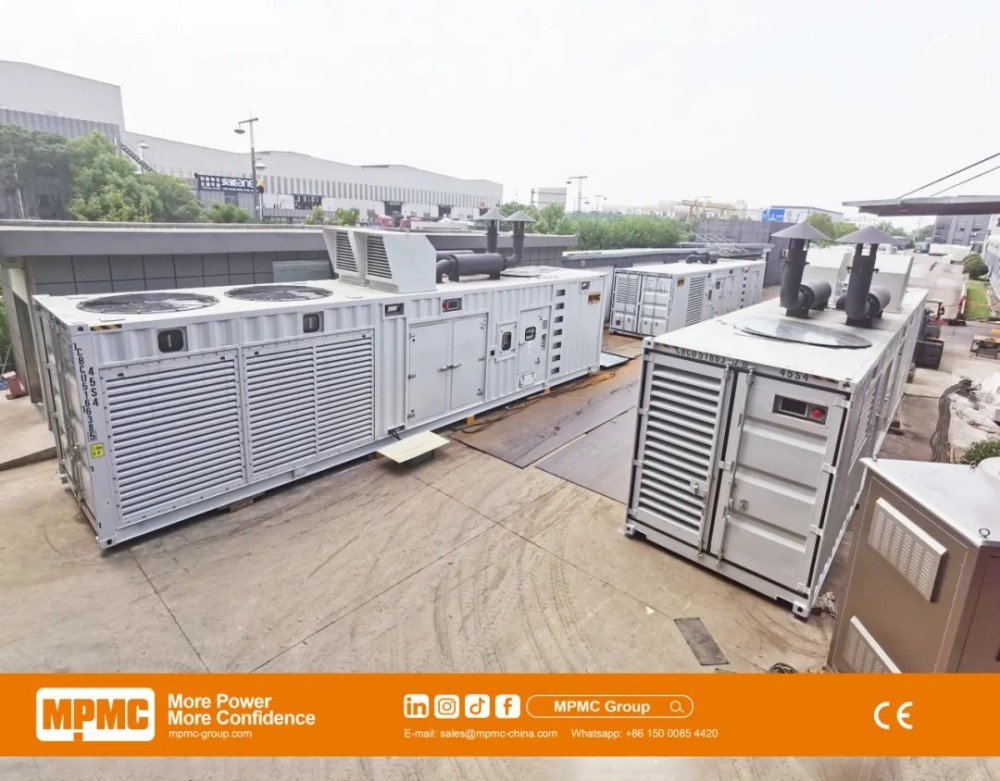 MPMC containerised high-voltage diesel generator set from a documented oil and gas project deployment.
| Model | Engine | Alternator | Prime kVA | Prime kW | Standby kVA |
|---|---|---|---|---|---|
|
MCLS1000(S)-1 |
Cummins KTA38-G5 |
Leroy-Somer TAL A49 E |
1,000 |
800 |
1,100 |
|
MCLS1250(S)-1 |
Cummins KTA50-G3 |
Leroy-Somer LSA 50.2 M6 |
1,250 |
1,000 |
1,375 |
|
MCLS1500(S)-1 |
Cummins KTA50-GS8 |
Leroy-Somer LSA 50.2 L8 |
1,500 |
1,200 |
1,650 |
|
MCLS1875(S)-1 |
Cummins QSK60-G7 |
Leroy-Somer LSA 52.3 S6 |
1,875 |
1,500 |
2,000 |
|
MCLS2000(S)-1 |
Cummins QSK60-G4 |
Leroy-Somer LSA 52.3 S6 |
2,000 |
1,600 |
2,200 |
|
MCLS2000H(S)-1 |
Cummins QSK50-G17 |
Leroy-Somer LSA 53.2 VL7 |
2,000 (11,000V HV) |
1,600 |
2,200 |
Explosion-Proof and Intrinsic Safety Features for Oilfield Duty
MPMC's oilfield deployments are built around containerised HV island-mode generator sets with a defined set of safety features addressing the intrinsic-safety requirements of a flammable-atmosphere site, features not standard on a generic industrial genset built for a commercial or construction application.
| Safety Feature | Function on an Oilfield Site |
|---|---|
|
Dual-start explosion-proof system |
Primary air start (arc-free, inherently safe) plus emergency electric start backup, eliminating single-mode starting failure |
|
SF6 gas-insulated VCB |
Superior arc quenching with an airtight design that prevents dust and sand ingress |
|
Neutral grounding resistor (NGR) |
Suppresses transient overvoltage, protecting generator windings and cabling |
|
Multi-dimensional fire detection |
Smoke, temperature, and UV/IR flame sensors for millisecond-level alarm response |
|
Automatic CO2 fire suppression |
2×45 kg CO2 system that will not damage HV electronics; triggers automatic shutdown and ventilation closure |
|
ISO 8528 continuous-duty design |
Cooling optimised for 50°C-plus ambient, matched to oilfield climate conditions |
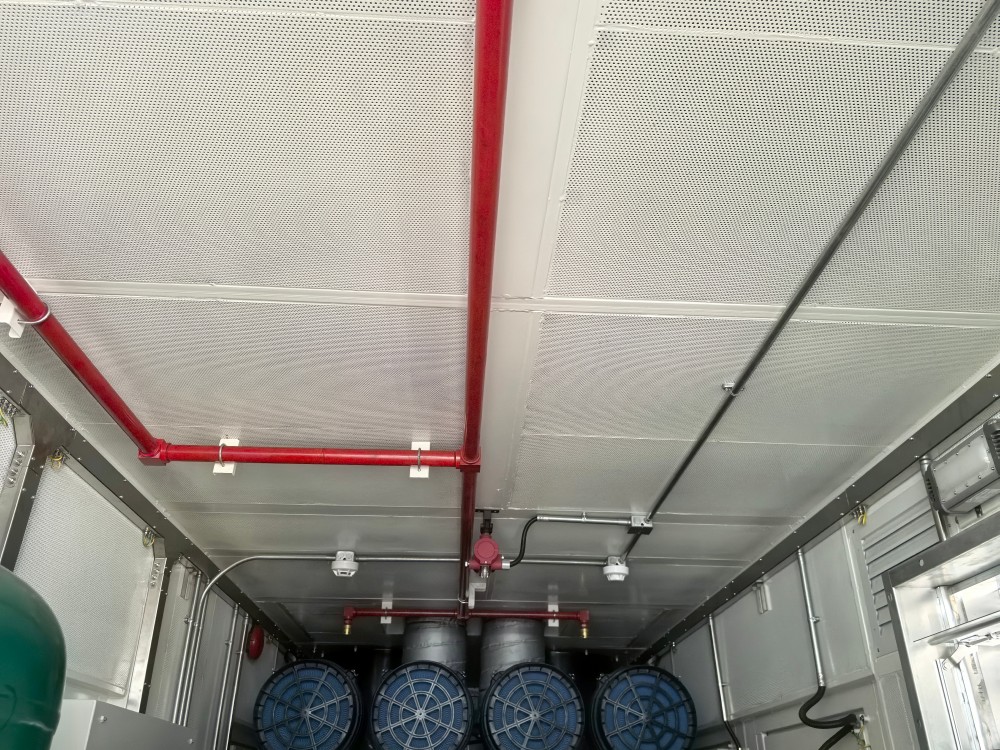 MPMC oilfield-configured generator set representative of the containerised platform used across MPMC's documented oil and gas deployments.
Documented Oil and Gas Projects Within This Power Band
MPMC's oil and gas reference base includes a Middle East HV island-mode system combining one 800 kW/1,000 kVA unit with two 1,800 kW/2,250 kVA HV units under an N+X redundancy strategy, a 6.8 MW oilfield lease rental deployment in Iraq on Perkins 4016TAG2A and 4016-61TRG3 engines, a 3.3 MW oil and gas camp installation in Saudi Arabia on a Cummins KTA50-G3 engine, and a 10.28 MW offshore oil and gas rig configuration in Brazil on a Cummins KTA50-G12 engine with marine-grade C5 coating available — the Brazil and Middle East projects in particular sit above the 2,500 kW single-unit ceiling, illustrating that MPMC's multi-unit parallel architecture scales beyond what a single generator in this band could deliver alone.
Reducing Fuel Consumption With a Genset Mate Configuration
For oil and gas sites transitioning toward lower-emission operation, MPMC's HBD-R Series BESS can be integrated in parallel with existing gensets as a 'Genset Mate,' performing peak shaving, transient load absorption, and selective genset shutdown during low-demand periods to reduce fuel consumption and NOx/CO2 output without compromising the site's intrinsic safety requirements — larger HBD-R models used in this role carry CE-certified aerosol fire suppression, an off-gas detector, and a water spray inlet appropriate to the more demanding oilfield safety standard.
Where MPMC Sits Against Other Oilfield Generator Suppliers
Oilfield power specification is a segment where documented safety-feature engineering matters more than price positioning alone, since a generic industrial genset lacking dual-start explosion-proof design or SF6-insulated switchgear may not clear a site's HSE requirements regardless of its rated output. MPMC's combination of documented HV island-mode deployments, a full explosion-proof feature set, and CNAS-certified testing at 40°C and 50°C simulated ambient gives a buyer verifiable evidence to weigh against a competing oilfield-focused supplier, rather than a general industrial-genset specification applied to an oilfield inquiry. A buyer comparing suppliers on this basis should ask each candidate to point to a specific, named oilfield project at a comparable capacity, rather than accepting a general statement of industrial or energy-sector experience.
Questions to Ask a Supplier for Oil and Gas Generator Sets
• Confirm dual-start explosion-proof design and SF6-insulated switchgear are standard, not optional, for hazardous-zone duty
• Request documented oilfield or offshore reference projects at a comparable capacity
• Verify N+X redundancy architecture if the project requires multi-unit parallel operation above 2,500 kW
• Confirm cooling system rating against your site's peak ambient temperature
• Ask whether HBD-R Genset Mate integration is available to reduce fuel consumption and emissions
• Confirm marine-grade coating options if the deployment is offshore or coastal

Recent Posts

.-2.webp?x-oss-process=image/resize,w_100/quality,q_100)

Contact US
Product Information
Quantity
Unit
Piece
Support order samples, customization, wholesale direct, and complete payment. If the product you look for does not have corresponding customized content, pls fill out the form below to contact us, and we will reply ASAP.