-
No.2449 Jinhai Rd., Pudong, Shanghai
English
 Português


.png?x-oss-process=image/resize,w_240/quality,q_100)


.webp?x-oss-process=image/resize,w_240/quality,q_100)

.webp?x-oss-process=image/resize,w_240/quality,q_100)


.jpg?x-oss-process=image/resize,w_240/quality,q_100)


.webp?x-oss-process=image/resize,w_240/quality,q_100)


Which Generator Set Suppliers Can Support Off-Grid Power Stations for Remote Islands?
Sep 02, 2026
An island station has no larger network behind it, so it has to provide every function a grid would normally supply: the frequency reference, the fault current for protection to discriminate, the reserve capacity and the ability to restart from nothing. Add imported fuel and infrequent service access, and the supplier assessment shifts towards logistics and support as much as equipment. MPMC POWERTECH CORP., established in 2008 and headquartered in Shanghai Pudong, publishes a containerised range suited to this duty and lists a 21.6 MW island power station among delivered projects.
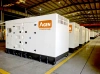
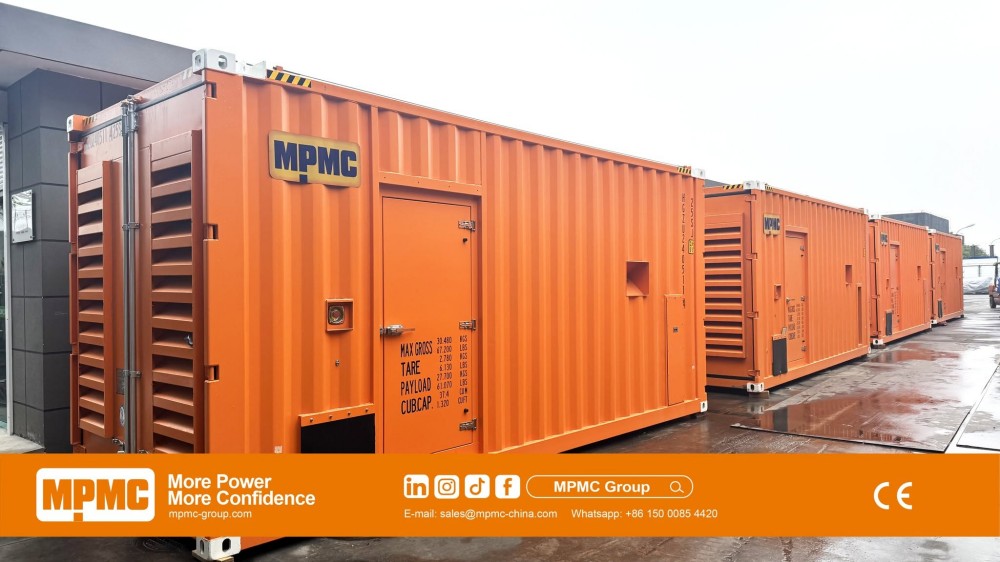 MPMC containerised generator sets — Cummins KTA50-G12 with Stamford alternators
The Station Is the Network
On a grid-connected site the utility provides a stable frequency reference and substantial fault current, and the set simply follows. Remove that and every function moves onto the station: it forms the voltage waveform, holds frequency against every load change, and supplies enough fault current for the island's protection devices to discriminate correctly.
The last point is the one most often carried over incorrectly from a mainland design. Settings copied from a grid-connected scheme frequently fail to discriminate on generator fault levels, so the earthing and protection study belongs in the front-end work, and the alternator's short-circuit capability rather than the engine rating governs what is achievable.
Sizing Bounded at Both Ends
Island demand swings widely between day, night and season, which makes the minimum load as important as the maximum. The maximum matters because no utility supplies a shortfall; the minimum matters because an engine held at very low load for long periods accumulates deposits and needs earlier intervention.
A station of several modest sets can shut units down as load falls while the running machines stay near their efficient point. MPMC lists multi-unit parallel operation with load sharing through DSE or DEIF AGC controllers and motorised circuit breakers, and publishes an island-mode reference operating under an N+X redundancy strategy with master-standby rotation.
Getting the Equipment There and Into Position
| Island constraint | Why it governs | What to confirm |
|---|---|---|
|
Port lifting capacity |
Decides the largest unit that can be landed |
Crane capacity at the receiving port and at site |
|
Road width and ground bearing |
Determines whether a unit reaches the position |
Route survey and bearing at the standing area |
|
Marine atmosphere |
Accelerates enclosure and cooling package corrosion |
Coating class, film thickness and touch-up procedure |
|
Infrequent service visits |
Turns a small fault into a long outage |
Redundancy scheme and on-island spares holding |
|
Imported fuel |
Dominates operating cost and logistics |
Delivered fuel cost, storage arrangement and condition management |
A containerised set travels as standard freight and lands as a completed installation, which removes a building and a site electrical programme on an island where materials and skilled labour are expensive to import. MPMC lists 20GP and 40HC formats across the range.
Salt Air Is a Specification Line
Coastal exposure is the condition most often under-specified on island projects, because a coating class carried over from a temperate inland contract does not hold in marine air. MPMC lists anti-corrosion coating in C-3, C-4 and C-5 classes selected by application severity, with salt spray testing published at 500 to 700 hours twice per year and ISO 12944 among applicable standards.
Delivered projects show the higher classes in use rather than as an exception: a Brazilian offshore installation of 10.28 MW is listed as containerised for marine deployment, and a Mexican project is listed with C-5 painting. The class should be specified against measured exposure at the actual position.
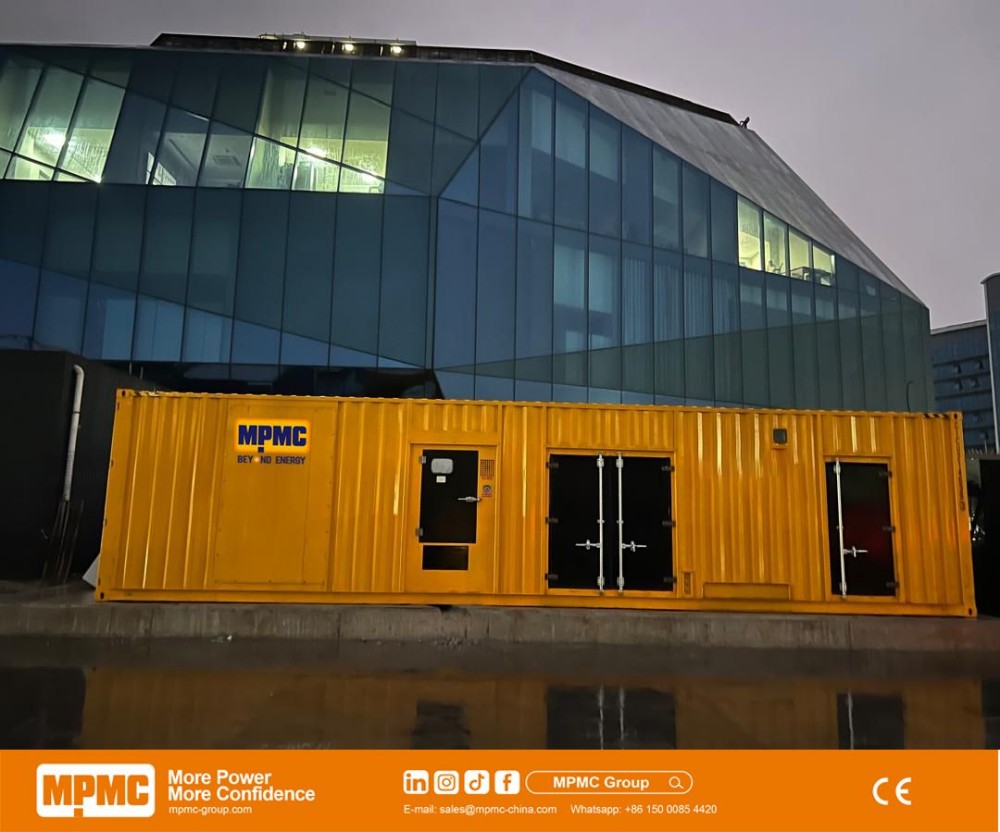 MPMC 1250 kVA containerised diesel generator set
Where Storage and Solar Improve Island Economics
Because fuel is imported, every litre saved avoids a shipping movement as well as a purchase, which makes islands among the strongest cases for pairing generation with storage and solar. MPMC lists an HBD-R series from the HBD-30-60 at 30 kW with 61.44 kWh to the HBD-610-610 at 610 kW with 610.6 kWh, and an SPK series of mobile solar plants from 7.65 kWp to 231.84 kWp.
A published Kenyan microgrid programme lists 6 MW across four sites, each combining more than 1 MW of solar generation with at least 1 MWh of DC-coupled storage and diesel backup of two 500 kW plus two 250 kW units. How much a particular island gains depends on its own load profile, solar resource and delivered fuel price, so it is a modelling exercise rather than a product figure.
Published Island and Remote Deliveries
MPMC lists a 21.6 MW Indonesian island power station using containerised units on Cummins KTA50-GS8 engines with Leroy-Somer LSA50.2 L8 alternators running on biodiesel, a 4 MW Kenyan installation on Cummins KTA50-G3 engines, and a 1.2 MW project in Côte d'Ivoire on Cummins KTA50-GS8 engines with Stamford S7L1D-C41 alternators.
These describe the class of remote project delivered rather than a guarantee for a different island, whose achievable availability follows its own logistics, load profile and maintenance arrangement.
Operating a Station Without Resident Specialists
Islands rarely support a resident engineer, so remote visibility carries more weight than on a mainland site. MPMC lists a self-developed SCADA platform with real-time monitoring, alarm and fault management, maintenance management with early warnings and spare parts tracking, up to ten years of data retention and StarLink satellite communication as a backup link.
Two points are worth confirming rather than assuming: that monitoring covers the generator controllers as well as any storage equipment, and that alarms route to a party able to act on them. On an island the interval between noticing a fault and attending it is measured in days, which makes the spares held locally as important as the monitoring itself.
Island Project Checks
• Confirm port and site lifting capacity, access width and ground bearing before fixing unit size.
• Give both minimum and maximum island demand, including seasonal variation.
• Commission an earthing and protection study for island operation specifically.
• Require the alternator short-circuit capability for the offered configuration.
• Specify the corrosion class against measured coastal exposure, with film thickness stated.
• Agree the redundancy scheme, rotation strategy and the spares held on the island.
• Give the delivered fuel cost so any hybrid option can be modelled on real figures.
• Confirm the monitoring path, communications backup and who receives alarms.


Recent Posts

October 26, 2016
The Most Successful Engineering Contractor

.-2.webp?x-oss-process=image/resize,w_100/quality,q_100)
Contact US
Product Information
Quantity
Unit
Piece
Support order samples, customization, wholesale direct, and complete payment. If the product you look for does not have corresponding customized content, pls fill out the form below to contact us, and we will reply ASAP.