-
No.2449 Jinhai Rd., Pudong, Shanghai
English
 Português


.png?x-oss-process=image/resize,w_240/quality,q_100)


.webp?x-oss-process=image/resize,w_240/quality,q_100)

.webp?x-oss-process=image/resize,w_240/quality,q_100)


.jpg?x-oss-process=image/resize,w_240/quality,q_100)


.webp?x-oss-process=image/resize,w_240/quality,q_100)


500 kW to 2000 kW Generator Sets for Hospitals: Matching the Rating to a Clinical Load
Aug 31, 2026
A hospital generator is judged on an event that may not arrive for a year and then decides whether a theatre list continues. Almost everything that determines the outcome happens while the set is standing still. From a procurement perspective the rating is the easy part of this band; what separates offers is starting reliability, the acoustic position and how the installation behaves during transfer. MPMC POWERTECH CORP., established in 2008 and headquartered in Shanghai Pudong, publishes configurations across 500 kW to 2000 kW and lists hospital critical-load installations in New Zealand and China.
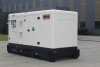
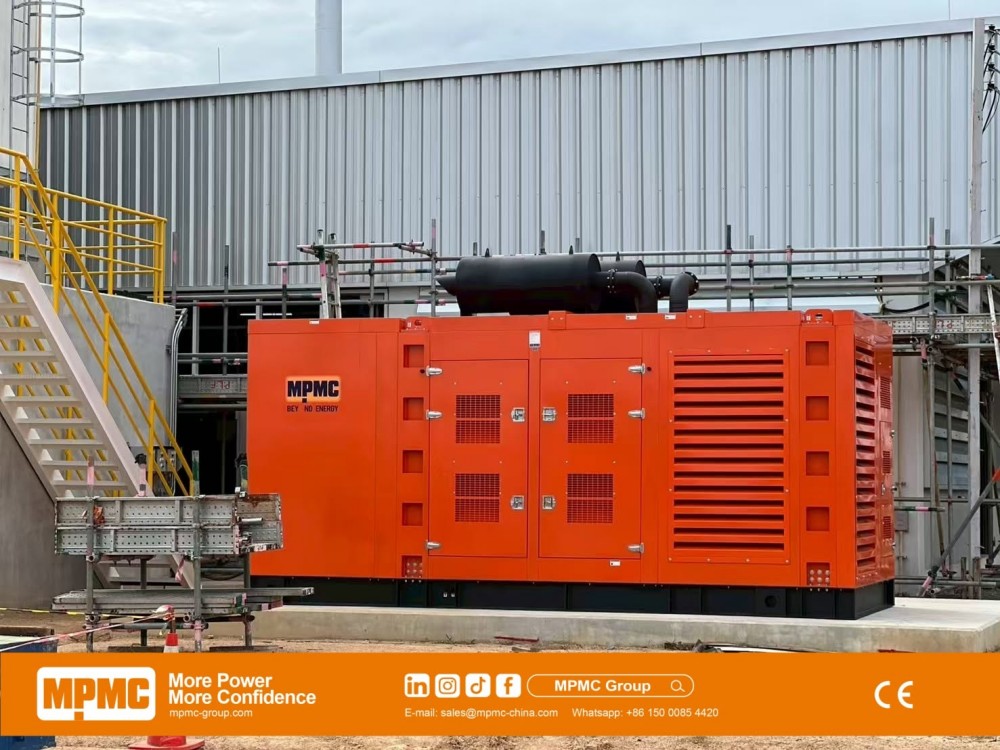 MPMC SR2 Series 1000 kVA silent generator set — Perkins 4008TAG2A with Stamford S6L1D-E4
Converting the Requirement Before Comparing Offers
Sets are rated in both kW and kVA at a standard 0.8 power factor, so a 500 kW to 2000 kW brief corresponds to 625 kVA to 2,500 kVA. A quotation expressed in the other unit against the same brief describes a different machine, so the first clarification on any offer is which unit the figure uses.
Duty follows. Hospital backup is normally standby, which permits limited annual hours and no sustained overload, and standby figures are higher than prime for the same physical machine. MPMC lists ISO 8528-5:2018, GB/T 2820.5-2009 and ISO 3046 among applicable standards, and the rating that belongs in the specification is the one matching the intended duty.
Configurations MPMC Publishes Across the Band
| Route | Published span | Engine platforms listed | Where it fits a hospital |
|---|---|---|---|
|
Silent enclosure (SR2) |
1,000 kVA documented |
Perkins 4008TAG2A with Stamford S6L1D-E4 |
Plant rooms and compounds near wards |
|
Containerised, single engine |
800–3,750 kVA |
Cummins, Perkins, Baudouin, MTU, Scania, SDEC |
Standalone energy centre outside the building |
|
Containerised, twin engine |
1,250–3,000 kVA |
Baudouin, Scania, Perkins |
Redundancy inside one footprint |
|
Documented hospital build |
1,500 kVA × 2 |
Perkins 4012-46TAG2A with Leroy-Somer LSA 50.2 L8 312 |
3 MW critical load served by two units in parallel |
Availability varies by rating and region, so the bill of materials belongs in the technical offer. Where the rating that suits the load sits between frame sizes, the same packager can quote an alternative engine platform at the same enclosure and control specification, which keeps the comparison clean because only the engine changes.
What Makes a Standing Set Start
A backup set proves nothing between tests, and the provisions that address this appear in MPMC's documented projects rather than in headline specifications. A 4 MW New Zealand hospital installation is listed with a Perkins 4016-61TRG3 engine and a Stamford S71D G41 alternator in a 40HC super-silent container, fitted with 2 × 3 kW engine block preheaters and an internal 500 litre fuel tank with an automatic filling device, controlled by DSE8610 with an ABB 3200 A three-pole air circuit breaker.
Each item answers a specific failure mode. Preheating keeps the engine warm so it accepts load promptly rather than after warming through; automatic filling prevents fuel ageing or running low unnoticed; automatic mains failure detection removes the human step from the sequence. A 3 MW New Zealand commercial installation is listed with a 9 kW preheater on the same principle.
Splitting the Duty Across Units
A hospital cannot take its backup out of service to maintain it, which is an argument for dividing the duty. MPMC's documented 3 MW Chinese hospital installation is listed as two 1,500 kVA units in parallel on Perkins 4012-46TAG2A engines with Leroy-Somer LSA 50.2 L8 312 alternators, AREP excitation with an R450 regulator and DSE7320 control, rather than a single machine.
MPMC lists multi-unit parallel operation with load sharing through DSE or DEIF AGC controllers and motorised circuit breakers, supporting N+X redundancy and master-standby rotation. Rotation matters in standby service because a set that has never run is an unproven one, and distributing hours keeps every machine demonstrated.
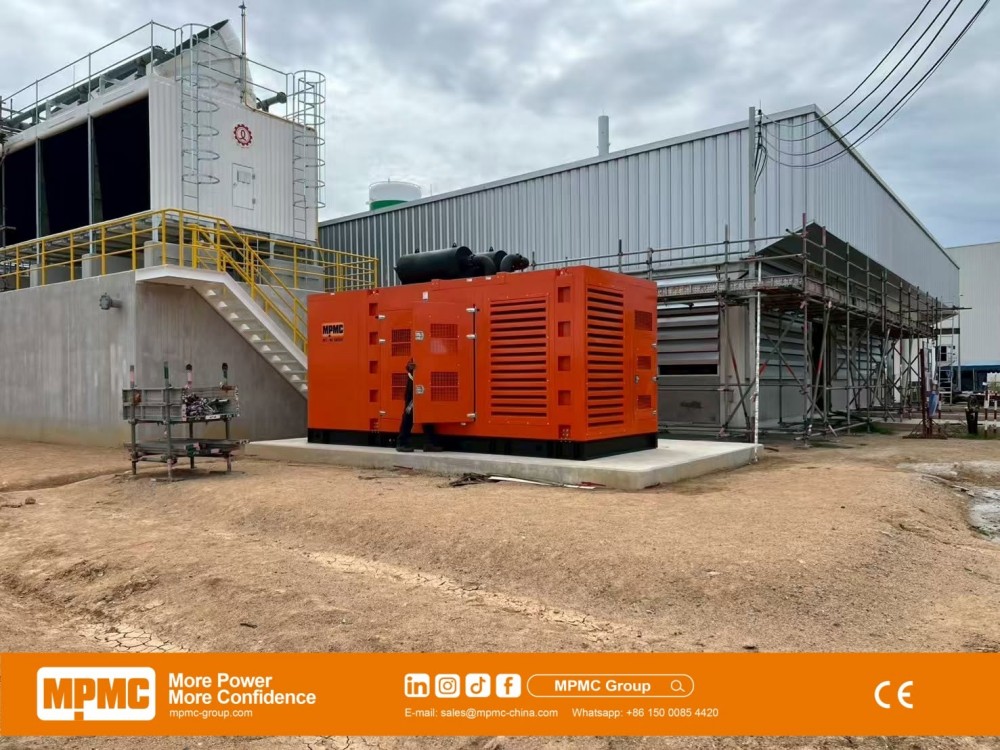 MPMC SR2 Series 1000 kVA silent generator set — Perkins 4008TAG2A with Stamford S6L1D-E4
Load Acceptance on a Clinical Panel
When the transfer completes, the protected load arrives as a block, and it includes lifts, chillers, air handling and imaging equipment whose starting current far exceeds their running load. MPMC lists published steady-state figures of frequency stability at ≤±0.25% at any constant load and rated voltage regulation of ±1%.
Those describe steady-state behaviour and are a separate measurement from transient response. The useful request is the ISO 8528-5 performance class for the offered engine and alternator combination, with the block load stated as a percentage of set rating and the permitted deviation and recovery time defined in the specification.
Acoustic Position Next to Wards
Hospital sites place plant close to occupied space, so the acoustic limit is normally set at a boundary or a ward window rather than at the equipment. MPMC lists an SR2 silent enclosure type, alongside SR, SE and SREU configurations, and containerised super-silent types between 75 and 91 dB(A) at 1 m at 75% load depending on model.
Published project figures use different bases: the 4 MW hospital installation is listed at 85 dB(A) at 1 m at 100% load, while a 3 MW commercial installation is listed at 75 dB(A) at 7 m at 100% load. Those are not directly comparable, so every offer should be restated on one measurement basis, and the derated output requested under the actual enclosure since acoustic treatment restricts airflow.
Fuel, Cooling and the Wider Backup Chain
MPMC lists a maximum ambient operating temperature of 50°C with copper high-temperature radiator options and altitude derating per engine specification, with diesel to ASTM D975 Grade 2D as standard and HVO to EN 15940 supported on selected models.
Generation is one link in the chain. An uninterruptible supply carries sensitive clinical equipment through the first seconds, so the handover point between the two defines the actual protection and should be modelled with the transient behaviour of the offered configuration. Fuel autonomy follows from the required period and consumption at the expected load rather than at full rating.
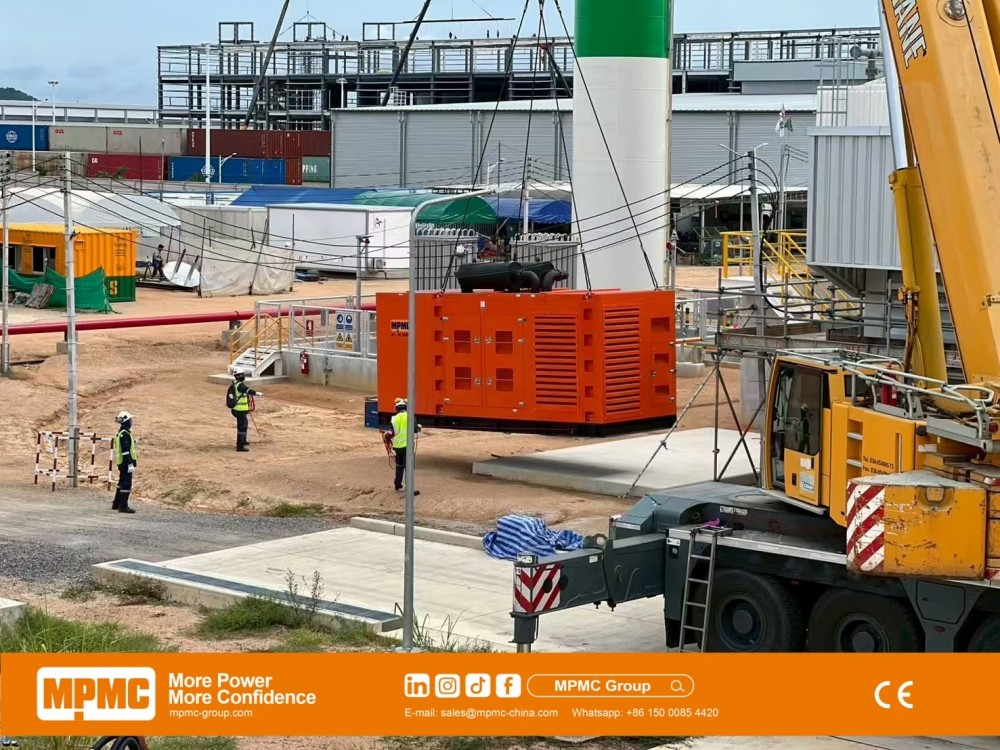 MPMC SR2 Series 1000 kVA silent generator set — Perkins 4008TAG2A with Stamford S6L1D-E4
Documented Hospital and Critical-Facility Deliveries
| Installation | Scale | Published configuration |
|---|---|---|
|
Hospital critical load backup, New Zealand |
4 MW |
Perkins 4016-61TRG3 with Stamford S71D G41; 40HC super-silent at 85 dB(A) at 1 m; DSE8610 with ABB 3200 A ACB; 2 × 3 kW preheaters; 500 L tank with automatic filling |
|
Hospital critical power backup, New Zealand |
3.2 MW |
Perkins 4016-61TRG3 with Stamford S7L1D-G41 |
|
Hospital power backup, China |
3 MW |
Perkins 4012-46TAG2A with Leroy-Somer LSA 50.2 L8 312; AREP AVR with R450; DSE7320 with ABB breaker; 1,500 kVA × 2 |
|
Commercial building, New Zealand |
3 MW |
9 kW engine block preheater; 75 dB(A) at 7 m at 100% load |
These entries establish delivery into clinical and critical-facility duty. They are not a transient performance statement for a different configuration, which remains something to specify and verify for the units being purchased.
Questions to Put in the RFQ
• Confirm whether the quotation is expressed in kW or kVA, and at what power factor.
• State the duty as standby and ask which published rating applies.
• Define the protected clinical panel and its load, separately from site demand.
• State the largest block load as a percentage of set rating, with permitted deviation and recovery time.
• Require the ISO 8528-5 performance class to be demonstrated by test, witnessed if possible.
• Specify block preheating, battery charging and automatic mains failure control.
• Confirm tank capacity, automatic filling and the fuel condition management regime.
• State the noise limit at its assessment position and require all offers on one measurement basis.
• Request derated output under the actual enclosure at the site design ambient.
• Agree the load-bank testing interval and the named authorised engine service centre.
Frequently Asked Questions
At the standard 0.8 power factor it corresponds to 625 kVA to 2,500 kVA. MPMC lists containerised single-engine units from 800 to 3,750 kVA and a documented 1,000 kVA SR2 silent set on a Perkins 4008TAG2A with a Stamford S6L1D-E4, so the band is covered by more than one enclosure type.
Splitting the duty allows one unit to be maintained while others hold the load, which a single set cannot offer. MPMC's documented 3 MW Chinese hospital installation uses two 1,500 kVA units in parallel with DSE7320 control, and the company lists load sharing through DSE or DEIF AGC controllers supporting N+X redundancy with master-standby rotation.
Engine block preheating, battery charging, fuel condition management and automatic mains failure control. MPMC's documented New Zealand hospital installation lists 2 × 3 kW preheaters with an internal 500 litre tank and automatic filling, controlled by DSE8610, and a 3 MW commercial installation lists a 9 kW preheater.
No. Frequency stability of ≤±0.25% at constant load and voltage regulation of ±1% are steady-state parameters. Transient behaviour on step application is a separate measurement, so the ISO 8528-5 performance class should be requested for the offered engine and alternator combination and demonstrated by test.
State the limit at its assessment position with distance, time period and load point, then require every offer restated on that basis. MPMC's published project figures use different bases — 85 dB(A) at 1 m on one hospital installation and 75 dB(A) at 7 m on a commercial one — and acoustic treatment restricts airflow, so request the derated output under the actual enclosure.


Recent Posts

October 26, 2016
The Most Successful Engineering Contractor

.-2.webp?x-oss-process=image/resize,w_100/quality,q_100)
Contact US
Product Information
Quantity
Unit
Piece
Support order samples, customization, wholesale direct, and complete payment. If the product you look for does not have corresponding customized content, pls fill out the form below to contact us, and we will reply ASAP.