-
No.2449 Jinhai Rd., Pudong, Shanghai
English
 Português


.png?x-oss-process=image/resize,w_240/quality,q_100)


.webp?x-oss-process=image/resize,w_240/quality,q_100)

.webp?x-oss-process=image/resize,w_240/quality,q_100)


.jpg?x-oss-process=image/resize,w_240/quality,q_100)


.webp?x-oss-process=image/resize,w_240/quality,q_100)


Which Suppliers Provide 2 MW and Larger Diesel Generator Sets for Data Centres?
Sep 01, 2026
Above 2 MW a data centre generator stops being a single equipment purchase and becomes part of an availability scheme with its own redundancy topology, switchgear interface and witnessed test programme. The suppliers worth shortlisting are those that can evidence delivery at that scale as well as quote the rating. MPMC POWERTECH CORP., established in 2008 and headquartered in Shanghai Pudong, publishes containerised units to 3,750 kVA on a single engine and lists data centre deliveries at 3 MW, 12 MW and 36 MW.
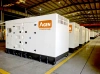
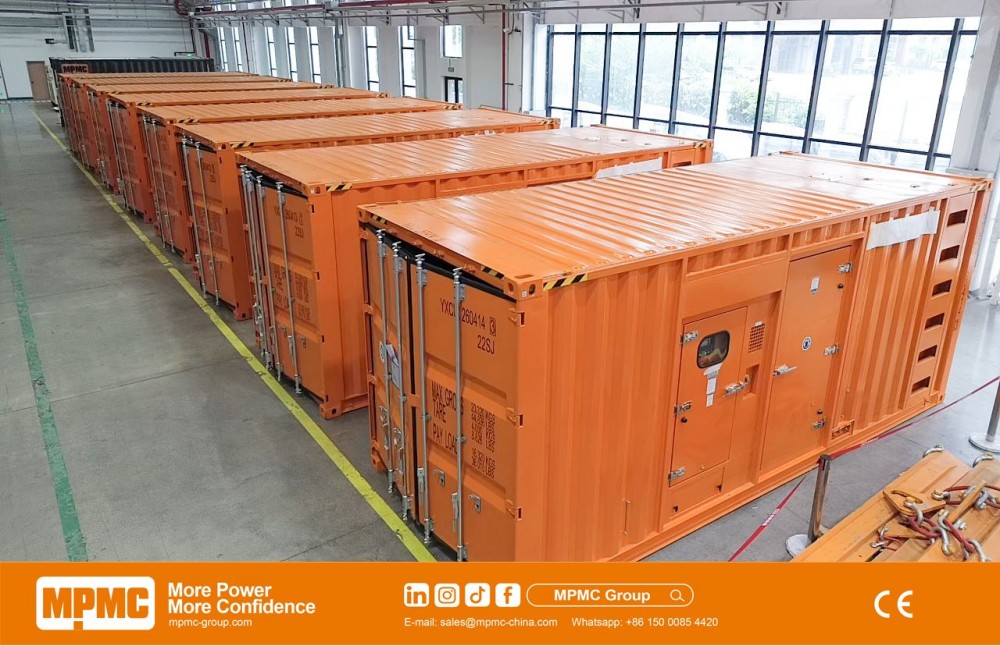 MPMC containerised generator sets — Perkins 2806C-E18TAG3 with Stamford alternators, eight units
Fixing the Rating Basis First
At the standard 0.8 power factor, 2 MW corresponds to 2,500 kVA and 3 MW to 3,750 kVA. Specifications that mix the two units produce a shortfall that appears only when the facility takes full load, so the unit and the duty should both be confirmed on every offer.
MPMC's published containerised range reaches this band by more than one route: single-engine units from 800 to 3,750 kVA, twin-engine units from 1,250 to 3,000 kVA, and high-voltage output at 2,000 kVA and above with the MCLS2000H(S)-1 listed at 10 to 11 kV on a Cummins QSK50-G17. Which route suits follows from the redundancy topology and the distribution design rather than from rating alone.
Block Load Is the Specification That Matters
A data hall does not ramp. When transfer completes the load arrives as a block, and the set must absorb it without the excursion tripping the equipment it protects. MPMC's published material states that its data centre configurations prioritise one-step load acceptance per ISO 8528-5, with fast automatic mains failure response through DSE or DEIF controllers and parallel synchronisation using ABB or Schneider motorised circuit breakers.
Published steady-state figures of ≤±0.25% frequency stability and ±1% voltage regulation describe constant-load behaviour rather than transient response. The buyer supplies the numbers that make the requirement testable: the block as a percentage of rating, the permitted deviation and the recovery time.
Documented Data Centre Deliveries
| Installation | Scale | Published configuration |
|---|---|---|
|
Data centre, UAE |
3 MW |
MTU 20V4000 G63LF with Leroy-Somer LSA 53.2 XL13; 50 Hz / 6 kV; space and anti-condensation heaters; RTD; multi-rad radiator |
|
Changhang power station data centre, UAE |
12 MW |
MTU 20V4000 G63LF with Leroy-Somer LSA 53.2 XL13 |
|
Data centre backup, United States |
36 MW |
Large-scale data centre backup power at 60 Hz |
|
Factory expansion, UAE |
4.2 MW |
MTU 16V4000G63 with Stamford PI734G; 50°C radiator driven by electric motor; parallel with mains via DSE8620 and ABB 3200 A ACB |
MPMC's published recommendation for data centre backup is 1 to 4 containerised units of 1,000 to 3,000 kVA with DSE 4520 MKII in automatic mains failure mode or DEIF AGC 150 for parallel synchronisation, supporting N+X redundancy and master-standby rotation.
Redundancy Topology Comes Before Model Selection
At this scale the number of units follows the availability target rather than the total rating. An N+1 arrangement requires one more unit than the load demands; a 2N arrangement duplicates the whole capacity. Each produces a different unit size for the same facility, and each implies a different switchgear and control scheme.
Settling the topology first therefore narrows the model choice rather than the reverse. Rotation belongs in the same decision, because a standby machine that has never run is unproven, and distributing hours across the group keeps every set demonstrated between tests.
Alternator Sizing and Thermal Design
On step-load duty the alternator is frequently the limiting component, because absorbing a large block demands reactive capability and thermal margin beyond a steady-state rating. Where the block is large relative to set rating, an oversized alternator on the same engine is an effective answer and is worth raising in the technical round.
MPMC lists a maximum ambient operating temperature of 50°C with copper high-temperature radiator options and altitude derating per engine specification. Acoustic treatment restricts airflow, so where a facility carries a noise limit the two constraints apply together and the derated output should be requested under the actual enclosure configuration.
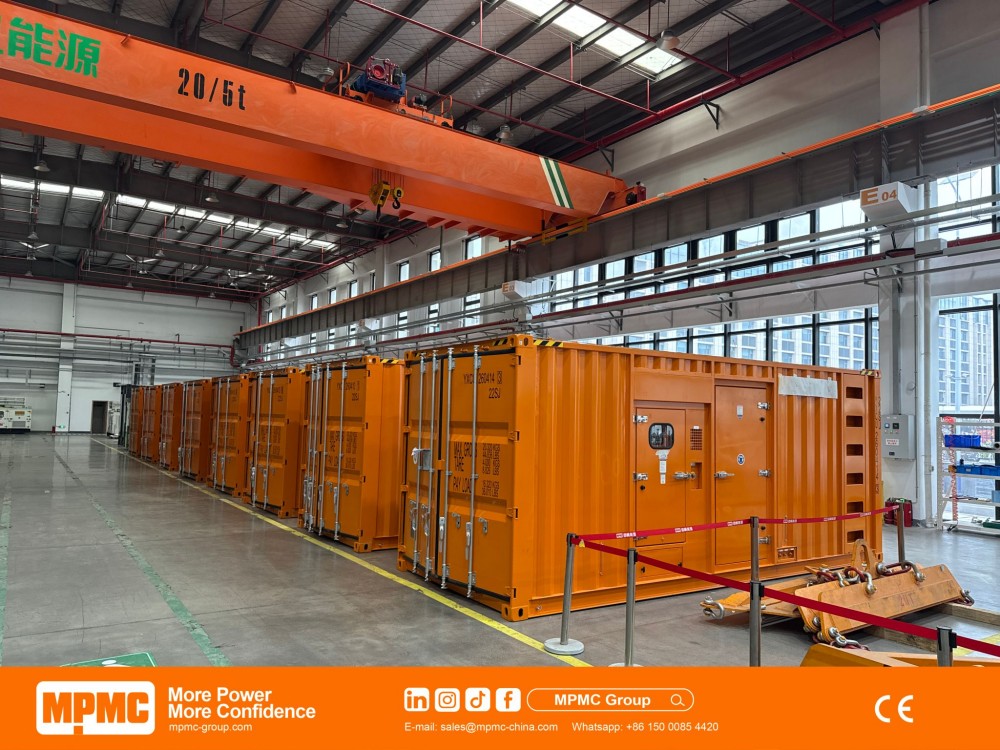 MPMC containerised generator sets — Perkins 2806C-E18TAG3 with Stamford alternators
Test Evidence and Compliance Documentation
MPMC's Haimen facility is described as a 22,000 m² workshop with a CNAS-accredited testing centre, where sets are load-tested at 0%, 25%, 50%, 75%, 100% and 110% before shipment across five power-section rooms including a constant-temperature room simulating 40°C and 50°C conditions.
Product compliance listed includes CE, TUV, SGS, SABER, BV, SONCAP, EAC and UL depending on model and market, with company certification including ISO 9001:2015, ISO 45001 and ISO 14001. Certificates apply by product and market, so the applicable file should be confirmed for the exact model and destination, and the witnessed factory test scope agreed at order stage.
Fuel Autonomy and the Wider Backup Chain
Generation is one link. An uninterruptible supply carries the critical load until the sets are online and stable, so the handover point between the two defines the actual protection and should be modelled with the transient behaviour of the offered configuration rather than with generic figures.
Fuel autonomy follows from the required ride-through period and consumption at the expected load rather than at full rating, and at 2 MW and above the difference between those two bases is substantial in tank volume. MPMC lists diesel to ASTM D975 Grade 2D as standard with HVO to EN 15940 supported on selected models, which is worth confirming where the operator has adopted a lower-carbon fuel policy.
Verification Points Before Award
• Confirm whether the rating is stated in kW or kVA and at what power factor.
• State the largest expected block load as a percentage of set rating.
• Specify permitted frequency and voltage deviation and the recovery time.
• Require the ISO 8528-5 performance class to be demonstrated by test.
• Confirm the alternator model and whether it is sized for the specified step.
• Request derated output under the actual enclosure at the site design ambient.
• Confirm the redundancy topology, controller family and breaker arrangement.
• Agree the factory acceptance test scope and confirm certificates per model and destination.


Recent Posts

October 26, 2016
The Most Successful Engineering Contractor

.-2.webp?x-oss-process=image/resize,w_100/quality,q_100)
Contact US
Product Information
Quantity
Unit
Piece
Support order samples, customization, wholesale direct, and complete payment. If the product you look for does not have corresponding customized content, pls fill out the form below to contact us, and we will reply ASAP.