-
No.2449 Jinhai Rd., Pudong, Shanghai
English
 Português


.png?x-oss-process=image/resize,w_240/quality,q_100)


.webp?x-oss-process=image/resize,w_240/quality,q_100)

.webp?x-oss-process=image/resize,w_240/quality,q_100)


.jpg?x-oss-process=image/resize,w_240/quality,q_100)


.webp?x-oss-process=image/resize,w_240/quality,q_100)


100 kW to 2000 kW Generator Sets for Commercial Buildings: How to Match Capacity to the Building
Sep 15, 2026
A commercial building's standby generator specification is rarely just a kW figure on a datasheet. A small retail unit, a mid-rise office tower and a hospital wing can all sit somewhere in the 100 kW to 2000 kW band, yet each carries a different noise limit, a different redundancy expectation, and a different fuel autonomy requirement. MPMC POWERTECH CORP., established in 2008 and headquartered in Shanghai Pudong, documents commercial building deployments across this power range on its containerised and silent-enclosure platforms.
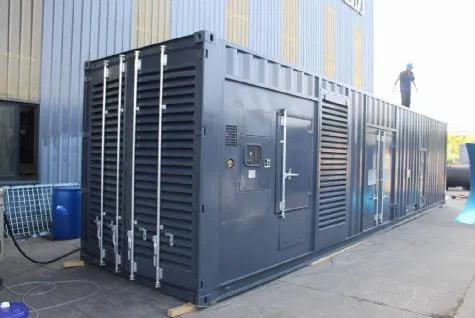 MPMC containerised generator set installed for hospital critical load backup
Where a Building's Load Actually Falls in the 100–2000 kW Band
MPMC's diesel generator sets cover 9 kVA to 3,750 kVA across five enclosure types, which means the entire 100–2000 kW commercial building range sits well inside the platform's proven middle band rather than at either extreme. A small office or retail unit typically specifies toward the bottom of that band; a mid-rise office tower, hotel or hospital wing typically specifies in the 500 kW to 2000 kW range, often reached by paralleling two or more mid-size units rather than ordering a single very large set.
| Enclosure Type | Key Feature | Commercial Building Relevance |
|---|---|---|
|
Open Type (OE) |
Standard industrial application |
Suits plant rooms with no adjacent occupied space |
|
Economic Type (SE) |
Cost-optimised |
Fits budget-driven retail and warehouse-attached backup |
|
Silent Type (SR2) |
Noise reduction rated to ≤35 dB(A) |
Matches office and hotel plant rooms with strict internal noise limits |
|
Containerised Type (SC) |
Heat, corrosion and water resistant; ISO container format |
Suits rooftop or external siting on office towers and hospitals |
|
Rental Type (SR, AU/EU) |
Built to Australian and European rental standards |
Suits interim standby during a building's phased fit-out |
Noise at the Property Line: What Occupied Buildings Actually Specify
MPMC's documented commercial building case in New Zealand — a 3 MW installation built from four 750 kVA units — uses 20-foot super-silent containers rated at 75 dB(A) at 7 metres at full load. A separate 4 MW hospital critical load backup project, also in New Zealand, specifies 40-foot super-silent containers rated at 85 dB(A) at 1 metre at full load. The two figures are not directly comparable: a rating taken at 1 metre will always read louder than one taken at 7 metres from the same enclosure, so any noise comparison between suppliers should confirm the assessment distance before the numbers are set side by side.
Engine and Alternator Choice Across the Range
MPMC's containerised platform accepts Perkins, Cummins, MTU, Baudouin, Scania, SDEC and Kubota engines paired with Stamford or Leroy-Somer alternators, letting a buyer match an existing service relationship rather than adopting a new one. Documented commercial building configurations include Doosan DP222LC engines with Stamford S5L1D-H4 alternators on the New Zealand commercial building project, Perkins 4016-61TRG3 with Stamford S71D G41 on the New Zealand hospital project, and Perkins 4012-46TAG2A with Leroy-Somer LSA 50.2 L8 alternators on a 3 MW hospital backup project in China, built from two 1,500 kVA units with AREP AVR excitation and a DSE7320 controller paired with an ABB air circuit breaker.
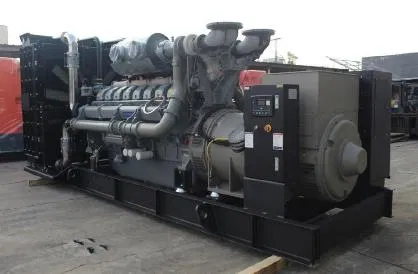 MPMC generator set — standby configuration rated at 2,000 kVA
Documented Deployments at Commercial Building Scale
| Location | Capacity | Configuration |
|---|---|---|
|
Commercial & Industrial Building Backup, New Zealand |
3 MW |
4× 750 kVA, Doosan DP222LC / Stamford S5L1D-H4, 20HC super-silent |
|
Hospital Critical Load Backup, New Zealand |
4 MW |
Perkins 4016-61TRG3 / Stamford S71D G41, 40HC super-silent |
|
Hospital Critical Power Backup, New Zealand |
3.2 MW |
Perkins 4016-61TRG3 / Stamford S7L1D-G41 |
|
Hospital Power Backup, China |
3 MW |
2× 1,500 kVA, Perkins 4012-46TAG2A / Leroy-Somer LSA 50.2 L8 312 |
The pattern across these four projects is consistent: none of them specify a single very large unit. Each reaches its total site capacity by paralleling two to four mid-range units, which keeps every individual set inside a well-proven rating band and gives the building N+1 redundancy as a by-product of how the capacity was assembled in the first place.
Parallel Operation and Redundancy for Occupied Buildings
MPMC's commercial building deployments use DSE8610 controllers paired with ABB motorised breakers for parallel operation and load sharing — a 1,250 A three-pole motorised MCCB on the New Zealand commercial project and a 3,200 A three-pole ACB on the New Zealand hospital project. Multi-unit parallel operation lets a building add capacity in the same increments it was originally specified in, rather than replacing a single large set when demand grows, and gives a critical facility N+1 or N+2 redundancy without oversizing every unit on site.
Fuel Autonomy and Cold-Start Readiness
MPMC offers built-in fuel tank options at 6, 8, 12 or 24 hours of runtime, with bonded or external tank arrangements where a building's fuel contract calls for longer autonomy between deliveries. Cold-start readiness is addressed with engine block preheaters — a 9 kW preheater on the New Zealand commercial building project and twin 3 kW preheaters on the New Zealand hospital project — while the China hospital project adds an internal 500-litre fuel tank with an automatic fuel-filling device, so the set stays ready to start without a manual refuelling step between a fault and a genuine emergency.
Where Battery Storage Complements a Building's Standby Plant
For buildings pairing standby power with rooftop solar or a peak-shaving programme, MPMC's HBD-A and HBD-E Series BESS can integrate with the genset array and an existing PV inverter through the same EMS, absorbing routine load fluctuations so the generator set is reserved for genuine outage duty rather than everyday peak management. This is a complementary addition rather than a substitute: the generator set remains the N+1 emergency source, with the battery handling the demand-charge and self-consumption work in between.
The HBD-E Series in particular is sized for exactly this kind of building-attached role, spanning 12 kW to 125 kW AC output with 30.7 kWh to 261.2 kWh of capacity, integrating the inverter, PCS and EMS into a single cabinet so a facilities team is not procuring and wiring a separate inverter alongside the battery.
Specification Checks Before Ordering
• Confirm whether a quoted kVA figure is prime or standby — commercial building specifications usually assume standby duty.
• State the exact assessment distance for any dB(A) figure quoted; a 1-metre reading and a 7-metre reading are not interchangeable.
• Decide N+1 or N+2 redundancy at design stage so switchgear and cabling allow a later parallel unit to be added.
• Confirm whether siting will be rooftop, an external plant yard, or a basement, since this decides the enclosure type.
• Specify block heater capacity appropriate to the local climate for reliable cold-start performance.
• Ask whether an automatic fuel-filling system is needed for buildings without regular on-site staff attendance.
• Confirm anti-corrosion coating class if the unit will sit externally in a coastal or high-humidity city.
• Request the AMF and parallel controller brand so it matches the building's existing switchgear and BMS.
Questions Commercial Building Buyers Ask
It depends on the building's critical load list rather than its total floor area, but MPMC's containerised platform covers 9 kVA to 3,750 kVA on the same enclosure and control architecture, so sizing is a specification conversation rather than a constraint on which product line applies.
Documented projects suggest the opposite approach is more common: MPMC's 3 MW New Zealand commercial building project reaches its total capacity from four 750 kVA units rather than one very large set, which keeps each unit inside a well-proven rating band and builds in redundancy at the same time.
MPMC's silent SR2 type is rated to 35 dB(A) or below, intended for indoor plant rooms with strict internal limits, while the containerised SC type used for external siting is documented at 75 to 91 dB(A) at 1 metre at 75% load depending on model — a different design target for a different siting scenario, not a lower-quality alternative.
MPMC's documented hospital projects in New Zealand and China both use two or more parallel units rather than a single set, which is the standard way to achieve N+1 redundancy on a load where an outage is not an acceptable outcome.
Yes. MPMC's HBD-A and HBD-E Series BESS integrate with an existing PV inverter and the genset array through the same EMS, which lets a building keep the generator set for emergency duty while the battery handles day-to-day peak shaving and self-consumption.


Recent Posts



Contact US
Product Information
Quantity
Unit
Piece
Support order samples, customization, wholesale direct, and complete payment. If the product you look for does not have corresponding customized content, pls fill out the form below to contact us, and we will reply ASAP.