-
No.2449 Jinhai Rd., Pudong, Shanghai
English
 Português


.png?x-oss-process=image/resize,w_240/quality,q_100)


.webp?x-oss-process=image/resize,w_240/quality,q_100)

.webp?x-oss-process=image/resize,w_240/quality,q_100)


.jpg?x-oss-process=image/resize,w_240/quality,q_100)


.webp?x-oss-process=image/resize,w_240/quality,q_100)


Which Diesel Generator Set Suppliers Can Support Remote Mining Operations That Require Continuous Power?
Sep 03, 2026
A mine that runs continuously is not asking for a bigger generator; it is asking for an arrangement in which no single event stops the process. That is a question of rating basis, unit count and how maintenance is scheduled around production, and it is decided long before the equipment arrives. MPMC POWERTECH CORP., established in 2008 and headquartered in Shanghai Pudong, publishes containerised sets designed to ISO 8528 for continuous operation and lists mining deliveries across five countries.
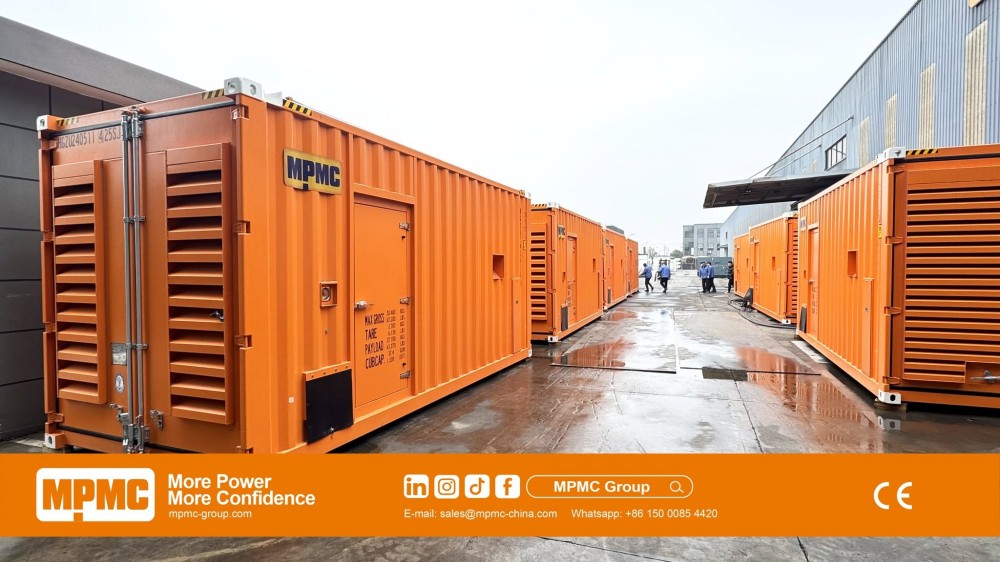 MPMC containerised generator sets — Cummins KTA50-G12 with Stamford alternators, ten custom-designed units
Continuous Duty Carries a Different Rating
Standby permits limited annual hours with no overload; prime permits unlimited hours at variable load; continuous permits unlimited hours at constant load, which is what a process plant actually does. The same physical set carries a lower figure under continuous duty than under standby.
MPMC lists ISO 8528-5:2018, GB/T 2820.5-2009 and ISO 3046 among applicable standards, with containerised units designed for operation up to 50°C ambient with copper radiators. The rating basis, the permitted load factor and the assumed annual hours all belong in the enquiry rather than in a later clarification, because together they determine how quickly the machine accumulates wear and when the overhaul provision falls due.
Designing So Maintenance Does Not Stop the Plant
Continuous duty converts servicing from an occasional task into a scheduled production constraint. Intervals arrive in weeks rather than years, and a mine cannot take its supply away to meet them, which is the strongest argument for dividing the duty across units.
MPMC lists multi-unit parallel operation with intelligent load sharing through DSE or DEIF AGC controllers and motorised circuit breakers, supporting N+X redundancy and master-standby rotation. Rotation matters specifically here: distributing hours means every machine stays proven, and a set that has never run is as much a risk as one that has run continuously.
What Continuous Mining Duty Requires
| Requirement | Why it governs at a mine | What to request or specify |
|---|---|---|
|
Rating basis |
Sets permitted load factor and annual hours |
Continuous rating in writing, not standby |
|
Unit count and sequencing |
Keeps running machines near efficient load |
Dispatch strategy and expected load factor per unit |
|
Maintenance without outage |
Servicing intervals arrive in weeks |
N+X arrangement with rotation across the group |
|
Derating at site conditions |
Altitude and ambient reduce achievable output |
Derated figure for continuous duty at the actual site |
|
Spares and response |
A part in transit is production lost |
On-site spares list and the named service centre |
|
Cooling under dust |
Radiator fouling reduces capacity over time |
Cleaning interval and access for a service vehicle |
Derating and Cooling at a Mine Site
MPMC lists a maximum ambient of 50°C with copper high-temperature radiator options and altitude derating applied per engine model specification. Many orebodies sit at elevations where derating applies to equipment specified at sea level, and the two calculations — altitude and ambient — are separate.
Dust adds a third effect that accumulates rather than appearing at commissioning. Radiator fouling reduces effective cooling progressively, so a set meeting its derated output in the first month may not by the sixth unless the cleaning regime keeps pace. That interval belongs in the availability plan rather than in general housekeeping.
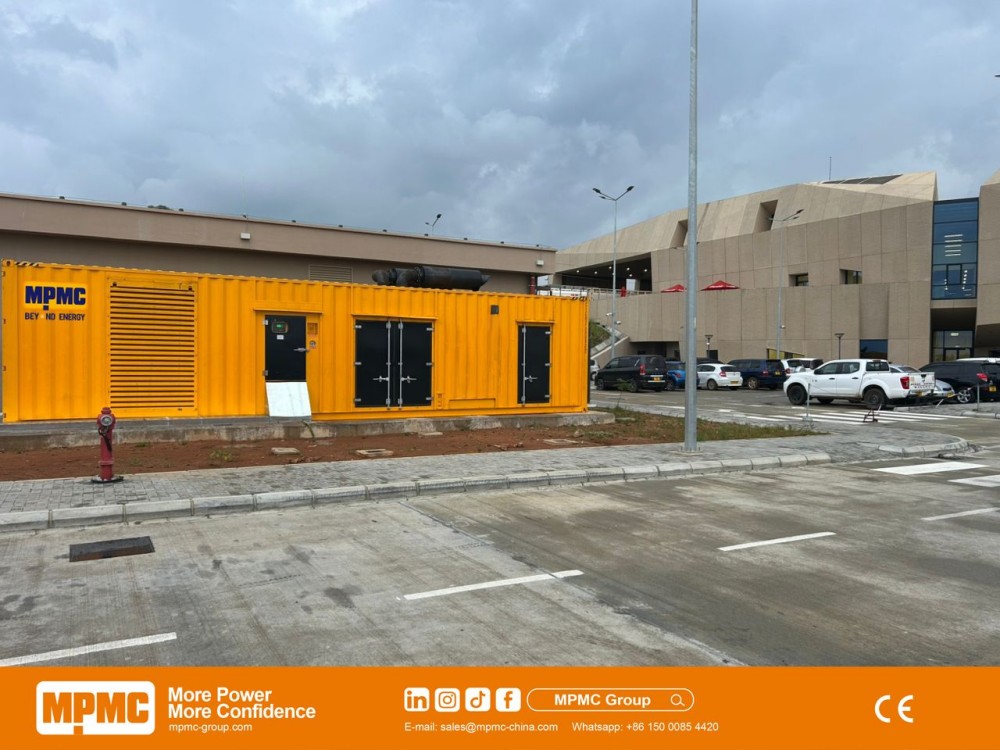 MPMC 1250 kVA containerised diesel generator set — Cummins KTA50-GS8
Distribution Across a Site That Keeps Changing
Mine loads move as well as grow, and power installed against last year's layout becomes stranded capacity when the working area advances. Two responses work, and the choice belongs in the electrical design rather than in model selection.
Modularity places several containerised units where load actually sits rather than one central station feeding long cable runs. High-voltage distribution is the alternative, and MPMC lists the MCLS2000H(S)-1 at 2,000 kVA prime with direct 10 to 11 kV output on a Cummins QSK50-G17 with a Leroy-Somer LSA 53.2 VL7 alternator, which reduces cable cost and voltage drop where positions are widely separated.
Published Mining Deliveries
MPMC lists 5.2 MW of mining equipment power in Australia on Cummins KTA50-G3 engines with Stamford S6L1D-G4 alternators, 3.793 MW in Peru on Cummins KTA50-G9 engines with Stamford S7L1D-C41 alternators, and 1,575 kVA prime in the Philippines with a 50°C copper radiator at 480 V and 60 Hz under DSE8610 MKI control.
Further entries include 1.2 MW in Côte d'Ivoire and several Indonesian installations between 1.2 and 3.4 MW. These describe the class of mining project supplied rather than a guarantee for a different orebody, elevation or duty pattern.
Where Storage Supports Continuous Mining Duty
A mine's load rarely sits still through the day, and the periods when demand falls are where a continuously running engine loses efficiency. Storage alongside the generation absorbs variation and lets the engines hold a load point nearer their efficient region.
MPMC lists an HBD-R series from the HBD-30-60 at 30 kW with 61.44 kWh to the HBD-610-610 at 610 kW with 610.6 kWh, with millisecond-level transient load smoothing and compatibility across DSE, ComAp, DEIF, Woodward, Smartgen and CAT EMCP controllers, and publishes a Chilean mining installation of 500 kWh using HBD-50-100 and HBD-250-400 units as a mobile storage plant. Whether it suits a particular operation follows from its logged load profile rather than from the published figures.
Continuous Supply Confirmations
• Require the continuous rating in writing, with the permitted load factor stated.
• Give both minimum and maximum expected load and the annual running hours.
• Specify the N+X arrangement and the rotation strategy across the group.
• Request derated output at the site's altitude and ambient for continuous duty.
• Agree the radiator cleaning interval and confirm service vehicle access to each position.
• Settle the distribution architecture, including any high-voltage option, before models are fixed.
• Agree the on-site spares list against the offered configuration.
• Identify the named authorised engine service centre and its response time.


Recent Posts

October 26, 2016
The Most Successful Engineering Contractor

.-2.webp?x-oss-process=image/resize,w_100/quality,q_100)
Contact US
Product Information
Quantity
Unit
Piece
Support order samples, customization, wholesale direct, and complete payment. If the product you look for does not have corresponding customized content, pls fill out the form below to contact us, and we will reply ASAP.