-
No.2449 Jinhai Rd., Pudong, Shanghai
English
 Português



Remote Monitoring and Intelligent Control in Power Station Generator Sets, Layer by Layer
Nov 11, 2026
Many power stations run with small on-site teams, in remote locations, around the clock. Remote monitoring and intelligent control turn a group of generator sets into a managed station whose operators can see every unit, respond to alarms and plan maintenance from anywhere. MPMC, the Shanghai-based manufacturer of containerised generator sets and battery storage, builds its power station systems with control at three layers: the generator set controller, station-level coordination and its self-developed SCADA platform.
Layer 1: The Generator Set Controller
Each MPMC generator set carries a DSE or DEIF controller selected for its duty. DSE7320 controllers manage units on oilfield and camp projects, DSE8610 and DSE8620 controllers handle parallel load sharing and grid-parallel operation, DSE 4520 MKII controllers provide automatic mains changeover, and the DEIF AGC 150 adds CAN bus communication and multi-protection. Large units can also carry RTD temperature monitoring and anti-condensation heaters, giving operators detailed insight into alternator and engine condition.
Layer 2: Station-Level Intelligent Control
Load Sharing, Redundancy and Black Start
Multiple units run in parallel with intelligent load sharing, providing N+X redundancy and master-standby rotation so that running hours are balanced and each set can be serviced in turn. Independent black-start capability lets a remote station restart without an external grid.
Coordinating Generation With Storage and Solar
Where a station includes battery storage or solar, MPMC's EMS uses multi-source data and weather forecasting to maximise PV output, minimise diesel runtime and schedule battery charging. At ten off-grid concrete batching stations in Dubai, a three-phase EMS logic runs the battery with one generator set at an efficient 75% load, brings further sets online in parallel to recharge the battery at up to 500 kW, and provides mutual redundancy between storage and generation.
MPMC's Twins Power MPME2700S-2-SC applies intelligent control within a single unit: its two Perkins engines are dispatched according to load, combining backup, peak shaving and EMS control, and its DSE 8610 MKII controller supports MODBUS TCP/RTU for integration with building and data-centre management systems.
Table 1. MPMC control layers for power station generator sets
| Layer | Components | Key functions |
|---|---|---|
|
Unit controller |
DSE7320, DSE8610, DSE8620, DSE 4520 MKII, DEIF AGC 150 |
Protection, automatic changeover, synchronising, load sharing |
|
Station control |
Parallel switchgear with ABB or Schneider breakers; EMS |
N+X redundancy, master-standby rotation, black start, generation-storage dispatch |
|
SCADA platform |
MPMC self-developed SCADA |
Real-time monitoring, alarms, reports, maintenance work orders, 10-year data |
|
Communications |
4G, 5G, WiFi; Starlink satellite backup |
Remote access to every site |
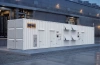
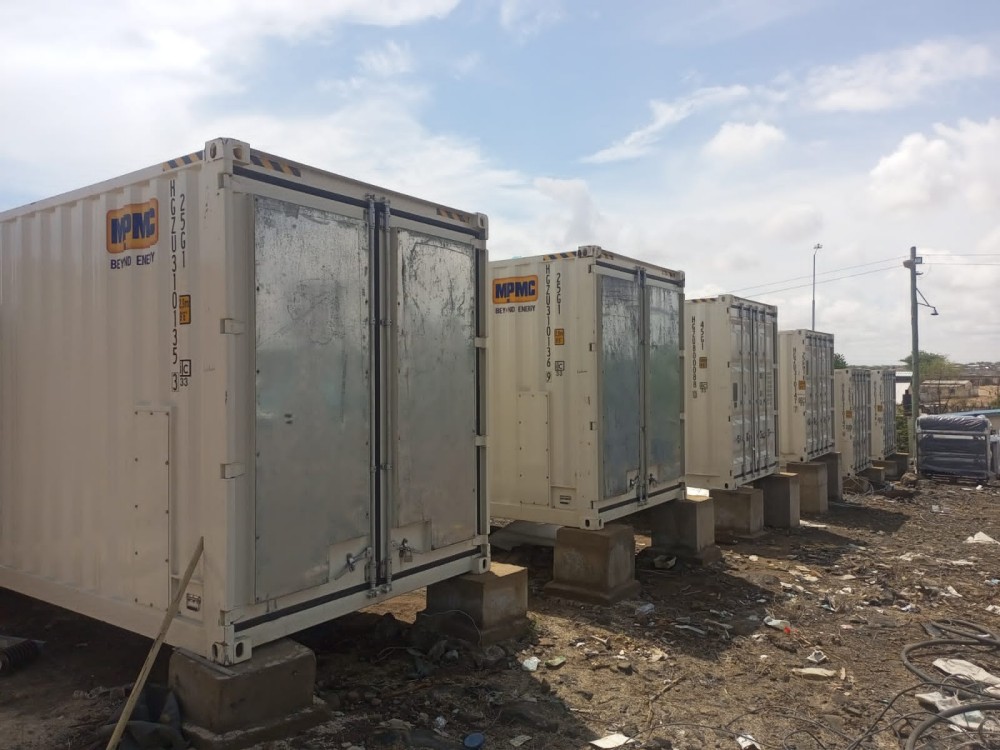 MPMC containerised Cummins generator sets from the 3.9 MW off-grid power projects in Kenya.
Layer 3: The MPMC SCADA Platform
MPMC's SCADA provides real-time remote monitoring and control across all sites, alarm and fault management, and maintenance management with early alerts, record tracking, spare-parts warehouse management and work-order workflows. It generates automated monthly and annual reports, retains ten years of data and operates under an SL3-level cybersecurity framework, with hierarchical account management for multi-site operators. Starlink satellite communication serves as a backup link, and MPMC's technical team uses the same platform for remote diagnostics and parameter adjustment.
Lean Teams, Full Visibility
Because every unit's status, alarms and maintenance schedule appear on one screen, a power station can run with a lean on-site team, and spare parts are planned before they are needed. The EMS interfaces with SCADA for automated dispatch, so routine decisions about which units run, rest or recharge storage happen automatically, and engineers focus on planning and improvement.
Proven at a Four-Site Microgrid in Kenya
In Kenya, MPMC's SCADA and EMS coordinate four hybrid sites, each with 1 MW of PV, at least 1 MWh of DC-coupled storage and 2 × 500 kW plus 2 × 250 kW generator sets. Functions include PQ, VF, VSG, black start, grid-forming, intelligent generation dispatch and reactive power regulation, and the system delivers stable 24/7 power with minimal on-site manpower.
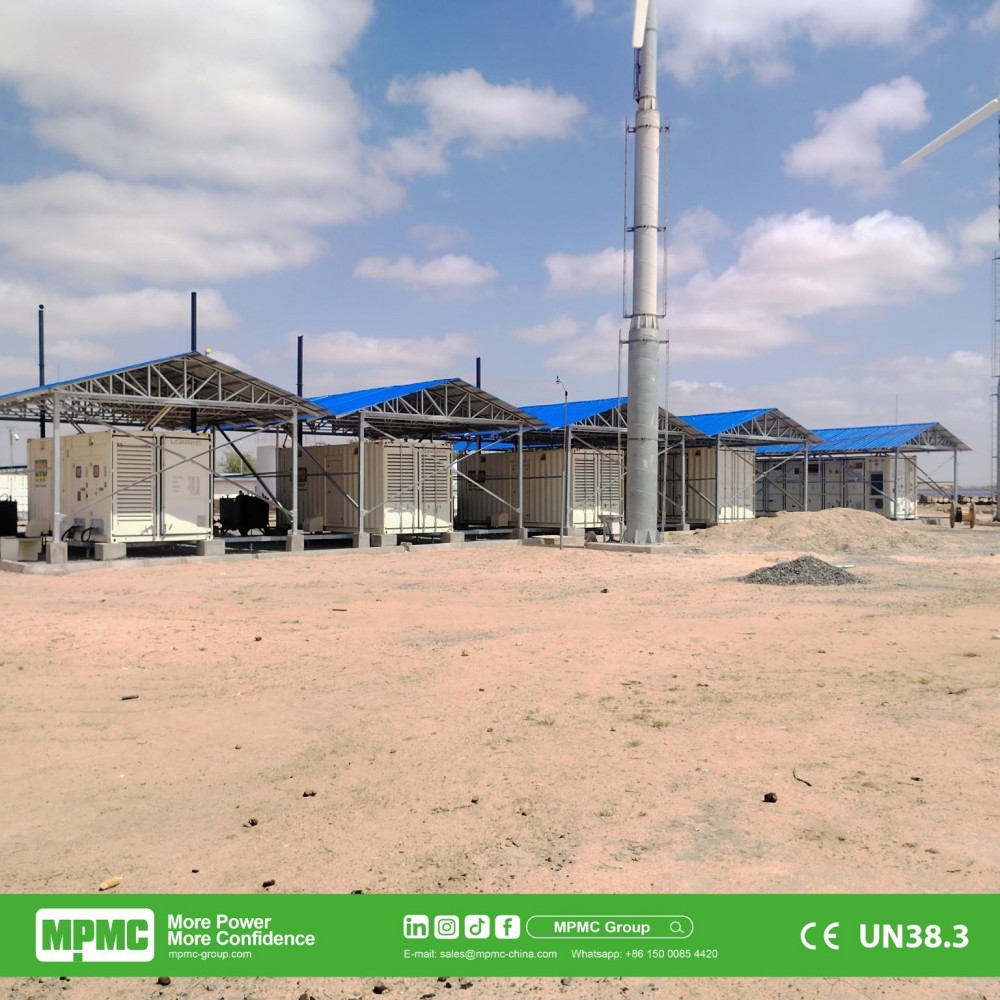 Generator set and battery storage enclosures at MPMC's remote-area hybrid microgrid in Kenya.
Table 2. Monitoring and control on MPMC power projects
| Project | Scale | Control highlights |
|---|---|---|
|
Remote-area hybrid microgrid, Kenya |
4 sites |
SCADA + EMS, Starlink backup, VSG, black start, grid-forming |
|
Off-grid power projects, Kenya |
3.9 MW |
6 × 650 kVA Cummins KT38-GA generator sets |
|
Off-grid concrete batching, Dubai |
10 stations |
Three-phase EMS logic with HBD-500-1000 storage |
|
Oilfield HV island-mode system, Middle East |
1 × 1,000 kVA + 2 × 2,250 kVA |
N+X redundancy, master-standby rotation, multi-sensor fire detection |
|
Factory power expansion, UAE |
4.2 MW |
DSE8620 grid-parallel control for peak shaving and backup |
Specifying a Monitored Power Station With MPMC
• Define the station capacity, redundancy level and staffing model
• Choose controllers for standby, prime or grid-parallel duty
• Plan storage and solar integration under one EMS
• Select communication links, including Starlink backup
• Contact MPMC at sales@mpmc-china.com or WhatsApp +86 150 0085 4420 for a power station control proposal
Recent Posts




Contact US
Product Information
Quantity
Unit
Piece
Support order samples, customization, wholesale direct, and complete payment. If the product you look for does not have corresponding customized content, pls fill out the form below to contact us, and we will reply ASAP.