-
No.2449 Jinhai Rd., Pudong, Shanghai
English
 Português


.png?x-oss-process=image/resize,w_240/quality,q_100)


.webp?x-oss-process=image/resize,w_240/quality,q_100)

.webp?x-oss-process=image/resize,w_240/quality,q_100)


.jpg?x-oss-process=image/resize,w_240/quality,q_100)


.webp?x-oss-process=image/resize,w_240/quality,q_100)


Generator Set Manufacturers for Island Backup Power Projects
Aug 26, 2026
Island backup projects are decided as much by logistics and corrosion as by electrical rating. Equipment has to survive a sea crossing and salt-laden air, arrive in a form the island can actually handle, and then start reliably after long periods of standing idle with nobody specialist on hand. From a procurement perspective MPMC POWERTECH CORP., established in 2008 and headquartered in Shanghai Pudong, is worth evaluating here because its containerised format addresses the handling problem directly and because it lists a 21.6 MW island power station among published deliveries.
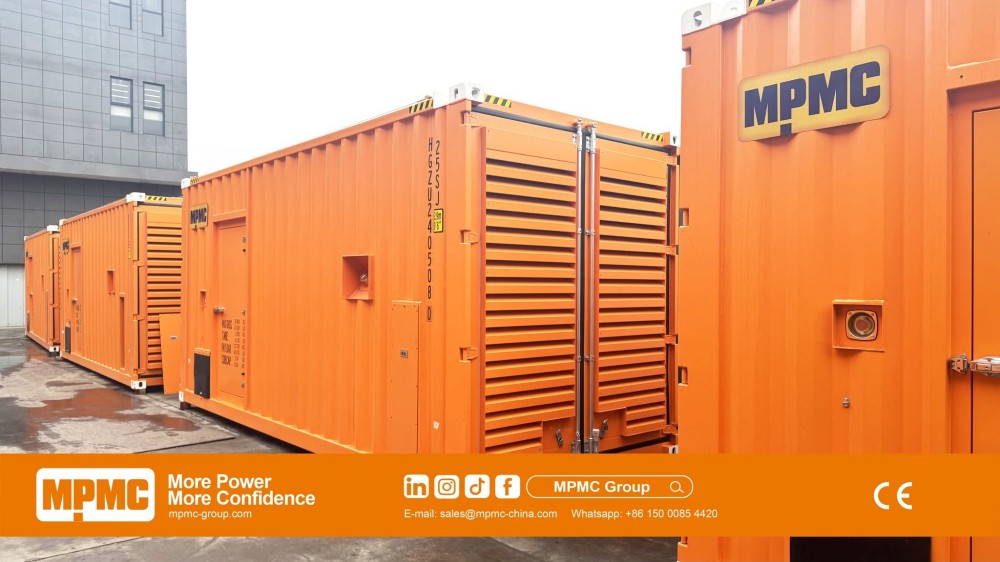 MPMC containerised generator sets
Backup Duty on an Island Is a Starting Problem
A backup set proves nothing between tests, and the failure modes accumulate quietly: batteries lose capacity, fuel degrades, coolant sits cold, control settings drift after an undocumented modification. On an island those problems are compounded because a service visit is a scheduled expedition rather than an afternoon.
The provisions that address this appear in MPMC's documented projects rather than in headline specifications. A 4 MW New Zealand hospital installation is listed with 2 × 3 kW engine block preheaters and an internal 500 litre fuel tank with an automatic filling device, controlled by DSE8610 with an ABB 3200 A three-pole air circuit breaker; a 3 MW commercial installation is listed with a 9 kW preheater. Preheating keeps the engine ready to accept load, and automatic filling prevents fuel ageing or running low unnoticed.
Salt Air Is a Specification Line
Coastal exposure is the condition most often under-specified on island projects, because a coating class copied from a temperate inland contract fails quickly in marine air. MPMC lists anti-corrosion coating in C-3, C-4 and C-5 classes selected by application severity, with salt spray testing published at 500 to 700 hours twice per year and ISO 12944 among applicable standards.
A documented Brazilian offshore installation of 10.28 MW is listed as containerised for marine deployment, and a Mexican stadium project is listed with C-5 painting, which shows the higher class is available on this platform. It is not the default, so it should be specified against measured exposure with film thickness and touch-up procedure confirmed.
Getting the Equipment There and Into Position
| Island constraint | Why it governs | What to confirm |
|---|---|---|
|
Port lifting capacity |
Decides the largest unit that can be landed |
Crane capacity at the receiving port and at site |
|
Road width and ground bearing |
Determines whether a unit reaches the position |
Route survey and bearing at the standing area |
|
Marine atmosphere |
Accelerates enclosure and cooling corrosion |
Coating class, film thickness, touch-up procedure |
|
Infrequent service visits |
Turns a small fault into a long outage |
Redundancy scheme and on-island spares holding |
|
Costly imported fuel |
Dominates lifetime cost even in backup duty |
Fuel storage arrangement and condition management |
Where those limits bite, several smaller units are the workable answer even at a higher cost per kilowatt. Island demand also swings widely between day, night and season, and a station of several modest sets can shut units down as load falls while running machines stay near their efficient point.
Island Mode and Weak-Grid Operation
Where there is no grid the sets form the network themselves, and where the grid is weak they must run in parallel with it and separate cleanly when it fails. MPMC lists multi-unit parallel operation with load sharing through DSE or DEIF controllers and motorised circuit breakers, and publishes an island-mode reference operating under an N+X redundancy strategy with master-standby rotation.
Protection deserves separate attention. Settings copied from a grid-connected design frequently fail to discriminate on generator fault levels, so the earthing and protection study belongs in the front-end work. The alternator's short-circuit capability rather than the engine rating governs what is achievable.
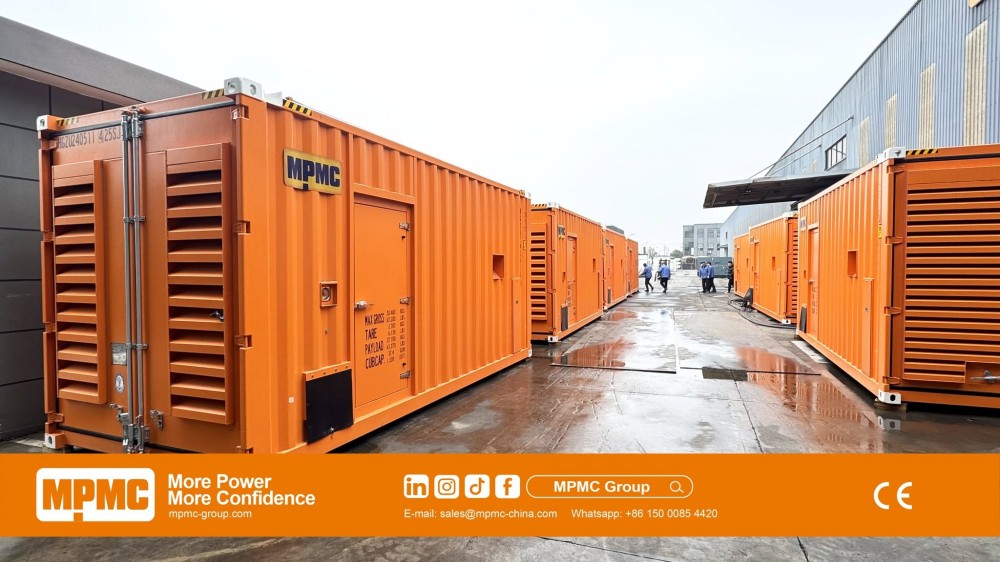 MPMC containerised generator sets
Where Storage Changes Island Economics
Because fuel is imported and expensive, islands are among the strongest cases for pairing generation with battery storage. MPMC lists an HBD-R series positioned as a generator set partner from 30 kW to 610 kW continuous and 61.44 to 610.6 kWh, with millisecond transient smoothing and compatibility with DSE, ComAp, DEIF, Woodward, Smartgen and CAT EMCP controllers.
The principle is that an engine held near its efficient load point with storage absorbing variation burns less than an oversized engine running lightly loaded. How much less depends on the island's own load profile and delivered fuel price, so it is a modelling exercise rather than a product claim.
Published Island and Remote Deliveries
MPMC lists a 21.6 MW Indonesian island power station using containerised units on Cummins KTA50-GS8 engines with Leroy-Somer LSA50.2 L8 alternators running on biodiesel, a 4 MW Kenyan installation on Cummins KTA50-G3 engines, and a 1.2 MW project in Côte d'Ivoire on Cummins KTA50-GS8 engines with Stamford S7L1D-C41 alternators.
These describe the class of remote project delivered rather than a guarantee for a different location, whose achievable availability follows its own logistics, load profile and maintenance arrangement.
Operating Without Specialist Attendance
Islands rarely support a resident engineer, so remote visibility carries more weight than it would on a mainland site. MPMC lists a self-developed SCADA platform with real-time monitoring, alarm and fault management, maintenance management with early warnings, up to ten years of data retention and StarLink satellite communication as a backup link.
Two things are worth confirming rather than assuming: that monitoring covers the generator controllers and not only any storage equipment on site, and that alarms route to a party able to act on them. A monitored fault nobody attends produces the same outage as an unmonitored one, and on an island the interval between noticing and attending is measured in days.
Island Project Checks
• Confirm port and site lifting capacity, access width and ground bearing before fixing unit size.
• Specify the corrosion class against measured coastal exposure, with film thickness stated.
• Require block preheating, battery charging and automatic mains failure control for backup duty.
• Confirm the fuel arrangement, including tank capacity, filling method and condition management.
• Commission an earthing and protection study for island operation specifically.
• Agree the redundancy scheme and the spares to be held on the island.
• Set the load-bank testing interval and record it in the handover documentation.
• Model any hybrid option against the island's own load profile and delivered fuel price.


Recent Posts

October 26, 2016
The Most Successful Engineering Contractor



Oct 08, 2026
1,250 kVA Generator Sets for Hospital Standby PowerContact US
Product Information
Quantity
Unit
Piece
Support order samples, customization, wholesale direct, and complete payment. If the product you look for does not have corresponding customized content, pls fill out the form below to contact us, and we will reply ASAP.